
.webp)
.png)
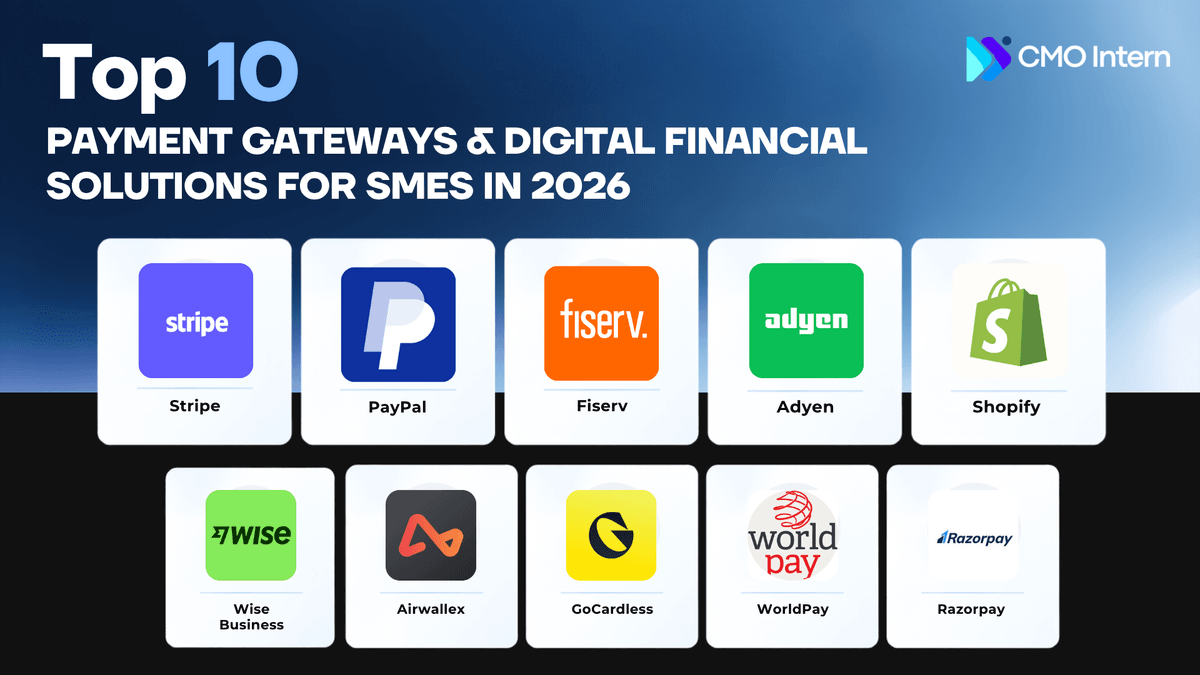
Choosing the right infrastructure is critical for small and medium-sized enterprises, which is why we have compiled the Top 10 payment gateways & digital financial solutions for SMEs in 2026 to help you optimize revenue, cash flow, and customer experience. Modern platforms now combine online checkout, digital wallets, recurring billing, fraud prevention, and multi-currency management into unified systems. The challenge lies in selecting a provider that aligns with your specific business model, whether you prioritize developer flexibility, retail point-of-sale, or international trade capabilities.
No single provider is ideal for every business. An e-commerce store may prioritize fast checkout and payment-method coverage, while a SaaS company may need subscription billing and APIs. An international SME may care more about foreign exchange and cross-border transfers. In this guide, we explore 10 payment gateways and digital financial solutions for SMEs in 2026 and explain which type of business each platform is best suited for.
Note: Pricing, supported countries, payment methods, and eligibility can vary by market. Businesses should verify current terms directly with each provider before making a decision.
Quick Comparison: Top Payment Gateways for SMEs
| Provider | Best For | Key Strength |
|---|---|---|
| Stripe | Online businesses & SaaS | Developer-friendly payment infrastructure |
| PayPal | International commerce | Global customer recognition |
| Fiserv | Small businesses, retailers & omnichannel merchants | Integrated payments, POS & business management |
| Adyen | Growing global businesses | Unified global payments |
| Shopify Payments | E-commerce businesses | Integrated Shopify checkout |
| Wise Business | International payments | Multi-currency business banking |
| Airwallex | Global SMEs & startups | Payments, FX and financial operations |
| GoCardless | Recurring & bank payments | Direct debit and bank payment collection |
| Worldpay | E-commerce, retailers & global businesses | Global payment processing & multi-market acceptance |
| Razorpay | Digital businesses in India | Payments and business financial tools |
What Are Payment Gateways for SMEs?
A payment gateway is technology that enables a business to securely accept payments from customers through channels such as credit cards, debit cards, digital wallets, bank transfers, and other local payment methods.
For example, when a customer purchases a product from an online store, the payment gateway helps transmit the transaction information between the customer, merchant, payment processor, and relevant financial institutions.
Modern payment gateways for SMEs increasingly combine gateway functionality with broader financial services. Depending on the provider, a business may be able to:
- Accept online and in-person payments
- Create payment links
- Send digital invoices
- Accept recurring payments
- Manage subscriptions
- Receive payments in multiple currencies
- Send international transfers
- Manage foreign exchange
- Detect fraudulent transactions
- Integrate payments with accounting software
- Connect payment data to business applications through APIs
This shift means SMEs can build a more streamlined financial infrastructure without relying entirely on traditional banking systems.
Top 10 payment gateways & digital financial solutions for SMEs in 2026
1. Stripe — Best for Online Businesses and SaaS
Best for: SaaS companies, startups, marketplaces, developers, and online-first businesses
Stripe is one of the strongest choices for businesses that want flexible payment infrastructure and extensive developer capabilities. Its ecosystem is designed around APIs and programmable financial infrastructure, making it particularly suitable for technology companies and businesses with customized checkout requirements. If you are looking to scale, you might also consider find digital marketing agencies to reach more enterprise clients.
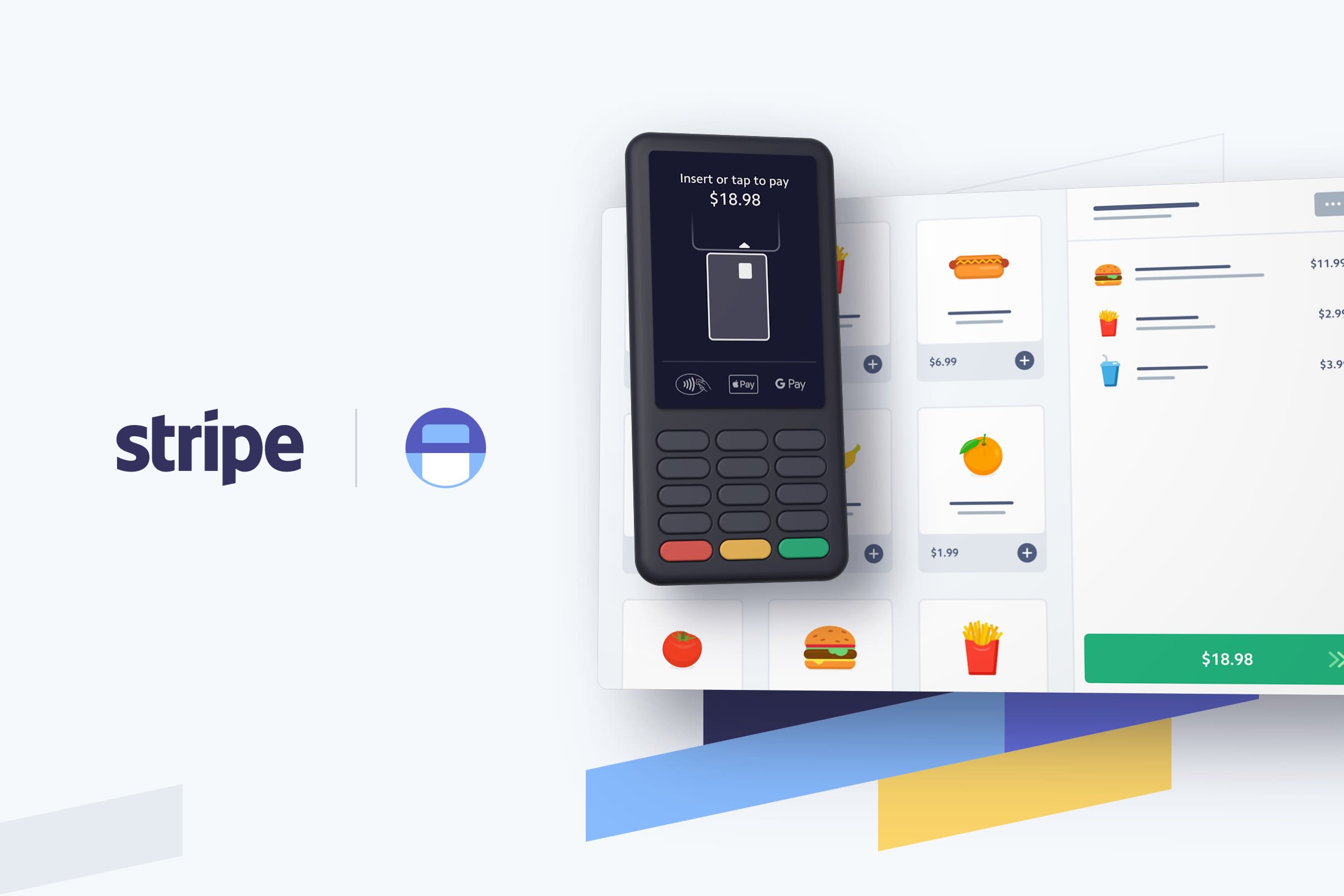
Stripe can support online payments, subscriptions, invoicing, payment links, marketplaces, fraud prevention, and other financial workflows.
Key strengths
- Developer-friendly APIs
- Online payment processing
- Subscription billing
- Invoicing
- Payment links
- Marketplace capabilities
- Fraud and risk-management tools
- Extensive integrations
Stripe is particularly attractive for SaaS businesses because payments can be integrated directly into an existing product experience rather than operating as a completely separate financial system. For those exploring new revenue streams, integrating bitcoin layer solutions can provide a competitive edge in modern markets.
Why SMEs may choose Stripe
A startup that expects to scale internationally may prefer Stripe because its infrastructure can grow alongside the business. Shopify's 2026 comparison of payment processors also lists Stripe among its leading options for small businesses, particularly for online-first companies. To ensure your growth strategy is sound, you may want to review find perfect digital marketing skills tailored for the financial sector.
Potential limitation: Stripe's flexibility can require more technical resources than simpler no-code payment solutions.
2. PayPal — Best for International Customer Trust
Best for: E-commerce, freelancers, online sellers, and SMEs serving international customers
PayPal remains one of the most recognizable online payment brands globally. For SMEs, its biggest advantage is familiarity: many customers already understand how PayPal checkout works.

PayPal's business platform supports online checkout, payment links, invoicing, subscriptions, payouts, and other business payment tools. PayPal says its Business platform can accept payments from more than 200 markets and support more than 100 currencies, although availability varies by market.
Key strengths
- Strong international recognition
- Online checkout
- Payment links
- Invoicing
- Recurring payments
- International transactions
- Business reporting and risk tools
Why SMEs may choose PayPal
For a small online business entering international markets, displaying a familiar payment option can help reduce customer hesitation.
PayPal is especially useful when a business wants to start accepting online payments without building a complex payment infrastructure from scratch.
Potential limitation: Fees and currency-conversion costs can vary significantly depending on the country, transaction type, and payment method.
3. Fiserv — Best for Comprehensive SME Payment Solutions
Best for: Small businesses, retailers, restaurants, professional services, e-commerce merchants, and growing businesses
Fiserv is a global financial technology and payments company providing payment processing, merchant services, e-commerce solutions, and business-management technology. Through solutions such as Clover, Fiserv helps small businesses accept payments and manage everyday operations from an integrated platform.

Key strengths
- Payment processing
- Online and in-person payments
- E-commerce payment solutions
- Point-of-sale (POS) systems
- Digital wallets and contactless payments
- Invoicing and billing
- Inventory management
- Customer management
- Payment reporting and analytics
Recent 2026 comparisons continue to position Square as a strong choice for small businesses that combine physical and digital sales channels.
Why SMEs may choose Fiserv
One of Fiserv's biggest advantages is its ability to combine payments with broader business-management capabilities. Through Clover, small businesses can accept card, contactless, mobile-wallet, and online payments while also managing inventory, invoices, customers, and other day-to-day operations.
For businesses that operate across both physical and digital channels, Fiserv also provides omnichannel payment infrastructure designed to connect online, mobile, and in-person commerce. Its merchant solutions include payment gateways, global acquiring, local payment methods, fraud management, and payment optimization.
4. Adyen — Best for Global and Omnichannel Businesses
Best for: International businesses, marketplaces, and companies operating across multiple sales channels
Adyen focuses heavily on global and unified commerce. It is generally more enterprise-oriented than some of the other providers on this list, but growing SMEs with international ambitions may find its infrastructure valuable.

Its platform can connect online and offline payment experiences while supporting multiple payment methods and markets.
Key strengths
- Global payment infrastructure
- Omnichannel commerce
- Multiple payment methods
- Fraud management
- Payment optimization
- International expansion
- Unified reporting
Adyen's international capabilities are particularly relevant for businesses operating across borders. In 2026, the company has also been expanding its presence in India's growing digital payments market, adapting its infrastructure to local requirements such as UPI and data-localization rules.
Why SMEs may choose Adyen
Adyen becomes more interesting when a company is no longer simply "an online store" and instead operates across countries, websites, apps, marketplaces, and physical locations.
Potential limitation: Its capabilities and commercial model can be more complex than what a small local business needs.
5. Shopify — Best for E-Commerce SMEs
Best for: Shopify merchants and e-commerce businesses
Shopify Payments is Shopify's built-in payment solution. Its biggest advantage is integration: merchants can manage payments directly inside the Shopify ecosystem instead of connecting a completely separate payment infrastructure.

Shopify says merchants can accept cards, wallets, installments, and other payment methods through Shopify Payments, with support for more than 130 currencies.
Key strengths
- Native Shopify integration
- Online checkout
- Digital wallets
- Local payment methods
- Fraud protection
- Multi-currency selling
- Sales and cash-flow visibility
- Shop Pay
Shopify's 2026 payment-processing guide identifies Shopify Payments as one of the main payment options for small businesses and notes that it can accept cards, digital wallets, and other online payment methods.
Why SMEs may choose Shopify Payments
If an SME already operates on Shopify, using its built-in payment infrastructure can reduce technical complexity and simplify payment management.
Potential limitation: Shopify Payments is only available in supported countries and regions, so businesses need to verify eligibility before planning around it.
6. Wise Business — Best for International Transfers and Multi-Currency Operations
Best for: International SMEs, agencies, freelancers, exporters, and businesses paying overseas suppliers
Wise Business is not a traditional checkout gateway in the same way as Stripe or PayPal. Instead, it is a digital financial platform focused heavily on international business payments, multi-currency accounts, foreign exchange, and business spending.

Wise says its Business platform is used by more than 900,000 businesses globally and supports international payments, multi-currency spending, batch transfers, and other financial tools.
Key strengths
- International business transfers
- Multi-currency accounts
- Foreign exchange
- Business debit cards
- Batch payments
- Payment tracking
- Accounting integrations
- International supplier payments
Consider an agency that receives revenue in USD and EUR but pays contractors in several countries. A traditional bank may require multiple accounts and international transfer processes, while a digital financial platform can consolidate much of this activity.
Wise also provides tools for businesses to pay teams and suppliers internationally and manage payments from a centralized account.
Potential limitation: Wise Business is better viewed as an international financial platform than a complete e-commerce checkout solution.
7. Airwallex — Best for Global Startups and Growing SMEs
Best for: Global startups, technology companies, e-commerce businesses, and international SMEs
Airwallex combines payments, foreign exchange, business accounts, corporate cards, expense management, billing, and financial APIs.

The platform describes itself as an intelligent financial platform for global businesses, supporting global accounts, international transfers, payment acceptance, billing, spend management, and embedded financial infrastructure.
Key strengths
- Global business accounts
- Multi-currency payments
- International transfers
- FX management
- Corporate cards
- Expense management
- Online checkout
- Payment links
- Billing
- APIs
Airwallex also supports more than 160 local payment methods for payment acceptance, making it particularly relevant for businesses selling to customers in multiple markets.
Why SMEs may choose Airwallex
Airwallex can be attractive to a startup that has outgrown basic payment processing and needs a broader financial operating system.
For example, an international SaaS company could use one ecosystem for customer payments, foreign exchange, company spending, employee cards, and financial integrations.
Potential limitation: Businesses operating only in one market may not need its broader international capabilities.
8. GoCardless — Best for Recurring Bank Payments
Best for: SaaS, subscriptions, memberships, professional services, and recurring B2B payments
GoCardless focuses on bank-based payment collection, including direct debit and ACH-style payment methods.
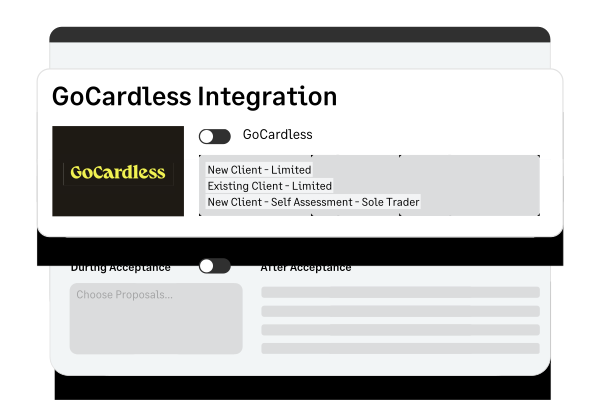
Rather than relying entirely on card transactions, businesses can use GoCardless to automatically collect recurring payments from customers.
The company says its platform is used by more than 100,000 businesses and supports one-off and recurring payments.
Key strengths
- Recurring payments
- Direct debit
- ACH payments
- Bank-based payment collection
- Payment automation
- Fraud prevention
- Accounting integrations
- API access
For a subscription-based business, reducing manual payment collection can improve cash flow and reduce administrative work.
GoCardless can be especially useful where customers are comfortable authorizing bank payments rather than entering card details every month.
Potential limitation: It is not intended to replace every type of card-based checkout.
9. Worldpay — Best for Global Payment Processing
Best for: E-commerce businesses, retailers, marketplaces, and SMEs processing payments across multiple markets
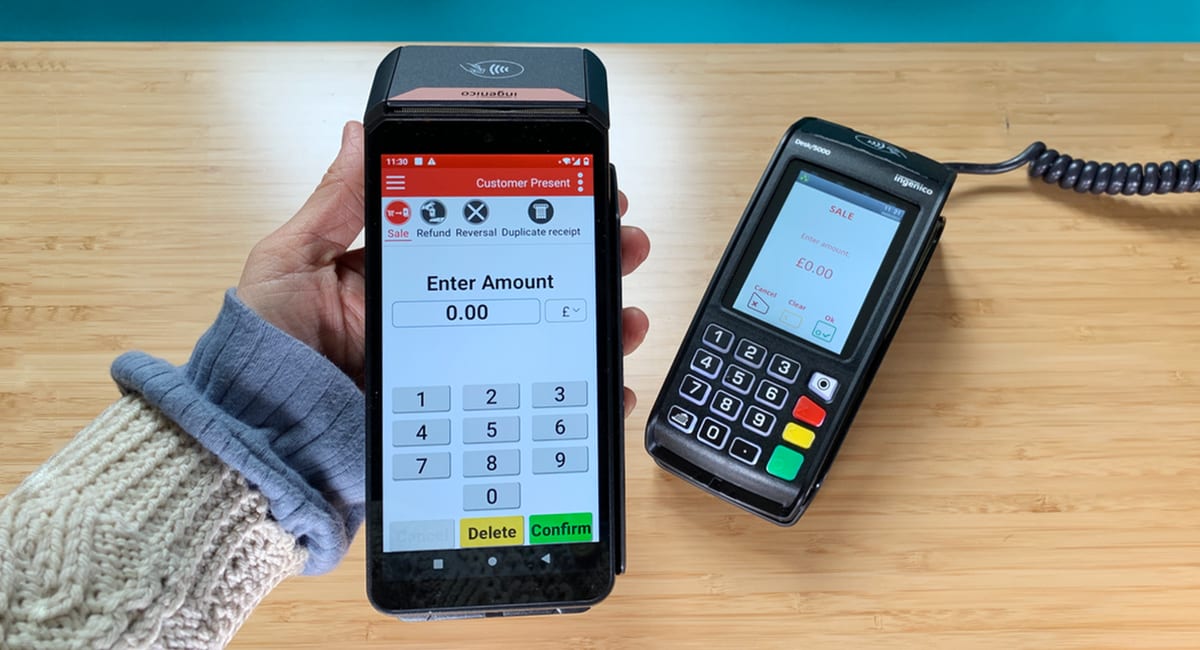
Worldpay is a major global payments technology company providing payment processing and acquiring solutions for businesses worldwide. Its platform supports online and in-person payments, multiple payment methods, fraud management, and international commerce.
Key strengths
- Global payment processing
- Online and in-person payments
- Credit and debit card acceptance
- Digital wallets and alternative payment methods
- Fraud and risk management
- Multi-currency capabilities
- Recurring payments
- E-commerce integrations
- Global acquiring infrastructure
Why SMEs may choose Worldpay
For SMEs looking to expand beyond their domestic market, payment infrastructure needs to support customers across different countries and payment preferences. Worldpay's global acquiring and payment-processing capabilities can help businesses accept payments across multiple markets without building separate payment relationships for every region.
It is particularly relevant for e-commerce retailers, travel businesses, digital marketing agencies, and other companies with international customers.
10. Razorpay — Best for Digital Businesses in India
Best for: Indian e-commerce businesses, startups, SaaS companies, and digital merchants
Razorpay is a major fintech platform focused on businesses operating in India. It provides payment acceptance and a broader suite of business financial tools.

For companies targeting the Indian market, local payment infrastructure can be particularly important because payment preferences, regulations, and banking infrastructure differ from those in North America or Europe.
Key strengths
- Online payment gateway
- Digital payment methods
- Payment links
- Subscription payments
- Invoicing
- Business financial tools
- APIs and developer integrations
A technology startup serving Indian customers may prefer a provider built around local payment requirements rather than relying entirely on an international gateway.
The platform is particularly relevant for businesses that need to integrate payments directly into websites, apps, or digital products.
Potential limitation: Its strongest value proposition is concentrated around businesses operating in India and relevant supported markets.
How to Choose the Best Payment Gateway for Your SME
Choosing among payment gateways for SMEs should start with your business model rather than the provider's popularity.
1. Identify where customers pay
Ask whether your business primarily sells:
- Online
- In physical stores
- Through marketplaces
- Through mobile apps
- Through invoices
- Through subscriptions
- Across international markets
For example, an e-commerce store may benefit from Shopify Payments, while a physical retailer may prefer Square.
2. Compare payment methods
Make a list of the payment methods your customers actually use.
Depending on your market, you may need:
- Visa and Mastercard
- American Express
- Apple Pay
- Google Pay
- PayPal
- Bank transfers
- Direct debit
- QR payments
- Local wallets
- Buy now, pay later
- Local payment methods
More payment methods are not automatically better. The objective is to provide the methods that matter to your target customers.
3. Evaluate transaction fees beyond the headline rate
Transaction fees are important, but they should not be the only consideration.
Look at:
- Domestic transaction fees
- International transaction fees
- Fixed transaction fees
- Currency-conversion costs
- Monthly fees
- Chargeback fees
- Refund costs
- Payout fees
- Cross-border transfer costs
- Additional software costs
For small transactions, fixed fees can have a surprisingly large effect on margins.
4. Check international coverage
If your business sells internationally, verify:
- Supported countries
- Supported currencies
- Local payment methods
- Settlement currencies
- FX rates
- International payout options
- Regulatory requirements
A provider that works perfectly for a domestic business may not be the best choice for an international SME.
Key Trends Shaping SME Payments in 2026
The SME payments market is moving beyond simple card processing.
Embedded Finance Is Becoming More Important
Businesses increasingly expect financial services to exist inside the software they already use.
Instead of switching between separate platforms for payments, banking, expenses, and accounting, SMEs can increasingly manage multiple workflows from a connected financial ecosystem.
Cross-Border Payments Are Becoming More Accessible
Fintech platforms are making international payments easier for smaller companies that historically relied on traditional bank transfers.
Research published in 2026 notes that internationally active SMEs are increasingly adopting fintech platforms for cross-border payments, while local collection capabilities and transparent FX pricing are becoming important differentiators.
Payment Data Is Becoming a Business Asset
Payments generate valuable information about:
- Revenue
- Customer behavior
- Geographic demand
- Payment failures
- Refunds
- Customer lifetime value
- Cash flow
The ability to connect payment information with analytics and accounting systems can therefore become an important competitive advantage.
Security Remains a Major Concern
As digital payments grow, businesses must pay attention to fraud, scams, chargebacks, account security, and payment disputes.
This is particularly relevant in emerging digital-payment markets. A 2026 Visa study found that 43% of surveyed Vietnamese SMBs were concerned about fraud, scams, or misdirected payments, while 34% cited difficulties tracking transactions or understanding refunds as barriers to greater adoption.
Frequently Asked Questions
1. What is the best payment gateway for SMEs?
There is no single best payment gateway for every SME. Stripe is a strong option for online and technology businesses, Square for physical retail and services, Shopify Payments for Shopify stores, and PayPal for businesses that prioritize international customer familiarity.
2. What should SMEs look for in a payment gateway?
SMEs should evaluate transaction fees, supported payment methods, geographic coverage, currencies, payout times, security, integrations, recurring billing, customer support, and scalability.
3. Are payment gateways expensive for small businesses?
Costs vary by provider, country, payment method, transaction volume, and business model. Shopify's 2026 review notes that small-business payment processing commonly falls within roughly 1.5%–3.5% per transaction, although actual costs can differ substantially.
4. Can an SME use more than one payment provider?
Yes. Some businesses use multiple providers to offer different payment methods, reduce dependency on one provider, or serve different geographic markets. However, operating multiple systems can increase reconciliation and technical complexity.
5. What is the difference between Stripe and PayPal?
Stripe is generally more focused on programmable payment infrastructure and developer flexibility, while PayPal places greater emphasis on its global consumer network, familiar checkout experience, and business tools. The right option depends on how much technical customization and international customer recognition the business needs.

