
.webp)
.png)
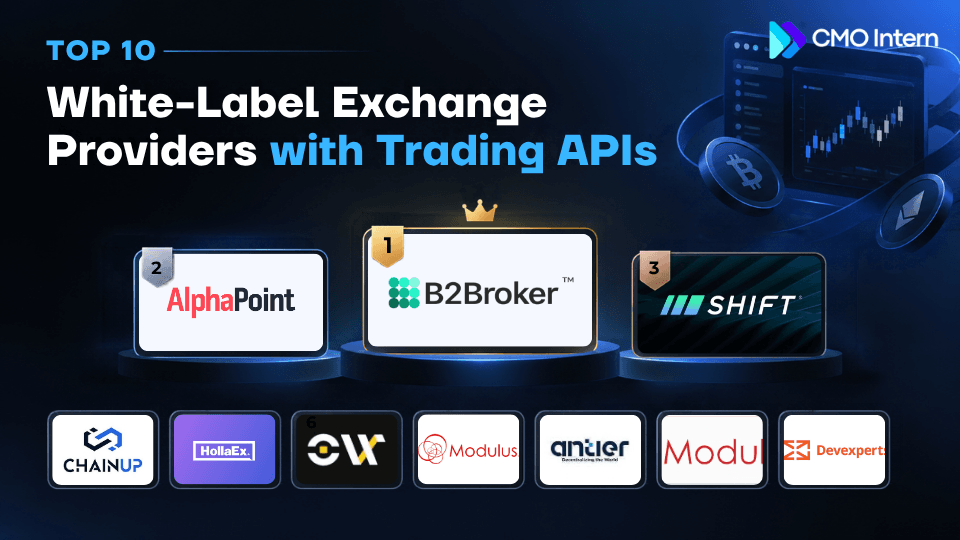
If you are looking for the Top 10 white-label exchange providers with trading APIs in 2026, you have reached the right place to evaluate web3 infrastructure that supports modern digital asset platforms. Launching a crypto exchange no longer requires building every component from the ground up, as these providers supply the core trading infrastructure, including matching engines, liquidity connectivity, wallets, administration tools, and APIs that connect the exchange to external applications and services.
For businesses evaluating a white-label link building strategy for their platform, however, the API layer deserves as much attention as the trading interface itself. A branded frontend may look complete, but APIs determine how easily the exchange can connect with trading terminals, mobile applications, liquidity providers, market-making systems, KYC/AML tools, analytics platforms, and internal back-office infrastructure.
This guide compares 10 established providers in the exchange infrastructure market. The list focuses on companies with identifiable exchange or digital-asset trading products rather than extremely large technology corporations or obscure development shops. The comparison considers API capabilities, trading infrastructure, liquidity connectivity, customization, deployment flexibility, and the types of businesses each provider appears designed to serve.
Important: A white-label technology provider does not automatically give an exchange operator a license to operate. Licensing, regulatory registration, banking relationships, AML/KYC obligations, custody arrangements, and jurisdiction-specific requirements should be assessed separately.
How We Compared White-Label Exchange Providers
The providers below were assessed using several practical criteria relevant to businesses planning a crypto exchange launch.
1. Trading API capabilities
The API should provide more than basic market data. Important capabilities can include:
- Order creation and cancellation
- Account and balance management
- Market data
- WebSocket streaming
- REST APIs
- FIX connectivity
- API authentication and permissions
- Trading-bot connectivity
- Third-party integrations
2. Exchange infrastructure
We looked at whether the provider offers components such as:
- Matching engine
- Order management
- Market-data infrastructure
- Risk management
- Back-office administration
- Wallet infrastructure
- Trading interfaces
3. Liquidity connectivity
Liquidity is a critical part of exchange infrastructure. A platform may support external liquidity providers, aggregation, market-making tools, or integrations with third-party venues.
Top 10 white-label exchange providers with trading APIs in 2026
1. B2Broker
Best known for: Full-stack trading infrastructure and API connectivity for brokers and exchange operators
B2Broker is one of the more comprehensive names in the white-label exchange infrastructure market. Its ecosystem combines trading technology with liquidity, CRM, back-office, payment, and operational components, making it relevant to businesses that want more than a standalone exchange frontend.
Its B2TRADER product provides a multi-asset trading environment with crypto spot and cryptocurrency CFD trading capabilities. The platform exposes REST, WebSocket, and FIX APIs, giving developers several options for connecting custom applications, trading systems, and external services. B2TRADER also provides API token management and granular permissions for automated trading use cases.
Another consideration is the broader B2Broker ecosystem. B2CORE handles areas such as user management, CRM, compliance workflows, and back-office operations, while B2CONNECT provides liquidity connectivity and routing infrastructure.
API and infrastructure highlights:
- REST API
- WebSocket API
- FIX connectivity
- Matching engine
- Spot and derivatives trading
- Liquidity connectivity
- CRM and back-office infrastructure
- API-based integrations
- User-level API token management
Suitable for: Brokerages, fintech companies, exchange operators, and businesses looking for a broader trading infrastructure ecosystem.
2. AlphaPoint
Best known for: API-heavy exchange infrastructure and institutional-oriented architecture

AlphaPoint has a long-standing presence in digital-asset exchange technology and positions its exchange platform around high availability, scalability, risk management, and integration flexibility.
One of its most notable API-related characteristics is the stated availability of 500+ granular APIs, alongside FIX gateway support and SDK integration options. The architecture separates frontend and back-office controls and can connect with third-party custody providers and liquidity infrastructure.
This makes AlphaPoint particularly relevant for organizations that expect their exchange to connect with a wider technology environment rather than operate as a standalone website.
Its infrastructure also emphasizes configurable market parameters, pre- and post-trade risk controls, market monitoring, and high-performance matching and execution.
API and infrastructure highlights:
- 500+ granular APIs
- FIX gateway
- SDK integration
- Matching and execution infrastructure
- Market data
- Risk management
- Custody integrations
- Liquidity connectivity
- Multi-region deployment capabilities
Suitable for: Financial institutions, institutional trading businesses, regulated-oriented operators, and teams with significant integration requirements.
3. Shift Markets
Best known for: Modular, API-driven exchange infrastructure

Shift Markets takes a strongly modular approach to exchange technology. Its white-label exchange is designed for both retail and institutional traders, while the company's Shift Platform uses an API-based architecture to allow customization and integration with other systems.
The platform covers more than the trading interface. Its broader infrastructure includes a white-label exchange, derivatives platform, back office, digital-asset ledger, crypto payment functionality, and market-making and liquidity components.
This modular approach can be particularly relevant when an operator wants to launch with spot trading and later expand its technology stack rather than committing to every component from day one.
API and infrastructure highlights:
- API-based architecture
- White-label trading interface
- Spot trading
- Derivatives
- Back-office controls
- Digital-asset ledger
- Liquidity infrastructure
- Market-making functionality
- Third-party integrations
Suitable for: Exchange operators, fintech companies, institutional businesses, and teams that prioritize modularity.
4. ChainUp
Best known for: Broad digital-asset infrastructure and integrated liquidity technology

ChainUp offers a wider digital-asset infrastructure ecosystem rather than focusing solely on an exchange frontend. Its white-label exchange platform supports spot and futures trading, advanced trading functions, wallets, liquidity technology, compliance tools, and operational management.
For API-focused businesses, ChainUp highlights an API framework designed to integrate the exchange with external tools and platforms. Its liquidity infrastructure also includes smart order routing and market-making technology.
Another distinction is its range of deployment models. ChainUp describes SaaS, private/hosted, and other deployment approaches, allowing businesses to consider infrastructure requirements alongside their trading functionality.
API and infrastructure highlights:
- API integration framework
- Spot and futures modules
- Liquidity aggregation
- Smart order routing
- Market-making technology
- Wallet infrastructure
- KYC/AML and KYT solutions
- Exchange management console
- SaaS and private deployment options
Suitable for: Businesses looking for a broad digital-asset technology stack rather than only an exchange trading terminal.
5. HollaEx
Best known for: Developer-oriented and customizable white-label exchange infrastructure
HollaEx takes a somewhat different approach from providers that primarily sell a fully managed enterprise stack. Its offering combines white-label exchange functionality with an open-source-oriented technology model and extensive API documentation.
The company's exchange product includes admin APIs, back-office controls, user management, KYC functionality, and multi-coin wallet infrastructure.
Its API documentation exposes exchange functionality through programmable interfaces, making it particularly interesting for teams that want developers to work directly with exchange components rather than relying exclusively on a preconfigured interface.
That flexibility can be useful, although organizations should carefully evaluate how much engineering and operational responsibility remains with their internal team under the chosen deployment model.
API and infrastructure highlights:
- Exchange APIs
- Admin APIs
- Back-office controls
- User management
- Multi-coin wallets
- KYC functionality
- Customizable exchange environment
- Developer-oriented architecture
Suitable for: Startups, technical teams, developers, and operators looking for greater control over their exchange implementation.
6. Openware / OpenDAX Aurora
Best known for: Modular exchange software with source-code and customization options
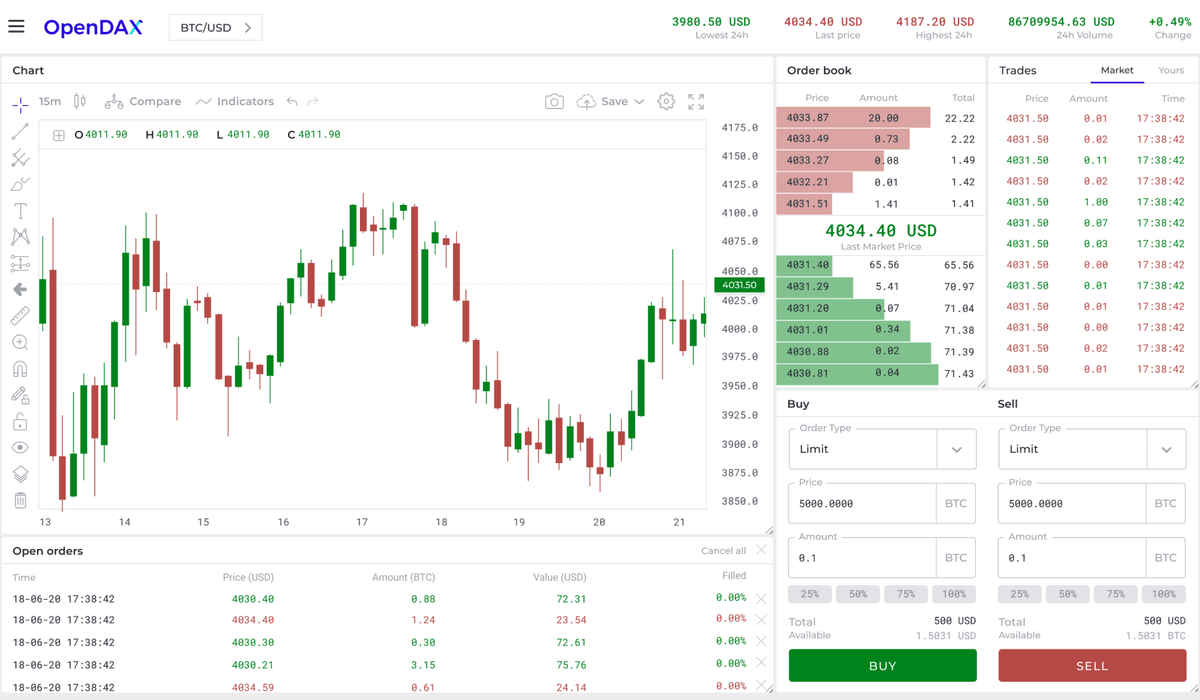
Openware's OpenDAX Aurora is designed as a modular crypto exchange software stack. It combines exchange functionality, customization, liquidity integrations, and a high-performance trading engine.
Openware describes Aurora as a customizable platform with built-in liquidity integrations, administration tools, scalable architecture, and different packages intended for startups through larger enterprises.
A particularly relevant feature for API-focused operators is the underlying Finex trading engine. Its API layer provides REST and bidirectional WebSocket connectivity, allowing users and trading bots to create and cancel orders and receive trade information in real time.
Openware also offers source-code access under its perpetual-license model, giving engineering teams more control over customization and deployment than a purely managed SaaS solution.
API and infrastructure highlights:
- REST API
- WebSocket API
- High-performance matching engine
- Modular architecture
- Built-in liquidity integrations
- Role-based administration
- Source-code access
- Cloud or bare-metal deployment options
Suitable for: Technical exchange operators that want deeper control over infrastructure and source-code customization.
7. PayBito
Best known for: API-enabled white-label exchange and broader financial platform functionality

PayBito provides a white-label exchange infrastructure that goes beyond basic spot trading. Its current API suite includes trading APIs with real-time market data and order management, alongside APIs for payments and white-label financial applications.
Its white-label API model supports exchange functionality including spot, futures, options, P2P, copy trading, portfolio management, asset management, and other modules depending on the implementation.
For businesses building an exchange into an existing financial product, the API-oriented approach can be particularly relevant because the exchange does not necessarily have to operate as an isolated web platform.
API and infrastructure highlights:
- Trading API
- Real-time market data
- Order management
- Spot trading
- Futures
- Options
- P2P
- Copy trading
- Portfolio and asset management
- White-label API access
Suitable for: Fintech companies, exchange startups, and businesses that want to integrate trading functionality into a broader financial platform.
8. Antier
Best known for: Customizable white-label exchange architecture and API-first integrations

Antier approaches white-label exchange infrastructure from a more development-oriented perspective. Its architecture covers the trading engine, liquidity, wallets and custody, security, APIs, analytics, and operational infrastructure.
The company specifically identifies API-first integration as a use case for fintechs and neobanks, while its architecture includes an API gateway responsible for authentication, routing, rate limiting, and communication between the trading application and backend services.
Its white-label exchange offering also covers spot, derivatives, and P2P modules, together with external liquidity aggregation and back-office controls.
For businesses requiring a combination of pre-built infrastructure and custom development, this model may be worth evaluating against more standardized SaaS providers.
API and infrastructure highlights:
- API gateway
- API authentication
- Rate limiting
- Spot and derivatives trading
- P2P
- Liquidity aggregation
- Wallet and custody infrastructure
- Back-office controls
- Third-party integrations
Suitable for: Fintechs, neobanks, brokerages, Web3 companies, and businesses requiring deeper customization.
9. Modulus
Best known for: Source-code-based white-label trading and exchange infrastructure

Modulus is positioned around customizable trading technology with full source-code access. Its multi-asset exchange product is designed for businesses that want to launch, customize, and operate their own trading infrastructure rather than rely entirely on a closed SaaS environment.
The platform supports spot exchange operations across multiple asset categories and provides a documented API for custom web interfaces, mobile applications, trading bots, administration tools, and other exchange workflows.
This makes Modulus particularly relevant when API access and ownership of the underlying technology are major considerations.
The trade-off is that source-code access generally makes the technical team more important. Operators should consider their own engineering, infrastructure, security, and maintenance capabilities before choosing a highly customizable architecture.
API and infrastructure highlights:
- Documented API
- Full source-code access
- Custom web and mobile interfaces
- Trading-bot integrations
- Matching engine
- Market data
- KYC/AML integrations
- Market surveillance
- Cloud, private cloud, bare-metal, and Kubernetes deployment
Suitable for: Financial technology companies and exchange operators with internal engineering capabilities.
10. Devexperts
Best known for: Institutional-grade trading technology and exchange components

Devexperts is a financial technology provider with products covering trading platforms, matching engines, market data, risk management, and exchange infrastructure.
Its DXtrade Crypto offering is a white-label digital-asset trading platform for brokers and exchanges, while DXmatch provides exchange infrastructure including matching, market-data delivery, storage, risk management, market-access APIs, and administrative functionality.
The company also supports FIX connectivity and integration with external systems, making its infrastructure relevant for organizations operating more complex trading environments.
Rather than positioning itself purely as a lightweight exchange-launch solution, Devexperts is more closely associated with financial-market infrastructure and customizable trading technology.
API and infrastructure highlights:
- Market-access APIs
- FIX connectivity
- Matching engine
- Risk management
- Market data
- OMS/EMS
- Web and mobile trading
- White-label deployment
- Custom development
- Exchange infrastructure
Suitable for: Established brokers, institutional operators, exchanges, and businesses requiring sophisticated trading infrastructure.
What Should You Look for in a Crypto Exchange Trading API?
Choosing among white-label exchange providers should not start with the number of endpoints listed in an API document. The more important question is whether the API supports the way your business intends to operate.
REST vs. WebSocket
REST APIs are commonly useful for actions such as:
- Account queries
- Order placement
- Order cancellation
- Balance information
- Historical data
WebSocket APIs are more appropriate for real-time information such as:
- Order-book updates
- Price changes
- Trade executions
- Account events
- Market-data streams
A trading business that requires real-time execution should therefore examine both rather than treating "API available" as a sufficient criterion.
FIX Connectivity
FIX can become important for institutional trading environments and connections to market participants or external systems.
Providers such as B2Broker, AlphaPoint, and Devexperts explicitly document FIX-related connectivity.
API Authentication and Permissions
Security should be evaluated at the API level as well as at the application level.
Look for controls such as:
- API key permissions
- Read-only access
- Trading-only permissions
- IP restrictions
- Rate limits
- Authentication mechanisms
- Separate user and administrative credentials
- Audit logs
These controls can become especially important when trading bots, market makers, third-party applications, and internal systems all interact with the same exchange.
Why Liquidity and APIs Should Be Evaluated Together
It is easy to evaluate a crypto exchange partnerships strategy by looking at the frontend: charts, order screens, mobile applications, and supported assets.
However, the underlying infrastructure often determines how the exchange actually performs.
Consider a simplified trading flow:
Trader → Trading Interface → API → Order Management → Matching / Routing → Liquidity → Execution
If the API is limited, connecting custom applications becomes harder. If liquidity connectivity is limited, the exchange may have fewer options for managing spreads and market depth. If the matching engine cannot scale with the business, API performance alone will not solve the problem.
This is why API functionality, liquidity architecture, and matching-engine design should be evaluated as one technology stack rather than as separate checkboxes.
White-Label Exchange vs. Building From Scratch
A white-label solution generally reduces the amount of infrastructure that a company has to develop internally.
A typical white-label stack may provide:
- Trading interface
- Matching engine
- Wallet infrastructure
- User management
- Back office
- API layer
- Liquidity connectivity
- KYC/AML integrations
- Reporting
- Security controls
By contrast, a fully custom exchange gives the operator more control over architecture but also transfers more responsibility to the internal engineering team.
The choice therefore depends heavily on the company's technical resources, desired launch model, target market, and long-term product roadmap.
For teams that need extensive ownership of the technology, providers such as Openware and Modulus explicitly emphasize source-code access and customization.
For organizations looking for a broader managed ecosystem, providers such as B2Broker and ChainUp combine exchange technology with additional infrastructure services.
Frequently Asked Questions
1. What is a white-label crypto exchange?
A white-label crypto exchange is a pre-built exchange technology solution that can be branded and configured for another business. Depending on the provider, it may include a matching engine, trading interface, wallets, APIs, liquidity connectivity, KYC/AML integrations, and back-office tools.
2. Why do white-label exchanges need trading APIs?
Trading APIs allow external applications and systems to communicate with the exchange. They can support automated trading, trading bots, mobile applications, custom interfaces, market-data systems, liquidity connections, and internal business infrastructure.
3. What is the difference between REST and WebSocket trading APIs?
REST is generally used for request-and-response operations such as placing orders, checking balances, or retrieving account information. WebSocket provides persistent connections that are better suited to real-time market data and execution updates.
4. Does a white-label exchange provider provide a crypto license?
Not necessarily. Exchange software and regulatory authorization are separate matters. A technology vendor may provide compliance tools or licensing support, but the operator must determine the legal and regulatory requirements applicable to its business and target jurisdictions.
5. How much does white-label exchange software cost?
Pricing varies considerably depending on the provider, deployment model, trading products, liquidity requirements, API access, customization, custody infrastructure, compliance integrations, and ongoing support. Many enterprise providers do not publish a single fixed price because implementation requirements differ between clients.

