


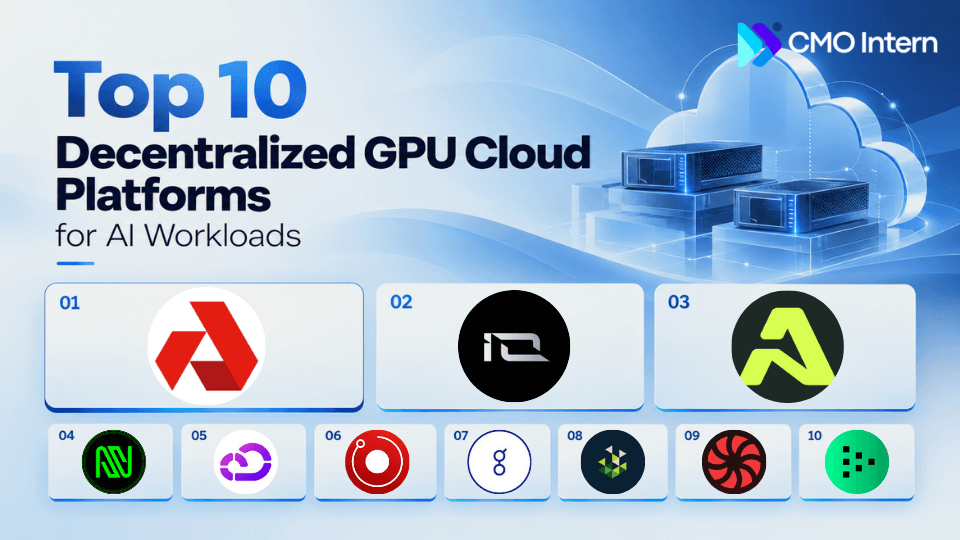
The top 10 decentralized GPU cloud platforms for AI workloads provide scalable, cost-efficient computing power by aggregating hardware from independent providers. As artificial intelligence development accelerates, these networks offer a flexible alternative to traditional cloud infrastructure for training large language models, fine-tuning machine learning systems, and running real-time inference without the constraints of centralized vendor lock-in.
However, centralized GPU cloud providers can introduce challenges such as limited hardware availability, expensive compute resources, vendor dependency, and geographical restrictions. These limitations have created opportunities for cloud mining platform and decentralized GPU cloud platforms, which connect independent GPU providers, data centers, and distributed computing resources through open marketplaces or decentralized infrastructure networks.
Powered by blockchain technology, Decentralized Physical Infrastructure Networks (DePIN), and peer-to-peer resource marketplaces, these platforms aim to make GPU computing more accessible, flexible, and cost-efficient. Depending on their architecture, they can support AI model training, inference, rendering, distributed workloads, and other compute-intensive applications.
In this article, we explore 10 decentralized GPU cloud platforms worth examining for AI workloads, highlighting their infrastructure models, key capabilities, and potential use cases.
What Are Decentralized GPU Cloud Platforms?
Decentralized GPU cloud platforms are computing networks that aggregate GPU resources from multiple independent providers instead of relying exclusively on infrastructure owned and operated by a single cloud company. These providers may include data center operators, independent server owners, gaming PC operators, and organizations with underutilized computing resources.
Through decentralized marketplaces, resource coordination protocols, and sometimes blockchain-based payment mechanisms, users can access GPU computing capacity for different AI workloads.
Unlike conventional cloud infrastructure, decentralized GPU networks can offer alternative resource allocation models, including provider bidding, peer-to-peer rentals, token-based incentives, and distributed workload execution. However, decentralization does not automatically guarantee lower costs, higher reliability, or enterprise-grade security. Hardware availability, network latency, workload compatibility, data privacy, and service-level commitments remain important evaluation factors.
How We Selected These Decentralized GPU Cloud Platforms
The platforms featured in this list were selected based on their relevance to decentralized or distributed GPU infrastructure and their potential applications in AI computing. The evaluation considers five main criteria:
Decentralized Infrastructure: Whether the platform aggregates computing resources from independent providers, distributed nodes, or an open GPU marketplace.
AI Workload Compatibility: Support for AI model training, inference, machine learning, deep learning, or other GPU-intensive applications.
GPU Accessibility: The availability of different GPU configurations and resource allocation mechanisms.
Developer Experience: Deployment workflows, infrastructure management, APIs, documentation, and compatibility with common AI development environments.
Network and Ecosystem Development: The maturity of the infrastructure, provider ecosystem, developer adoption, and ongoing platform development.
The following platforms are not presented as a strict performance ranking. Each serves a different segment of the decentralized GPU computing ecosystem, and suitability ultimately depends on workload requirements.
Top 10 Decentralized GPU Cloud Platforms for AI Workloads
1. Akash Network – Best for Open and Permissionless GPU Cloud Computing
Akash Network is an open-source decentralized cloud computing marketplace that connects developers with independent infrastructure providers offering CPU, GPU, storage, and other computing resources. Rather than operating as a conventional cloud provider with a single infrastructure owner, Akash uses a marketplace-based model in which providers compete to host customer workloads.
For AI developers, Akash provides access to GPU resources through its decentralized marketplace, supporting workloads such as machine learning, model inference, and AI application deployment. Its reverse-auction mechanism allows infrastructure providers to submit bids based on deployment requirements and pricing, giving users greater flexibility when selecting computing resources.
One of Akash's notable capabilities is its container-native deployment approach. Developers can deploy Docker-based applications through the Akash Console or use Stack Definition Language (SDL) configurations to specify infrastructure requirements. The platform also provides AI inference capabilities through AkashML, allowing users to access open-source AI models without managing the underlying GPU infrastructure themselves.
Key Features:
Decentralized marketplace connecting independent GPU and cloud infrastructure providers.
Reverse-auction pricing that enables providers to compete for deployment contracts.
Support for containerized applications and customized deployment configurations.
GPU availability across multiple hardware configurations, including A100, H100, and H200.
AI inference capabilities through AkashML and OpenAI-compatible APIs.
Best For: AI startups, independent developers, and research teams looking for flexible GPU infrastructure, competitive marketplace pricing, and greater control over cloud deployment environments.
2. io.net – Best for Distributed AI Training and GPU Clusters
io.net is a decentralized GPU computing network designed to aggregate underutilized hardware from independent data centers, mining operations, and private infrastructure providers. Built around the concept of Decentralized Physical Infrastructure Networks (DePIN), the platform aims to make GPU resources more accessible to AI developers and machine learning teams.

Unlike conventional GPU rental services that rely on a relatively centralized infrastructure model, io.net brings together geographically distributed computing resources and organizes them into GPU clusters. This approach is particularly relevant for AI teams that need flexible access to different GPU configurations without committing to long-term infrastructure investments.
The platform's infrastructure is designed to support several stages of the AI development lifecycle, including model training, fine-tuning, inference, and deployment. Through io.cloud, developers can provision GPU clusters and manage computing resources according to their workload requirements. Its broader ecosystem also includes AI-oriented tools and services intended to simplify model access and orchestration.
Another important aspect of io.net is its focus on cluster management. AI workloads frequently require multiple GPUs working together, making resource coordination and hardware availability important considerations. By aggregating computing resources from different providers, io.net seeks to address these infrastructure requirements through a distributed network.
Key Features:
Decentralized GPU aggregation from independent infrastructure providers.
GPU cluster provisioning for AI and machine learning workloads.
Support for model training, fine-tuning, and inference.
Flexible GPU configurations, including A100, H100, and other accelerator options.
Cloud infrastructure management through io.cloud.
Best For: AI startups, machine learning engineers, and development teams that need scalable GPU clusters for training, fine-tuning, and deploying AI models.
3. Aethir – Best for Enterprise AI Computing
Aethir is a decentralized GPU cloud infrastructure platform focused on providing high-performance computing resources for enterprise AI and cloud gaming applications. Its infrastructure model connects independent GPU providers with organizations that require substantial computing capacity, creating a distributed alternative to conventional data center-based GPU services.
The platform operates through a network of Cloud Hosts and Cloud Customers. Cloud Hosts contribute GPU infrastructure to the network, while Cloud Customers access computing resources for their applications and workloads. This model allows organizations to access distributed GPU capacity without having to independently build and maintain every component of their computing infrastructure.
Aethir places particular emphasis on enterprise-grade GPU infrastructure. Its network has supported advanced NVIDIA GPU configurations, including A100 and H100 hardware, and the company has announced further expansion into next-generation accelerators for AI training. Its 2026 infrastructure developments include NVIDIA B300 deployments and a managed Kubernetes layer intended to support enterprise AI workloads.
Beyond raw GPU access, Aethir's ecosystem is designed to support AI developers, infrastructure providers, and Web3 projects. Its decentralizing power deep dive into infrastructure models may be particularly relevant to organizations exploring AI applications that require substantial computing resources and flexible deployment options.
Key Features:
Distributed GPU infrastructure connecting independent compute providers and enterprise customers.
Access to high-performance GPU hardware for demanding AI workloads.
Infrastructure supporting AI development, training, and inference.
Cloud Host participation and GPU resource monetization.
Ecosystem development targeting enterprise AI and Web3 applications.
Best For: Enterprises, AI infrastructure companies, and Web3 developers seeking distributed access to high-performance GPU resources for demanding computing applications.
4. Nosana – Best for AI Inference and On-Demand GPU Workloads
Nosana is a decentralized GPU cloud platform built around a global network of independent GPU providers. Operating within the Solana ecosystem, it aims to make computing resources more accessible to AI developers through an open marketplace that connects GPU supply with demand.
The platform focuses on providing on-demand GPU computing for AI applications, particularly inference workloads. Through its OpenGPU marketplace, users can access distributed GPU resources using a task-based model rather than managing their own physical infrastructure. This approach can be useful for teams that need computing power for specific jobs, experiments, and AI application deployments.
Nosana also supports AI image generation and other computationally intensive workloads. Its ecosystem includes projects that use the network for model inference, AI development, and batch processing. For example, Sogni AI uses Nosana's distributed GPU infrastructure to support on-demand image generation, while other ecosystem participants use the network for AI security testing and model-related workloads.
From a developer perspective, Nosana's open-source infrastructure and distributed provider ecosystem offer an alternative to traditional GPU rental arrangements. Its task-oriented model is particularly relevant for workloads that can be divided into independent jobs and executed across available computing resources.
Key Features:
Decentralized GPU marketplace for AI training and inference.
On-demand access to distributed GPU resources.
Task-based computing model through OpenGPU.
Support for AI image generation and batch processing.
Open-source infrastructure and a global GPU provider ecosystem.
Best For: AI developers, independent researchers, and startups running inference-heavy applications, image generation systems, and other GPU-intensive tasks.
5. Theta EdgeCloud – Best for Community-Powered AI Computing
Theta EdgeCloud is a decentralized computing marketplace that connects GPU resource providers with developers and organizations looking for computing capacity. Through its distributed infrastructure model, the platform allows individuals to contribute idle GPU resources and participate in the network while enabling AI teams to access computing power for their applications.
A central component of Theta EdgeCloud is its community-operated infrastructure. Instead of relying exclusively on dedicated data centers, the platform enables GPU owners to contribute their hardware through a lightweight client application. These resources can then be used to execute containerized computing workloads across the network.
For AI developers, Theta EdgeCloud provides access to distributed GPU resources for model inference and other computing tasks. Its marketplace model allows users to select available nodes based on their performance requirements and budgets, while node operators can establish their own hourly rental rates.
The platform also uses TFuel as part of its network reward mechanism. Contributors receive rewards for executing eligible computing tasks, creating an incentive structure that encourages participation from independent hardware providers.
Key Features:
Decentralized marketplace connecting GPU providers with AI developers.
Community-operated GPU infrastructure.
Support for containerized AI and computing workloads.
Flexible provider-set hourly rental pricing.
TFuel-based rewards for eligible GPU computing contributions.
Best For: AI developers, independent GPU owners, and teams interested in community-powered computing resources for inference and distributed workloads.
6. Render Network – Best for Generative AI and GPU-Intensive Creative Workloads
Render Network is a decentralized GPU computing network originally developed to support high-performance 3D rendering. Over time, its ecosystem has expanded into generative AI imaging and other GPU-intensive creative applications, making it relevant to developers and creators exploring distributed computing for AI-powered content production.
The network connects GPU providers with users who need additional computing resources for rendering and digital content creation. By distributing workloads across available GPU resources, Render Network aims to make high-performance rendering more accessible without requiring creators to maintain expensive local hardware.
Its AI-related applications focus particularly on generative visual workflows. The platform integrates with creative technologies and supports workflows involving generative AI imaging, 3D content production, and spatial computing. This makes it different from GPU networks that primarily target conventional machine learning training or general-purpose AI inference.
Render Network also operates through an open-source protocol supported by the Render Network Foundation. Its decentralized infrastructure and provider ecosystem are designed to facilitate resource sharing between GPU owners and creative professionals.
While its strongest positioning remains in rendering and visual computing, its integration with generative AI tools makes it an interesting option for AI-assisted creative production.
Key Features:
Decentralized GPU marketplace connecting providers and computing users.
Distributed rendering for 3D content and visual production.
Support for generative AI imaging workflows.
Integration with established rendering engines and creative applications.
Flexible access to GPU resources through a distributed provider network.
Best For: Digital artists, 3D studios, creative AI developers, and teams working with generative image production and GPU-intensive visual applications.
7. Golem Network – Best for Open-Source and Experimental AI Computing
Golem Network is an open-source decentralized computing platform that enables users to share and access unused computing resources through a distributed marketplace. Established as a resource-sharing ecosystem, it connects independent providers with requestors who need additional processing power for computational tasks.

Although Golem initially focused on general-purpose distributed computing, its ecosystem has increasingly explored GPU-powered applications and AI workloads. Its AI initiatives aim to make computing resources more accessible by utilizing both independent GPU providers and other distributed infrastructure participants.
One of its relevant components is Golem-Workers, a high-level API that provides developers with direct access to GPU and CPU resources on the network. This allows users to configure computing workers and manage workloads through an HTTP-based interface. Developers can use these resources for applications such as AI model fine-tuning, data processing, and other GPU-intensive operations.
Golem also supports AI experimentation through documented workflows for running models on GPU providers. For example, developers can use its infrastructure to execute open-source models through tools such as Ollama.
An important distinction is that Golem's GPU ecosystem is still developing, and available hardware and provider capabilities should be evaluated before using it for production-scale AI workloads.
Key Features:
Open-source decentralized computing infrastructure.
GPU and CPU resource access through Golem-Workers.
Support for AI model execution and experimental inference workflows.
Permissionless participation for computing resource providers.
GLM-based transactions between resource providers and requestors.
Best For: Open-source developers, AI researchers, and technical teams experimenting with decentralized computing, model inference, and GPU resource sharing.
8. SaladCloud – Best for Distributed Consumer GPU Infrastructure
SaladCloud is a distributed computing platform that aggregates GPU resources from a large network of independent devices, including consumer gaming PCs and workstation hardware. Rather than depending exclusively on traditional data center infrastructure, it uses distributed computing resources to provide GPU capacity for AI applications and other demanding workloads.
The platform's core infrastructure is built around container orchestration. Its Salad Container Engine schedules containerized applications across available nodes, manages execution, and reallocates workloads when individual machines become unavailable. This orchestration layer helps developers deploy applications without needing to manage each participating GPU independently.
SaladCloud supports a range of AI applications, including large language model inference, image generation, transcription, computer vision, and batch processing. It also provides API-based deployment options and supports different GPU configurations depending on workload requirements.
One important distinction is that SaladCloud is a distributed cloud platform rather than a blockchain-based DePIN marketplace. Its orchestration and service management are platform-operated, even though its infrastructure draws on geographically distributed hardware. This makes it relevant to comparisons of distributed GPU clouds, but different from fully open, permissionless decentralized networks.
Key Features:
Distributed GPU infrastructure powered by independent hardware contributors.
Container-based deployment and workload orchestration.
Support for LLM inference, image generation, transcription, and computer vision.
API-based deployment and application management.
Community Cloud and dedicated infrastructure options.
Best For: AI startups, application developers, and businesses looking for distributed GPU capacity for inference, image generation, and containerized AI applications.
9. Clore.ai – Best for Flexible Peer-to-Peer GPU Rentals
Clore.ai is a decentralized peer-to-peer GPU marketplace that connects GPU owners with developers, researchers, and businesses looking to rent computing resources. Its infrastructure model allows independent providers to list their hardware and establish rental prices, giving users access to different GPU configurations through a marketplace environment.

The platform supports several GPU-intensive applications, including AI model training, inference, 3D rendering, and GPU-accelerated applications. Users can browse available hardware and choose between different rental arrangements depending on their workload requirements and budget.
One of Clore.ai's distinguishing characteristics is its flexible rental structure. It offers on-demand and spot rental options, allowing users to choose between different pricing and availability arrangements. On-demand rentals are intended for users who prioritize access to selected hardware, while spot rentals provide another option for cost-conscious workloads.
Clore.ai also enables GPU owners to monetize otherwise underutilized hardware. Through its hosting software, providers can list their machines, configure pricing, and earn revenue when their resources are rented.
For AI developers, this model can be particularly useful when experimenting with different GPU configurations or running workloads that do not require a permanently reserved infrastructure environment.
Key Features:
Peer-to-peer GPU marketplace connecting independent hardware providers and renters.
Support for AI training, inference, and GPU-intensive applications.
On-demand and spot rental options.
Flexible pricing determined by individual hardware providers.
Crypto payment options and decentralized resource sharing.
Best For: Independent AI developers, researchers, and small teams seeking flexible GPU rentals for experimentation, model inference, and computationally intensive projects.
10. Livepeer – Best for AI Video Generation and Media Workloads
Livepeer is a decentralized infrastructure network that has expanded from video transcoding into AI-powered media processing and inference. Its open network connects developers and applications that require GPU computing with independent providers capable of executing AI-related workloads.
Unlike general-purpose GPU marketplaces, Livepeer has a more specialized focus on video and visual computing. Its infrastructure is designed to support AI video generation, image processing, and other media-related applications where GPU acceleration plays an important role.
The network operates through independent GPU providers who contribute computing resources and receive compensation for completing eligible jobs. Developers can access the network through its evolving AI infrastructure and associated tools, including Livepeer Agent, which supports AI-powered workflows involving video, images, audio, and other creative tasks.
This specialized approach makes Livepeer particularly relevant as generative AI applications increasingly incorporate video and multimodal capabilities. Instead of competing directly with general-purpose GPU cloud marketplaces across every AI workload category, it focuses on enabling distributed infrastructure for media-centric applications.
For developers building AI video products, automated content creation tools, and multimodal applications, Livepeer offers an alternative model for accessing distributed GPU computing resources.
Key Features:
Decentralized network connecting AI workload requestors with independent GPU providers.
Infrastructure focused on AI video generation and media processing.
Support for image, video, audio, and other creative AI workflows.
Independent GPU provider participation and job-based compensation.
Open ecosystem with developer-oriented AI tools.
Best For: AI video developers, creative technology companies, and teams building applications involving video generation, media processing, and multimodal AI.
How to Choose the Right Decentralized GPU Cloud Platform
Selecting a decentralized GPU cloud platform requires more than comparing GPU rental prices. Different AI workloads have different infrastructure requirements, and the most suitable solution depends on the computing resources, deployment environment, and operational reliability needed.
Here are several considerations when evaluating potential platforms:
1. Identify Your AI Workload Requirements
AI model training, fine-tuning, and inference require different levels of computing resources. Large-scale training projects may require high-memory GPUs and interconnected clusters, whereas inference applications may prioritize availability, cost efficiency, and predictable response times. Creative applications involving image and video generation may benefit from distributed GPU resources that can process multiple jobs simultaneously.
2. Evaluate GPU Availability and Compatibility
Not every decentralized GPU network offers the same hardware configurations. Developers should examine GPU models, VRAM capacity, multi-GPU support, storage, and networking capabilities before selecting a provider. Compatibility with CUDA, PyTorch, TensorFlow, Docker, and other development tools may also influence deployment decisions.
3. Consider Reliability and Workload Continuity
Distributed infrastructure can involve hardware with different performance characteristics and availability levels. Before deploying production applications, evaluate provider reputation, uptime history, workload interruption policies, checkpointing options, and recovery mechanisms. For long-running AI training tasks, the ability to resume interrupted workloads is particularly important.
4. Understand Pricing and Payment Models
Decentralized GPU platforms may use provider bidding, hourly rentals, spot pricing, or token-based payment mechanisms. However, the cheapest advertised GPU rate does not necessarily translate into the lowest total computing cost. Developers should also consider storage, network transfer, orchestration, failed jobs, and the time required to manage distributed infrastructure.
5. Assess Data Privacy and Security
AI workloads frequently involve proprietary datasets, customer information, and confidential model parameters. Organizations should evaluate isolation mechanisms, encryption, access controls, provider verification, and data handling policies. Decentralized infrastructure should not automatically be treated as suitable for sensitive enterprise workloads without additional security assessments.
Frequently Asked Questions
1. What is a decentralized GPU cloud platform?
A decentralized GPU cloud platform is a computing network that aggregates GPU resources from multiple independent providers instead of relying exclusively on infrastructure owned by a single cloud operator. It allows developers and businesses to access distributed GPU capacity for AI training, inference, rendering, and other computationally intensive applications.
To learn more about the broader ecosystem, you can explore decentralized applications dapps and their impact on modern tech stacks.
2. How do decentralized GPU cloud platforms support AI workloads?
These platforms connect GPU providers with users through computing marketplaces, distributed infrastructure protocols, and resource coordination systems. Depending on the platform, developers can rent GPUs, deploy containerized applications, create computing clusters, or execute individual AI inference jobs without purchasing and maintaining physical GPU hardware.
For those interested in the financial side of these networks, understanding the decentralized stablecoin protocol is often a key step in managing payments.
3. Are decentralized GPU cloud platforms cheaper than traditional GPU cloud providers?
They can offer competitive pricing by utilizing underused hardware and allowing independent providers to compete for computing demand. However, actual costs depend on GPU specifications, availability, workload duration, network performance, storage, and operational overhead. Developers should compare total workload costs rather than relying exclusively on advertised hourly rates.
4. What is the difference between decentralized GPU computing and traditional cloud computing?
Traditional cloud computing generally relies on infrastructure managed by a centralized provider, while decentralized GPU computing aggregates resources from multiple independent hardware operators. Decentralized platforms may use open marketplaces, blockchain-based coordination, or peer-to-peer resource allocation to distribute computing demand. However, their management, security, and service guarantees vary considerably.
Many firms are now adopting decentralized marketing strategies to promote these new infrastructure solutions to a wider audience.
5. Which decentralized GPU cloud platform is best for AI inference?
The answer depends on the application. Nosana and Akash Network are worth considering for on-demand AI workloads, while io.net offers GPU cluster infrastructure for more extensive AI development requirements. Livepeer is particularly relevant for video-centric AI applications, and SaladCloud provides distributed GPU infrastructure for inference and other containerized workloads.
If you are building your own infrastructure, check out our guide on Decentralized Identity Implementation Guide to secure your access points.

