


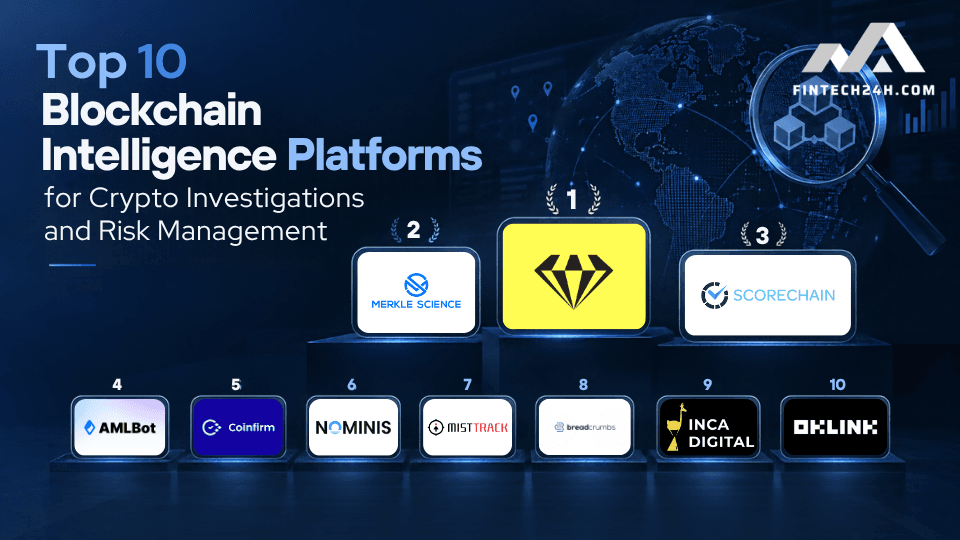
The top 10 blockchain intelligence platforms for crypto investigations and risk management provide the essential analytical tools needed to navigate complex on-chain activity. While cryptocurrency transactions are recorded on public blockchains, transparency does not automatically make suspicious activity easy to investigate. Funds often move across multiple wallets, decentralized exchanges, bridges, and networks, creating trails that are difficult to interpret without specialized software. For exchanges, financial institutions, and Web3 businesses, these platforms are critical for identifying financial crime and managing crypto asset management risk.
By combining transaction tracing, wallet attribution, risk scoring, behavioral analysis, and blockchain data visualization, these platforms help organizations turn raw on-chain activity into actionable intelligence. Depending on the solution, teams can investigate suspicious transfers, identify exposure to high-risk addresses, monitor transactions against internal policies, and organize evidence for further review.
However, not every platform serves the same purpose. Some prioritize blockchain forensics and investigative workflows, while others focus on anti-money laundering (AML) compliance, wallet screening, predictive risk detection, or broader on-chain intelligence. Choosing the right solution therefore requires more than comparing feature lists; organizations must understand their investigation requirements, supported networks, data quality, reporting needs, and operational constraints.
In this guide, we explore 10 blockchain intelligence platforms worth evaluating for crypto investigations and risk management. The selection emphasizes specialized providers and established industry participants rather than defaulting exclusively to the largest enterprise vendors. Each platform is assessed according to its primary use cases, distinguishing capabilities, and considerations for prospective buyers.
What Are Blockchain Intelligence Platforms?
Blockchain intelligence platforms are software solutions that analyze blockchain transactions, wallet addresses, and on-chain relationships to help users understand digital asset activity. They combine blockchain data with analytical models, address labels, entity attribution, and risk indicators to make complex transaction histories easier to investigate.
Depending on the provider, these tools may support several important functions:
Transaction tracing: Follow the movement of digital assets between wallets, exchanges, smart contracts, and supported blockchain networks.
Wallet screening: Assess addresses for potential exposure to sanctioned entities, scams, stolen funds, darknet markets, or other designated risk categories.
Entity attribution: Connect wallet addresses with known organizations, services, or other identifiable entities when supporting intelligence is available.
Transaction monitoring: Screen incoming and outgoing transactions against risk policies and generate alerts for further review.
Blockchain forensics: Visualize transaction relationships, investigate suspicious fund flows, and organize findings into case documentation.
Risk management: Help compliance teams prioritize alerts, assess exposure, and make more consistent decisions about digital asset activity.
These capabilities are related but not interchangeable. A platform designed primarily for visual investigations may not provide the same compliance automation as a dedicated defi risk management solution. Similarly, a public blockchain explorer can expose transaction records without providing the attribution depth, investigative workflow, or risk intelligence needed for professional investigations.
For this reason, organizations should evaluate platforms blockchain data according to the problems they need to solve, rather than assuming that every tool provides a complete investigation and compliance stack.
Top 10 Blockchain Intelligence Platforms for Crypto Investigations and Risk Management
The following platforms represent different approaches to blockchain analytics, crypto forensics, transaction monitoring, and digital asset risk assessment. The list is intended as a practical shortlist, not a universal ranking. Product capabilities and supported networks vary by package and may change over time, so buyers should verify current specifications before making a procurement decision.
1. Crystal Intelligence
Best for: Blockchain investigations, transaction tracing, and compliance-oriented risk analysis.
Crystal Intelligence provides blockchain analytics and investigative tools designed to help financial institutions, cryptocurrency businesses, and investigative professionals understand digital asset transactions. Its platform combines transaction visualization with blockchain intelligence to support the analysis of suspicious fund movements and potential financial crime.
One of Crystal Intelligence's central use cases is helping investigators follow transaction paths and interpret relationships between wallet addresses. Rather than examining individual transactions in isolation, analysts can explore how funds move through connected addresses and services, building a more comprehensive picture of an incident.
For compliance teams, blockchain intelligence can also support risk assessment by providing context around wallet activity and potential exposure to suspicious entities. This is particularly relevant when an organization needs to investigate a flagged deposit, review a transaction history, or understand how digital assets reached a particular destination.
Crystal Intelligence is worth considering for organizations that need both investigative visibility and compliance-oriented analysis. Before adopting the platform, buyers should evaluate the networks relevant to their operations, the depth of available entity attribution, and the quality of its reporting and case documentation workflows.
Key capabilities to evaluate:
Visual transaction tracing and wallet relationship analysis.
Blockchain intelligence for investigating suspicious fund movements.
Risk analysis supporting crypto compliance workflows.
Investigation and reporting features for professional users.
Potential limitation: The practical value of an investigation depends on the available attribution data, supported blockchain networks, and the investigator's ability to interpret the evidence. Organizations should test these factors against representative cases.
2. Merkle Science
Best for: Crypto AML operations, behavioral risk assessment, and transaction monitoring.

Merkle Science develops blockchain analytics and cryptocurrency risk management solutions for organizations that need to identify and investigate potentially illicit digital asset activity. Its product offerings address compliance monitoring, wallet screening, and investigative workflows, making the company relevant to exchanges, financial institutions, and other businesses operating in the digital asset economy.
A notable area of interest is its emphasis on risk intelligence and behavioral indicators. Known wallet labels are useful, but suspicious activity does not always originate from an address that has already been publicly identified. Behavioral analysis can help compliance teams recognize patterns that warrant closer examination, although a risk signal should not be treated as proof of wrongdoing.
Merkle Science is particularly relevant when organizations want to connect blockchain analytics with operational risk controls. Depending on the selected product and configuration, teams can assess wallet exposure, monitor transactions, and investigate activity that triggers internal compliance rules.
The platform may suit businesses looking for a more structured approach to crypto risk management, especially where monitoring and investigation need to work together. Prospective buyers should assess supported networks, configurable rules, alert quality, integration requirements, and the explainability of risk scores.
Key capabilities to evaluate:
Cryptocurrency transaction monitoring and wallet screening.
Risk intelligence for identifying potentially suspicious activity.
Investigation workflows for analyzing blockchain transactions.
Compliance-oriented analytics and integration options.
Potential limitation: Behavioral indicators and automated risk scores can generate false positives. Organizations should assess how effectively the platform explains its alerts and supports human review before high-impact decisions are made.
3. Scorechain
Best for: Crypto AML compliance, wallet screening, and risk monitoring for digital asset businesses.
Scorechain is a blockchain analytics provider focused on cryptocurrency compliance, transaction monitoring, and investigations. Its solutions are relevant to virtual asset service providers, cryptocurrency exchanges, and financial organizations that need to assess blockchain-related risks as part of their compliance operations.
The platform's appeal lies in its compliance-oriented approach to blockchain data. Businesses need more than a transaction record when reviewing a potentially risky transfer; they also need context that helps explain the exposure, document the decision, and determine whether additional investigation is required.
Scorechain supports workflows associated with crypto risk analysis and blockchain investigations, helping organizations incorporate on-chain information into their compliance processes. For teams operating in regulated markets, the ability to connect screening results with internal procedures and reporting requirements can be an important purchasing consideration.
Scorechain is a candidate for organizations that want a dedicated blockchain analytics solution without necessarily building an investigative process around a general-purpose data platform. Teams should confirm that the product's supported networks, risk categories, monitoring rules, and reporting capabilities align with their specific regulatory and operational requirements.
Key capabilities to evaluate:
Blockchain analytics for cryptocurrency compliance.
Wallet screening and transaction risk assessment.
Investigative support for suspicious transaction reviews.
Compliance workflows and access to relevant analytical data.
Potential limitation: Suitability depends on the organization's geographic exposure, blockchain coverage, and complexity of its monitoring requirements. Buyers with extensive cross-chain investigation needs should validate those workflows using real examples before committing.
4. AMLBot
Best for: Cryptocurrency AML screening, wallet risk checks, and practical investigation workflows.
AMLBot provides cryptocurrency compliance and investigation services aimed at helping users assess the risk associated with wallet addresses and digital asset transactions. It is relevant to crypto businesses, financial professionals, and other users who need to evaluate blockchain exposure before accepting funds or proceeding with a transaction.
A key use case is checking whether a wallet or transaction may be associated with suspicious activity or other risk indicators. Such checks can help businesses establish a more consistent initial screening process, especially when interacting with counterparties whose transaction histories are not fully understood.
AMLBot is also relevant to teams that need actionable risk information without necessarily implementing a large enterprise investigation environment. Depending on the service selected, users can investigate wallet activity and obtain analytical information to support their assessment of potential exposure.
For smaller exchanges, OTC desks, payment providers, and Web3 businesses, the most important evaluation criteria include screening depth, turnaround time, supported networks, reporting quality, and integration options. Organizations should also establish clear internal rules for how a screening result influences transaction approval, escalation, or rejection.
Key capabilities to evaluate:
Cryptocurrency wallet and transaction risk assessment.
AML-oriented screening for digital asset activity.
Investigation support for reviewing potentially risky funds.
Services suited to a range of crypto-related compliance needs.
Potential limitation: Screening alone may not provide the investigative depth required for complex, multi-hop or cross-chain cases. Buyers should distinguish between a quick risk check and a full forensic investigation workflow.
5. Coinfirm
Best for: Blockchain AML analytics, compliance risk assessment, and digital asset screening.
Coinfirm is a blockchain analytics and compliance provider associated with cryptocurrency AML risk assessment. Its solutions address the challenge of identifying potentially problematic blockchain exposure and incorporating analytical information into digital asset compliance processes.
Organizations handling cryptocurrency must consider not only the immediate sender or recipient of a transaction but also relevant historical exposure and connections to potentially high-risk activity. Blockchain analytics can help compliance teams examine these relationships and determine whether a transaction requires additional review.
Coinfirm is worth evaluating for businesses seeking specialized AML capabilities rather than relying solely on manual transaction inspection. Depending on the available product and service configuration, relevant considerations include wallet risk analysis, transaction screening, compliance reporting, and integration with existing operational systems.
The platform may be particularly relevant to teams that need to strengthen their cryptocurrency risk controls while maintaining documented review procedures. Before selection, buyers should confirm current product availability, supported networks, data coverage, and the precise scope of screening and investigative functionality offered.
Key capabilities to evaluate:
Blockchain AML analytics and cryptocurrency risk assessment.
Screening-related intelligence for digital asset activity.
Compliance-oriented analysis of wallet and transaction exposure.
Potential integration with existing risk management processes.
Potential limitation: Product scope and commercial availability should be verified directly, particularly if an organization requires a specific combination of real-time monitoring, deep forensic tracing, and case management.
6. Nominis
Best for: Blockchain intelligence, wallet attribution, and cryptocurrency risk investigations.

Nominis is a specialized blockchain intelligence provider relevant to organizations that need to understand the relationships between cryptocurrency addresses and potential real-world entities. Entity attribution is important in blockchain investigations because a wallet address, by itself, rarely explains who controls the funds or why a transaction occurred.
When combined with transaction tracing and contextual intelligence, attribution can help investigators identify connections between wallets, services, and suspicious fund movements. This can make it easier to prioritize leads, investigate exposure, and build a more coherent account of activity across a blockchain network.
For risk management teams, the value of such intelligence depends on how well the underlying data supports the decisions being made. A label or relationship should be assessed according to its supporting evidence, confidence, and relevance to the specific case rather than treated as definitive proof of identity or misconduct.
Nominis is a candidate for teams that place particular importance on attribution quality and investigative context. Prospective users should examine the depth of its coverage across relevant networks, the provenance of intelligence labels, and the way findings can be exported or incorporated into existing investigation processes.
Key capabilities to evaluate:
Blockchain intelligence for understanding wallet relationships.
Entity attribution and contextual analysis of on-chain activity.
Support for investigating suspicious transaction patterns.
Intelligence coverage relevant to crypto risk assessment.
Potential limitation: Attribution coverage can vary significantly between networks and entities. Buyers should test the platform against known addresses and representative cases to understand its accuracy and limitations.
7. MistTrack by SlowMist
Best for: Crypto security investigations, suspicious wallet tracing, and scam-related fund analysis.
MistTrack is a cryptocurrency tracking and investigation product associated with SlowMist, a blockchain security company. It is relevant to users who need to examine suspicious addresses, investigate potentially stolen assets, or understand transaction paths associated with cryptocurrency scams and security incidents.
In a typical investigation, an analyst needs to establish what happened, identify the addresses involved, follow the movement of funds, and determine which transfers deserve further attention. A specialized tracking tool can help organize this information into a more understandable transaction trail.
MistTrack is particularly worth evaluating in workflows connected to blockchain security incidents, where tracing suspicious funds may complement smart contract analysis, incident response, and other security investigations. It can also be relevant when a Web3 team needs to investigate reported scams or assess the movement of assets after a suspected compromise.
However, tracing activity is only one part of an investigation. Recovering stolen assets, identifying an individual, or establishing criminal liability may require cooperation from exchanges, additional evidence, legal processes, and other investigative resources.
Key capabilities to evaluate:
Cryptocurrency address and transaction tracking.
Investigation of suspicious or potentially stolen funds.
Analysis of blockchain transaction paths.
Support for crypto security and incident investigation workflows.
Potential limitation: The visibility available depends on the relevant blockchain and the movement of funds. Privacy-enhancing services, off-chain activity, and certain cross-chain transfers can complicate investigations.
8. Breadcrumbs
Best for: Visual blockchain investigations, wallet relationship analysis, and transaction-flow exploration.
Breadcrumbs is a blockchain investigation tool designed around the visualization and analysis of cryptocurrency transactions. Its graph-oriented approach can help users explore relationships between addresses and understand how funds move through connected wallets.
For investigators, visual context is often easier to interpret than a long list of transaction hashes. A transaction graph can help reveal potential paths between an initial address and a destination, highlight intermediary wallets, and identify areas that warrant closer examination.
This approach is useful for exploratory investigations, including cases where a user has a suspicious wallet address but does not yet know the full extent of the transaction network. It can also help analysts communicate their findings by turning complex blockchain activity into a more accessible visual representation.
Breadcrumbs is worth considering for teams that value interactive transaction exploration and need to develop investigative leads. Buyers should confirm the current product's supported networks, available features, data coverage, export options, and suitability for professional case documentation.
Key capabilities to evaluate:
Visual exploration of blockchain transaction networks.
Wallet relationship analysis and transaction-path tracing.
Investigation support for following the movement of funds.
Graph-based workflows for understanding complex on-chain activity.
Potential limitation: Visual tracing does not automatically establish wallet ownership or the intent behind a transaction. Investigators still need to validate their conclusions with reliable supporting evidence.
9. Inca Digital
Best for: Broader digital asset intelligence, market monitoring, and risk analysis.

Inca Digital focuses on digital asset intelligence and analysis, offering a broader perspective on cryptocurrency activity than tools designed exclusively for wallet screening. Its relevance to risk management comes from the need to understand how on-chain activity relates to wider digital asset markets, trading behavior, and emerging threats.
In some investigations, a blockchain transaction is only one part of a larger picture. Analysts may also need to understand the surrounding market activity, identify unusual patterns, and connect blockchain observations with other sources of digital asset intelligence. A broader analytical approach can help organizations develop a more informed view of potential risks.
Inca Digital is therefore worth evaluating when an organization needs intelligence that extends beyond routine AML screening. Depending on the current product offering and access arrangements, buyers should assess the availability of relevant datasets, analytical workflows, monitoring capabilities, and the degree to which the solution supports their specific investigative objectives.
The platform may be more suitable for intelligence-led risk assessment than for organizations seeking only a straightforward wallet-checking utility. Its fit should be determined by the breadth of intelligence required and how that information will be used in daily operations.
Key capabilities to evaluate:
Digital asset intelligence and market-related analysis.
Monitoring and interpretation of cryptocurrency activity.
Analytical context for broader digital asset risk assessment.
Potential support for intelligence-led investigations.
Potential limitation: A broader intelligence platform is not necessarily a replacement for dedicated blockchain forensics or real-time AML transaction monitoring. Buyers should verify the exact product scope and current availability of each required capability.
10. OKLink
Best for: Multi-chain blockchain data, on-chain analysis, and AML-related investigation workflows.
OKLink provides blockchain data and analytics services, including tools associated with on-chain investigation and AML analysis. Its blockchain explorer infrastructure can help users inspect transactions, addresses, and network activity, while its specialized analytical offerings may support more structured risk assessment and investigation requirements.
A useful distinction when evaluating OKLink is the difference between blockchain data access and intelligence built on top of that data. Explorers help users verify transactions and examine address activity. More advanced investigative and compliance workflows may require additional capabilities, such as address attribution, risk indicators, transaction monitoring, or specialized analytical tools.
For organizations working across multiple blockchain ecosystems, network coverage and access to understandable transaction data are important starting points. Teams considering OKLink for risk management should confirm which current products support their intended workflows rather than assuming that every explorer or analytics feature includes comprehensive AML functionality.
OKLink is a candidate for teams that need multi-chain visibility and want to assess how blockchain data can support investigations or operational risk controls. Evaluation should focus on the relevant product tier, supported networks, analytical depth, and integration requirements.
Key capabilities to evaluate:
Blockchain transaction and address exploration.
Access to on-chain information across supported networks.
Analytical tools relevant to blockchain investigations.
Potential support for AML and risk-related workflows through applicable products.
Potential limitation: Basic explorer functionality should not be confused with a complete blockchain intelligence platform. Buyers should verify the specific capabilities, data sources, and commercial terms available for their intended use case.
How to Choose the Right Blockchain Intelligence Platform
Selecting among blockchain intelligence platforms requires a clear understanding of the organization's investigation and risk management objectives. A solution that works well for a cryptocurrency exchange screening customer deposits may not be sufficient for a law enforcement team investigating a complex theft, or a security team tracing funds after a smart contract exploit.
The following criteria can help narrow the shortlist.
1. Blockchain and Asset Coverage
Start by identifying the networks and assets relevant to your operations. Bitcoin and Ethereum support alone may not be sufficient for businesses handling stablecoins, Solana-based assets, or transactions involving multiple networks and bridges.
Ask vendors which networks are supported by the specific product, whether transaction tracing works across the networks you need, and how frequently the underlying data and attribution labels are updated. Distinguish between basic transaction visibility and the ability to trace and interpret fund movements across different networks.
2. Entity Attribution and Intelligence Quality
Transaction tracing shows where funds moved, but attribution helps explain which known entities or services may be associated with the addresses involved. High-quality attribution can make investigations more efficient, although it should never be interpreted as infallible.
Evaluate the evidence behind wallet labels, the availability of confidence indicators, and the process used to correct inaccurate or outdated information. For high-impact decisions, analysts should be able to explain why a wallet was flagged and what evidence supports the conclusion.
3. Real-Time Monitoring and Alert Management
Businesses that process cryptocurrency transactions may need continuous monitoring rather than investigations conducted only after an incident occurs. Relevant features can include configurable risk thresholds, automated alerts, transaction screening, and integrations with internal systems.
However, alert volume matters as much as detection capability. A system that flags too many low-value events can overwhelm compliance teams, while overly restrictive rules may miss relevant activity. Test the platform with representative transactions and measure alert precision, review workload, and escalation efficiency.
4. Investigation and Reporting Workflows
Professional investigations require more than a visual transaction graph. Analysts may need to preserve transaction identifiers, document investigative decisions, export findings, and maintain a clear record of how conclusions were reached.
Assess whether the platform supports the level of documentation required by your organization. If the tool will support legal or regulatory proceedings, confirm applicable evidence-handling procedures and validate whether its outputs meet the relevant standards. No software feature alone guarantees that evidence will be accepted in a particular proceeding.
5. Integration, Security, and Total Cost
A platform should fit into existing compliance, security, and data workflows. Review API access, authentication and permission controls, data retention, audit logging, deployment requirements, and vendor security documentation.
Pricing should also be evaluated in context. Subscription fees may represent only part of the total cost, which can include implementation, analyst training, integration work, additional data access, and ongoing operational support. Ask vendors to explain which features are included in the proposed package and which require additional fees.
Ultimately, the most appropriate platform is the one that performs reliably against your organization's actual cases, supports explainable decisions, and fits its operational and regulatory requirements.
Frequently Asked Questions
1. What are blockchain intelligence platforms used for?
Blockchain intelligence platforms analyze cryptocurrency transactions, wallet addresses, and on-chain relationships to help users investigate suspicious activity and assess digital asset risk. Depending on the product, they may support transaction tracing, wallet screening, entity attribution, AML monitoring, and investigative reporting.
2. What is the difference between blockchain analytics and blockchain forensics?
Blockchain analytics is the broader practice of collecting and interpreting on-chain data to identify patterns, relationships, and risk indicators. Blockchain forensics applies analytical techniques to specific investigative questions, such as tracing stolen cryptocurrency or examining the movement of funds associated with a suspected crime. Forensic investigations may also require evidence from sources outside the blockchain.
3. Can blockchain intelligence tools identify the real owner of a wallet?
Not necessarily. These tools may associate an address with a known exchange, service, organization, or other entity when supporting intelligence is available. However, a wallet address does not inherently reveal the identity of its controller. Attribution must be assessed carefully, and additional evidence may be required to establish ownership.
4. Are blockchain intelligence platforms useful for crypto AML compliance?
Yes. Suitable platforms can support AML programs through wallet screening, transaction monitoring, risk scoring, suspicious activity investigation, and documentation. Their usefulness depends on the networks covered, the quality of the underlying intelligence, and how the organization integrates the tools into its compliance procedures.
5. How much do blockchain intelligence platforms cost?
Pricing varies according to product scope, transaction volume, data access, supported networks, API usage, and organizational requirements. Some providers offer limited or self-service tools, while enterprise investigation and compliance platforms may require customized commercial agreements. Request a quote based on your actual workload rather than comparing headline prices alone.

