


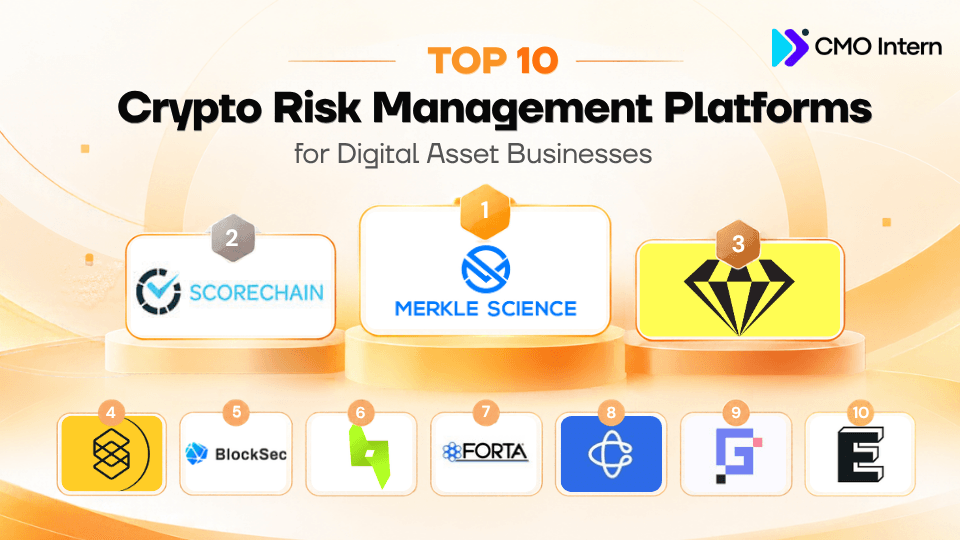
The top 10 crypto risk management platforms for digital asset businesses in 2026 provide the essential infrastructure to monitor blockchain transactions, detect market manipulation, and secure decentralized protocols. Digital asset businesses face a risk landscape that extends far beyond cryptocurrency price volatility. Suspicious fund flows, wallet exposure, market manipulation, smart contract exploits, liquidity shortages, and counterparty failures can all threaten financial stability and operational continuity. As crypto markets become more interconnected, managing these risks requires a combination of reliable data, specialized monitoring tools, and clearly defined response procedures.
For crypto exchanges, virtual asset service providers (VASPs), custodians, fintech companies, financial institutions, and decentralized finance (DeFi) protocols, defi community management platforms provide the infrastructure needed to identify potential threats, investigate suspicious activity, and make more informed decisions. Depending on the solution, these platforms can analyze blockchain transactions, assess wallet exposure, monitor trading behavior, detect on-chain threats, or model the economic resilience of decentralized protocols.
However, not every crypto risk management platform solves the same problem. Blockchain analytics providers help compliance teams trace transactions and evaluate financial crime exposure. Market surveillance platforms focus on suspicious trading behavior, while blockchain security tools monitor technical threats and potential exploits. DeFi risk specialists concentrate on collateral, liquidity, liquidation mechanisms, and protocol-level economic vulnerabilities.
Choosing the right solution therefore starts with understanding the risks a business needs to control.
This guide compares 10 crypto risk management platforms worth evaluating in 2026, highlighting their primary capabilities, practical applications, and key considerations for digital asset businesses. Rather than treating every provider as interchangeable, the comparison groups each platform according to its principal role in the digital asset risk management ecosystem.
Top 10 crypto risk management platforms for digital asset businesses in 2026
1. Merkle Science
Best for: Predictive blockchain analytics and digital asset risk intelligence

Merkle Science provides blockchain analytics and cryptocurrency risk intelligence designed to help digital asset businesses identify suspicious activity, investigate financial crime, and assess exposure to potentially high-risk entities. Its platform addresses several important areas of digital asset risk management, including transaction monitoring, forensic investigations, and crypto business due diligence.
A key consideration for compliance teams is that risk does not always originate from an address already identified as suspicious. Emerging scams, new transaction patterns, and indirect exposure to risky counterparties can create challenges for monitoring systems that rely exclusively on previously identified entities. Merkle Science incorporates behavioral and predictive risk intelligence to help organizations assess blockchain activity in a broader context.
Its capabilities are relevant to exchanges, payment providers, financial institutions, and other businesses that need to understand the origin and movement of cryptocurrency funds. The platform's intelligence solutions can also support due diligence on crypto businesses by combining on-chain indicators with relevant off-chain information.
Key capabilities:
Blockchain transaction monitoring and risk assessment.
Predictive and behavior-based risk intelligence.
Cryptocurrency investigations and transaction tracing.
Counterparty and vendor due diligence.
Risk reporting and configurable monitoring policies.
Why digital asset businesses should consider Merkle Science
Merkle Science is worth evaluating when a business needs to connect transaction-level monitoring with broader risk intelligence. Compliance teams can use blockchain analytics to investigate suspicious fund movements, while counterparty intelligence can support decisions about onboarding and ongoing business relationships.
For organizations managing substantial transaction volumes, these capabilities may help establish more structured investigation workflows and improve visibility into potential exposure.
Considerations: Buyers should assess supported networks and assets, attribution quality, monitoring latency, alert configuration, and integration requirements. Predictive risk indicators should be treated as inputs to a documented decision-making process, not as definitive proof of misconduct.
2. Scorechain
Best for: Crypto AML monitoring and blockchain transaction analytics
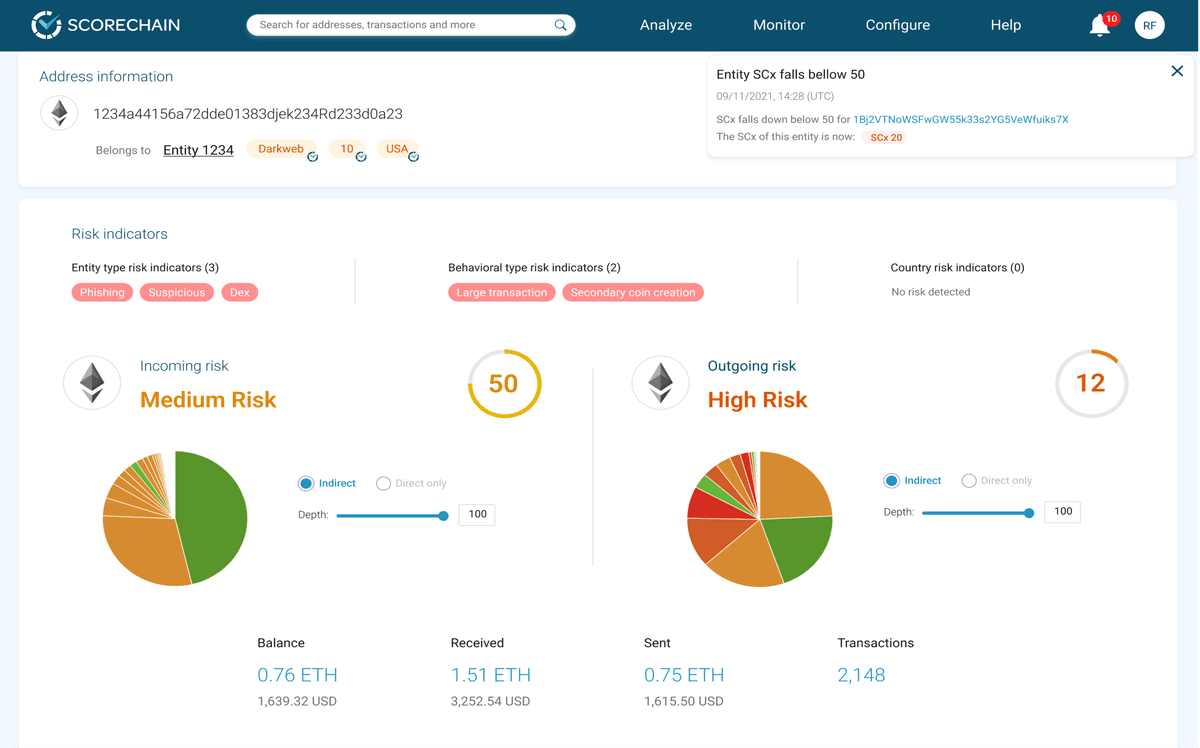
Scorechain specializes in blockchain analytics and crypto compliance solutions for businesses that need to monitor transactions, investigate wallet activity, and assess digital asset exposure. Its monitoring capabilities support continuous or periodic checks, configurable scenarios, and risk-based alerting.
For a crypto exchange or VASP, transaction risk rarely ends with a one-time wallet screening. A previously acceptable counterparty may develop new exposure, while transaction patterns may change as funds move between addresses and services. Ongoing monitoring helps compliance teams identify these changes and determine whether further investigation is necessary.
Scorechain's scenario-based approach is particularly relevant to organizations that need to align monitoring rules with internal risk policies. Instead of relying exclusively on a fixed set of thresholds, teams can evaluate whether their monitoring scenarios reflect their transaction flows, customer profiles, and operational requirements.
Key capabilities:
Real-time and periodic blockchain transaction monitoring.
Configurable scenarios for suspicious activity detection.
Wallet risk assessment and transaction analysis.
Blockchain investigation and exposure evaluation.
Compliance-oriented alerts and reporting workflows.
Why digital asset businesses should consider Scorechain
Scorechain is a relevant option for exchanges, financial institutions, and crypto payment providers seeking structured blockchain analytics and ongoing transaction monitoring. Its configurable monitoring approach can be useful for compliance teams that need to adapt controls to different customer segments and transaction types.
It may also suit businesses that want to connect risk detection with operational workflows rather than treat screening as an isolated activity.
Considerations: Evaluate the depth of blockchain coverage, available risk indicators, alert quality, case management functionality, and integration options. Businesses with significant DeFi exposure may also require specialized tools for protocol economics, collateral, and liquidity risk.
3. Crystal Intelligence
Best for: Blockchain investigations and cryptocurrency forensic analysis
Crystal Intelligence focuses on blockchain analytics and investigations, helping organizations trace cryptocurrency transactions, examine wallet relationships, and investigate potentially suspicious fund movements.
When a financial crime alert occurs, the initial transaction is often only one part of the problem. Investigators may need to reconstruct a series of transfers, identify related addresses, assess exposure to known entities, and document how funds moved through the blockchain. These tasks require investigative capabilities that go beyond a basic risk score.
Crystal Intelligence is relevant to organizations that need this deeper analytical perspective. Its blockchain intelligence tools support investigations into potentially illicit activity and can help risk teams build a clearer picture of transaction flows and connected entities.
For digital asset businesses, investigative depth is particularly valuable when responding to fraud reports, suspected theft, suspicious deposits, or requests for information from internal compliance teams and relevant authorities.
Key capabilities:
Cryptocurrency transaction tracing and visual investigation.
Analysis of blockchain addresses and transaction relationships.
Risk intelligence for suspicious fund movements.
Support for financial crime investigations.
Investigative reporting and exposure analysis.
Why digital asset businesses should consider Crystal Intelligence
Crystal Intelligence is worth considering when investigative workflows are central to a risk management program. Its focus is relevant to compliance analysts, financial crime investigators, and institutions that need to move from an initial alert toward a documented assessment of the underlying activity.
It can also complement transaction monitoring tools by providing deeper analytical capabilities for cases requiring additional scrutiny.
Considerations: Buyers should verify the provider's coverage of their required networks, the depth of entity attribution, the availability of ongoing monitoring, and the formats supported for investigation records and reports. Organizations should distinguish between a tool's ability to trace transactions and its ability to establish the identity or intent of the people behind them.
4. Solidus Labs
Best for: Crypto market surveillance and trading-related risk

Solidus Labs focuses on market integrity and risk monitoring across digital asset markets. Its solutions address trading surveillance, transaction monitoring, and related compliance workflows, making it relevant to businesses whose exposure extends beyond blockchain transfers into trading behavior and market conduct.
Crypto markets operate around the clock across centralized exchanges, decentralized venues, spot markets, and derivatives products. This fragmented environment can complicate the identification of suspicious activity, including wash trading, spoofing, insider-related behavior, and other potential forms of market abuse.
Solidus Labs approaches these challenges through surveillance designed for digital asset market structures. Its solutions can help organizations analyze trading activity alongside relevant transaction and behavioral signals, supporting a more contextual assessment of potential misconduct.
Key capabilities:
Crypto trade and market surveillance.
Detection of potentially suspicious trading patterns.
Transaction monitoring across relevant fiat and crypto flows.
Monitoring for risks involving tokens and digital asset markets.
Investigation workflows and compliance case management.
Why digital asset businesses should consider Solidus Labs
Solidus Labs is particularly relevant to exchanges, trading platforms, market makers, and other businesses that need to monitor market conduct. Its specialization can complement blockchain analytics tools by addressing trading-related risks that cannot be fully understood through wallet screening alone.
For organizations operating multiple trading venues or supporting different digital asset products, the ability to evaluate suspicious behavior across relevant data sources may be an important selection criterion.
Considerations: Buyers should confirm supported venues, asset classes, data feeds, surveillance scenarios, and reporting requirements. They should also determine how alerts are prioritized and how investigation outcomes are documented within existing compliance processes.
5. BlockSec
Best for: Blockchain security and smart contract risk management
BlockSec provides blockchain security solutions for Web3 businesses, including best AI agents for business use cases, smart contract security assessments, threat monitoring, and transaction-level protection capabilities through relevant products.
Unlike transaction screening tools that primarily assess financial crime exposure, blockchain security platforms address technical vulnerabilities and suspicious interactions with smart contracts. These risks can be significant for DeFi protocols, exchanges, and applications that manage assets through programmable on-chain infrastructure.
A smart contract vulnerability may allow an attacker to exploit protocol logic, while compromised permissions or abnormal contract interactions may expose user funds. Effective risk management therefore requires both preventive measures and monitoring that can help security teams identify threats during live operations.
BlockSec's security-focused capabilities are relevant to organizations seeking to assess vulnerabilities, monitor potential attacks, and improve incident response readiness.
Key capabilities:
Smart contract security audits and vulnerability assessment.
Blockchain security monitoring.
Analysis of suspicious transactions and exploit-related activity.
Transaction-level protection through applicable security products.
Technical support for Web3 security and incident investigation.
Why digital asset businesses should consider BlockSec
BlockSec is a relevant option for organizations that view technical security as a core part of digital asset risk management. It can be particularly useful for DeFi teams that need to combine smart contract assessments with ongoing security monitoring.
Its role differs from that of a conventional crypto AML platform: the primary objective is to identify and mitigate technical threats rather than independently determine the financial crime risk of every transaction.
Considerations: A security audit cannot guarantee that a protocol will remain secure, and monitoring cannot eliminate every exploit scenario. Buyers should review the scope of audits, supported chains, monitoring coverage, response mechanisms, and the responsibilities assigned to internal security teams.
6. Hypernative
Best for: Real-time on-chain threat detection
Hypernative focuses on real-time blockchain threat detection and proactive risk monitoring for Web3 applications and digital asset protocols. Its approach is designed to help security teams identify potentially harmful activity and respond before an incident develops further.
In on-chain environments, timing matters. Suspicious contract interactions, unusual transactions, compromised permissions, and exploit-related behavior can escalate quickly. Once transactions are confirmed, recovering affected assets may be difficult or impossible. Organizations therefore need monitoring systems that can surface relevant signals quickly and support a predefined response process.
Hypernative's monitoring capabilities are relevant to protocols and Web3 businesses seeking earlier visibility into potential threats. Depending on the deployment, alerts can support investigation, escalation, and security operations.
Key capabilities:
Real-time on-chain threat monitoring.
Detection of potentially suspicious blockchain activity.
Alerts for exploit-related signals and emerging threats.
Security monitoring for Web3 protocols and applications.
Support for incident response workflows.
Why digital asset businesses should consider Hypernative
Hypernative is worth evaluating when proactive threat detection is a priority. It may be particularly relevant to organizations that operate continuously and cannot rely on periodic security reviews to identify risks in live blockchain activity.
For businesses with substantial on-chain exposure, the ability to connect detection signals with clear escalation and response procedures can be an important part of operational resilience.
Considerations: Evaluate detection latency, supported networks, alert precision, response integrations, and the amount of manual investigation required. Buyers should also clarify which response actions are available for their specific configuration rather than assuming every alert can trigger an automatic protective action.
7. Forta
Best for: Decentralized blockchain monitoring and specialized threat detection
Forta provides blockchain monitoring infrastructure and a decentralized ecosystem of detection mechanisms designed to identify security threats and other suspicious on-chain activity.
Different blockchain applications face different threats. A lending protocol may need to monitor unusual borrowing behavior, while a decentralized exchange may be more concerned about abnormal liquidity movements or transactions associated with potential exploits. A flexible monitoring approach allows security teams to focus on the scenarios most relevant to their applications.
Forta is relevant to organizations that want programmable monitoring capabilities and access to specialized detection mechanisms. Its ecosystem can help developers and security teams incorporate blockchain monitoring into their broader operational workflows.
Key capabilities:
Monitoring of blockchain transactions and smart contract activity.
Detection mechanisms for security threats and suspicious behavior.
Specialized monitoring logic for different application scenarios.
Support for Web3 developers and security teams.
Integration of relevant monitoring signals into operational workflows.
Why digital asset businesses should consider Forta
Forta may be suitable for technically capable teams that need application-specific monitoring rather than relying exclusively on a single centralized analytics interface. Its detection ecosystem can be useful when organizations want to tailor monitoring to their protocol architecture and threat model.
It is also worth considering for teams that need monitoring signals to complement existing security and incident response systems.
Considerations: Actual detection coverage depends on the monitors, rules, and integrations deployed. Organizations should evaluate the availability and maintenance of relevant detection mechanisms, the quality of alerts, and the engineering effort required to translate monitoring signals into actionable controls.
8. Chaos Labs
Best for: DeFi economic risk modeling and protocol resilience
Chaos Labs specializes in economic risk management for decentralized finance. Its work focuses on helping protocols understand how collateral, liquidity, market conditions, user behavior, and financial parameters interact under different scenarios.
DeFi risk is not limited to cyberattacks or suspicious transactions. Lending markets may accumulate bad debt when collateral values fall sharply, liquidation mechanisms may become less effective during periods of low liquidity, and poorly calibrated parameters can amplify losses during market stress.
These challenges require quantitative analysis and scenario testing. Chaos Labs helps DeFi teams evaluate protocol behavior and make more informed decisions about risk parameters, market configurations, and economic resilience.
Key capabilities:
Quantitative analysis of DeFi protocol risk.
Economic simulation and stress testing.
Assessment of collateral and lending-market exposure.
Analysis of protocol parameters under changing market conditions.
Support for risk monitoring and protocol resilience.
Why digital asset businesses should consider Chaos Labs
Chaos Labs is relevant to lending protocols and other DeFi applications where financial design and market behavior are major sources of risk. Its specialization can help teams examine how adverse conditions affect protocol solvency, liquidation dynamics, and overall risk exposure.
For projects that manage lending markets or other complex financial mechanisms, economic modeling can complement smart contract audits and transaction monitoring.
Considerations: Model results depend on assumptions, data quality, and the scenarios evaluated. Buyers should understand how models are validated, which market conditions are included, and how recommendations are translated into governance decisions and operational controls.
9. Gauntlet
Best for: Quantitative DeFi risk analysis and parameter optimization
Gauntlet focuses on quantitative modeling and risk management for decentralized financial protocols. Its work helps protocol teams evaluate the trade-offs between capital efficiency, liquidity, growth, and financial resilience.
In decentralized lending markets, for example, collateral factors and liquidation thresholds influence how much users can borrow and how a protocol responds when asset prices change. Conservative settings may limit capital utilization, while aggressive settings can increase exposure to bad debt and liquidation risk.
Gauntlet uses quantitative analysis and simulation to help organizations understand these trade-offs. Its approach is relevant to protocol teams that need to assess the effects of parameter changes and improve risk decisions using modeled scenarios rather than relying solely on intuition or historical performance.
Key capabilities:
Quantitative DeFi risk modeling.
Simulation of protocol behavior under different market conditions.
Analysis of collateral, liquidity, and liquidation dynamics.
Support for risk parameter recommendations.
Economic risk assessment for decentralized financial markets.
Why digital asset businesses should consider Gauntlet
Gauntlet is worth evaluating when risk management requires a detailed understanding of financial mechanisms within a protocol. Its quantitative approach can help teams evaluate potential consequences before adjusting parameters that influence lending capacity, liquidation behavior, or market stability.
It may be particularly relevant to protocols seeking to balance financial efficiency with prudent risk controls.
Considerations: Quantitative models cannot anticipate every market shock, adversarial strategy, or governance decision. Organizations should review model assumptions, validation methods, scenario coverage, and the process used to approve and implement recommended changes.
10. Elliptic
Best for: Blockchain analytics, transaction monitoring, and institutional risk reporting
Elliptic provides blockchain analytics and digital asset risk intelligence for crypto businesses and financial institutions. Its capabilities include wallet and transaction screening, ongoing monitoring, blockchain investigations, and analysis of exposure to potentially illicit activity.
As digital asset operations expand across networks, bridges, exchanges, and decentralized applications, assessing risk at the level of a single wallet or transaction may not provide a complete picture. Institutions also need to understand how exposure develops across their broader portfolio and whether risk trends are changing over time.
Elliptic supports these requirements through blockchain intelligence and monitoring workflows. Its platform can help compliance teams investigate transactions, assess exposure, and provide risk information that supports operational decisions and institutional oversight.
Key capabilities:
Wallet screening and transaction monitoring.
Blockchain investigations and transaction tracing.
Cross-chain risk analysis, subject to supported coverage.
Assessment of digital asset exposure.
Portfolio-level risk reporting for institutional oversight.
Why digital asset businesses should consider Elliptic
Elliptic is relevant to organizations seeking blockchain analytics that support both operational compliance and broader risk oversight. Its portfolio-level reporting capabilities may be especially useful to financial institutions that need to communicate digital asset exposure to senior management, risk committees, and other governance stakeholders.
For compliance teams, the combination of screening, monitoring, and investigation capabilities can support a more structured approach to managing cryptocurrency-related financial crime risk.
Considerations: Buyers should verify coverage for their required networks and assets, the availability of cross-chain tracing, risk attribution detail, integration requirements, and reporting flexibility. Institutions should also ensure that analytical outputs are incorporated into their own risk assessments and governance processes.
How to Choose the Right Crypto Risk Management Software
The best crypto risk management software is not necessarily the platform with the longest feature list. It is the solution that addresses an organization's most material risks while fitting its operating model, technical infrastructure, and control requirements.
Before selecting a provider, digital asset businesses should evaluate the following factors.
Identify Your Primary Risk Exposure
Start by determining which risks create the greatest potential financial, operational, regulatory, or reputational impact.
Financial crime and transaction risk: Prioritize wallet screening, transaction monitoring, risk scoring, and investigation workflows.
Trading and market integrity: Focus on surveillance capabilities, trading behavior analysis, and relevant venue coverage.
Smart contract and on-chain security: Evaluate threat detection, vulnerability assessment, monitoring latency, and incident response.
DeFi economic risk: Look for collateral analysis, liquidity modeling, stress testing, and parameter optimization.
Institutional and counterparty risk: Assess exposure reporting, due diligence, portfolio-level monitoring, and auditability.
Businesses exposed to several risk categories may need multiple complementary tools rather than a single all-purpose platform.
Evaluate Blockchain and Asset Coverage
Confirm that a vendor supports the networks, tokens, bridges, and transaction types used by your business. Broad network coverage is useful, but coverage alone does not guarantee that a platform provides sufficient attribution, contextual intelligence, or investigation depth.
Ask vendors to demonstrate how they handle your actual transaction flows, including cross-chain activity and interactions with relevant decentralized applications.
Assess Detection Quality and Alert Management
A high volume of alerts does not automatically mean better risk management. Poorly prioritized alerts can overwhelm compliance and security teams, delaying investigations into more consequential threats.
Evaluate how the platform prioritizes alerts, supports configurable rules, explains risk indicators, and helps analysts distinguish between routine activity and behavior that requires further investigation. Where possible, test the system using representative scenarios from your operating environment.
Review Integration and Response Capabilities
Risk management software should work with existing systems, such as custody infrastructure, transaction processing, compliance case management, security monitoring, and internal reporting tools.
For time-sensitive risks, determine whether the platform only provides alerts or also supports additional response mechanisms through its available integrations. Clarify which actions are automated, which require human approval, and how decisions are recorded.
Consider Scalability and Total Cost of Ownership
Pricing may depend on transaction volume, selected modules, supported networks, API usage, deployment requirements, and service agreements. The total cost also includes implementation, engineering resources, staff training, monitoring-rule maintenance, and investigation workloads.
A solution that appears inexpensive initially may require substantial internal resources to operate effectively. Evaluate the full cost of ownership against the risks the platform is expected to mitigate.
Examine Governance, Auditability, and Regulatory Fit
For regulated businesses, risk monitoring must support documented decisions and appropriate oversight. Assess access controls, audit records, investigation evidence, reporting capabilities, and the transparency of risk indicators.
The platform should fit the organization's legal obligations and internal risk policies. Using a vendor can strengthen a compliance program, but it does not automatically establish compliance with every applicable regulation.
Frequently Asked Questions
1. What is a crypto risk management platform?
A crypto risk management platform is software that helps digital asset businesses identify, assess, monitor, and respond to risks associated with cryptocurrency transactions, blockchain activity, trading, smart contracts, or decentralized financial protocols. Depending on its specialization, it may provide transaction monitoring, wallet screening, market surveillance, threat detection, economic modeling, or investigative tools.
2. Why do digital asset businesses need crypto risk management software?
Digital asset businesses face risks that can develop quickly, including suspicious transactions, fraud, sanctions exposure, smart contract vulnerabilities, liquidity stress, and counterparty risk. Specialized software helps teams identify relevant signals, investigate potential incidents, document decisions, and apply controls consistently. Its effectiveness depends on appropriate configuration, human oversight, and well-defined operational procedures.
3. What is the difference between blockchain analytics and crypto risk management?
Blockchain analytics focuses on collecting and interpreting blockchain data, including transaction flows, wallet relationships, and entity exposure. Crypto risk management is broader: it uses analytics alongside risk policies, monitoring procedures, investigation workflows, security controls, and governance to manage potential threats. Blockchain analytics is therefore one important component of a comprehensive risk management framework.
4. Are crypto compliance platforms and DeFi risk management tools the same?
No. Crypto compliance platforms generally focus on financial crime risks, wallet screening, transaction monitoring, sanctions exposure, and investigations. web3 brand management tools concentrate more heavily on economic resilience, collateral, liquidity, liquidation mechanisms, and protocol parameters. Businesses operating across both regulated financial services and decentralized protocols may need capabilities from both categories.
5. Can one platform manage every type of crypto risk?
Not necessarily. Crypto risk encompasses distinct disciplines that require different data, analytical methods, and controls. A transaction monitoring platform may not provide the economic simulations needed by a lending protocol, while a smart contract monitoring tool may not satisfy an exchange's market surveillance requirements. A combination of specialized platforms may provide more appropriate coverage.

