
.webp)
.png)
Selecting the right partner from the top 10 digital banking software development companies for financial institutions is a critical decision that directly impacts customer experience and long-term operational flexibility. Digital banking has evolved beyond simple mobile applications; financial institutions now require integrated digital experiences, secure transaction processing, and automated workflows that connect seamlessly with existing financial technology. For banks, credit unions, and fintech businesses, the right development partner provides the architectural expertise necessary to modernize legacy infrastructure and build scalable, compliant banking solutions.
Digital banking software development companies help financial institutions build new banking applications, modernize legacy infrastructure, integrate financial services, and develop technology tailored to their business models. Depending on the provider, services may include web development agencies, digital onboarding, payment processing, lending systems, API development, cloud engineering, and ongoing software maintenance.
However, not every provider serves the same purpose. Some specialize in custom software engineering for regulated financial environments, while others offer banking platforms, reusable financial technology components, or modular solutions that reduce the need to build everything from scratch. Understanding these differences is essential when evaluating potential partners.
This article explores nine digital banking software development companies worth considering, including established fintech specialists and technology providers with relevant banking capabilities. The selection focuses on industry relevance, publicly presented service offerings, and potential project fit rather than claiming that one company is universally superior to another.
What Makes a Digital Banking Software Development Company Worth Considering?
Financial institutions should evaluate potential partners against the requirements of their intended banking products rather than relying on general software development credentials. A company experienced in consumer mobile applications, for example, may not necessarily have the architectural expertise required to develop a transaction-processing platform or integrate with an established core banking system.
Several considerations are particularly important when comparing digital banking software development companies:
Banking and fintech expertise: Experience with financial workflows, account management, payments, lending, digital onboarding, and transaction processing can help teams address domain-specific requirements.
Security and regulatory considerations: Providers should be able to explain their approach to data protection, access controls, auditability, secure development, and applicable regulatory obligations. Compliance remains a shared responsibility and must be verified for each engagement.
Integration capabilities: Digital banking projects frequently involve core banking systems, payment networks, identity verification services, customer relationship management platforms, and third-party APIs.
Architecture and scalability: Institutions should assess whether a proposed solution supports their expected transaction volumes, deployment requirements, resilience objectives, and future product expansion.
Customization and ownership: The appropriate balance between custom development, reusable components, source-code access, and vendor-managed infrastructure depends on the institution's technical strategy.
Long-term support: Testing, monitoring, maintenance, incident response, and future enhancements are important considerations for software that supports essential financial services.
The companies below represent different approaches to these requirements, so the most suitable option will depend on the institution's existing infrastructure, budget, internal engineering resources, and delivery objectives.
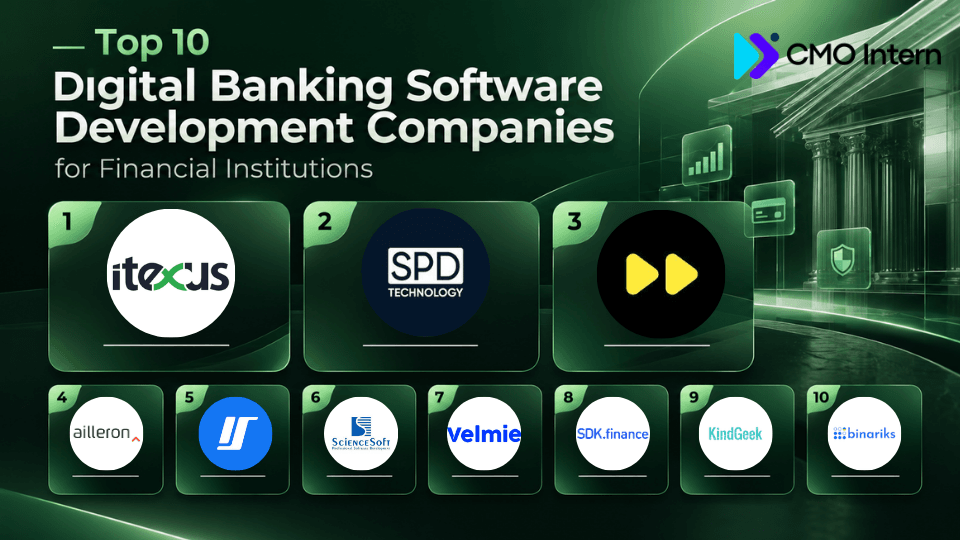
Top 10 Digital Banking Software Development Companies for Financial Institutions
The following companies are presented as a curated shortlist, not a strict performance ranking. They include custom development partners and specialized banking technology providers, each with a different emphasis. Financial institutions should validate relevant project references, delivery capabilities, security practices, and contractual terms before making a final decision.
1. Itexus
Itexus is a software development company focused on fintech and financial services applications. Its specialization makes it relevant to organizations that need custom financial software rather than a standardized banking product with limited room for adaptation. The company works across several financial technology areas, including banking, payments, lending, trading, and wealth management.
For digital banking projects, Itexus is worth evaluating when the scope involves developing a customer-facing banking application alongside the supporting business logic, integrations, and administrative functionality. Depending on the project, this may include mobile banking, digital wallets, customer onboarding, financial dashboards, and connections to external financial services.
Key areas to evaluate:
Custom banking and fintech application development.
Mobile and web applications for financial services.
Payment, lending, and digital wallet functionality.
Financial data processing and third-party integrations.
Modernization and enhancement of existing financial applications.
Why consider Itexus? Its financial technology focus is relevant to banks and fintech businesses that require tailored software and domain-specific engineering support. Institutions should assess the team's experience with comparable banking workflows, production deployments, integration complexity, and security requirements before selecting it for a regulated project.
Best suited for: Financial institutions and fintech companies seeking custom-built banking applications or enhancements to existing financial products.
2. SPD Technology
SPD Technology is a software engineering company with experience across complex digital products and financial technology. It is relevant to organizations that require a development partner capable of combining application engineering with broader architectural, data, and system integration work.

Digital banking transformation frequently involves more than replacing an outdated interface. Institutions may need to connect multiple internal systems, restructure data flows, improve operational processes, or introduce new digital services without disrupting established banking operations. A development partner must understand how individual software components interact within the larger technology environment.
SPD Technology is worth considering for projects where banking software development intersects with enterprise engineering, modernization, and the delivery of business-critical systems. Its fit should be assessed against the specific banking components required, particularly when a project involves complex integrations or an established technology estate.
Key areas to evaluate:
Custom software engineering for financial services.
Digital product development and system integration.
Enterprise application modernization.
Data engineering and analytics capabilities.
Cloud infrastructure and software delivery practices.
Why consider SPD Technology? It offers an engineering-oriented option for institutions whose requirements extend beyond a standalone mobile banking application. Buyers should confirm the proposed team's direct experience with banking systems, regulated workloads, and the institution's required implementation model.
Best suited for: Financial institutions pursuing complex digital transformation initiatives or custom software projects involving multiple interconnected systems.
3. DashDevs
DashDevs is a fintech-focused software development company that works with financial products and digital financial infrastructure. It is particularly relevant to organizations exploring new fintech propositions, including digital banking experiences, payment-related services, and products that require a combination of application development and financial backend capabilities.

Launching a digital bank or introducing a new banking feature involves several interconnected layers. The user interface must communicate account information clearly, while backend services manage business rules, transaction workflows, integrations, and data. Where applicable, identity verification, payment processing, and third-party financial services must also fit into the overall architecture.
DashDevs is worth evaluating when a financial institution needs a partner that understands the relationship between customer-facing fintech products and the infrastructure supporting them. Its suitability for a particular project will depend on the required banking functionality, the existing core system, and the degree of customization involved.
Key areas to evaluate:
Fintech product design and software development.
Digital banking and financial application development.
Payment and account-related functionality.
Backend architecture and third-party integrations.
Product development for new digital financial services.
Why consider DashDevs? Its fintech orientation makes it relevant to institutions that want to develop or extend digital financial products with specialized engineering support. During evaluation, buyers should request examples of comparable production systems and clarify which banking components the company would build directly.
Best suited for: Banks, fintech startups, and financial service providers developing new digital products or extending existing financial platforms.
4. Ailleron
Ailleron is a technology provider known for its focus on financial services software and digital banking experiences. Its relevance lies in the intersection of banking technology, customer-facing digital channels, and the software needed to support interactions between financial institutions and their customers.

Customer expectations have changed significantly as mobile applications have become a primary channel for checking balances, reviewing transactions, managing accounts, and accessing financial services. Banks must provide consistent experiences across digital touchpoints while maintaining appropriate security and integration with their underlying systems.
Ailleron is worth considering for institutions evaluating digital banking applications and broader customer experience modernization. The scope of a potential engagement should be clarified carefully: improving digital channels is not necessarily the same as replacing the underlying core banking system, and the two initiatives may require different vendors or complementary technologies.
Key areas to evaluate:
Digital banking solutions for financial institutions.
Customer-facing banking applications and digital channels.
Banking experience and service workflow modernization.
Integration with existing financial systems.
Digital product development and implementation support.
Why consider Ailleron? Its financial services orientation makes it relevant to banks seeking to improve how customers access and use banking services. Institutions should determine whether their main requirement is a digital engagement layer, custom application engineering, core modernization, or a combination of these capabilities.
Best suited for: Banks and financial institutions focused on modernizing digital customer experiences and banking service delivery.
5. Intellectsoft
Intellectsoft is a software engineering and technology consulting company serving organizations with complex digital product and enterprise technology requirements. Its broader engineering capabilities make it a potential candidate for financial institutions that need custom software development, integration, and modernization support.
Banking organizations often operate a mixture of established platforms, internal applications, and newer cloud-based services. Introducing a digital banking product into this environment requires careful consideration of data consistency, authentication, system dependencies, deployment architecture, and ongoing maintenance. A development partner must understand not only how to build a new application but also how it will operate within the institution's existing environment.
Intellectsoft is worth evaluating when a digital banking initiative requires custom engineering alongside broader technology consulting. However, its general software development capabilities should not be treated as proof of experience with every banking product or regulatory framework. Institutions should verify the specific expertise of the team assigned to their project.
Key areas to evaluate:
Custom enterprise software development.
Financial application development and integration.
Cloud engineering and application modernization.
API development and connected digital services.
Technical consulting and ongoing software support.
Why consider Intellectsoft? Its enterprise software engineering orientation may suit institutions with complex integration or modernization needs. Buyers should examine the proposed architecture, banking-specific delivery experience, and responsibility boundaries for security and compliance.
Best suited for: Financial institutions that need a custom technology solution spanning application development, integration, and enterprise modernization.
6. ScienceSoft
ScienceSoft is an established IT consulting and software development company with experience across enterprise systems and multiple regulated or business-critical industries, including financial services. It is relevant to institutions seeking a development partner for custom applications, system integration, software quality assurance, or the modernization of existing technology.

For banks, modernization projects can involve improving a legacy application without replacing every underlying component. Other initiatives may require a new digital interface, a redesigned data architecture, or integration between existing banking software and new customer-facing services. In these situations, the ability to assess the current system before proposing changes can be as important as the ability to develop new functionality.
ScienceSoft is worth considering when an institution needs a structured software engineering engagement with attention to architecture, testing, and maintainability. Its broader industry presence means that financial institutions should specifically confirm the team's banking experience rather than assume every service offering is equally specialized in banking.
Key areas to evaluate:
Custom software development for financial services.
Application modernization and legacy system integration.
Software testing and quality assurance.
Data management and business intelligence.
Cloud adoption and enterprise application support.
Why consider ScienceSoft? Its range of software engineering and IT consulting capabilities may be useful for institutions managing several connected modernization requirements. Project proposals should identify the banking-specific deliverables, testing responsibilities, support model, and approach to handling sensitive financial data.
Best suited for: Banks and financial organizations modernizing existing systems or developing custom applications that must integrate with an established enterprise environment.
7. Velmie
Velmie focuses on digital banking and fintech technology, making it relevant to organizations that want a more product-oriented approach to launching financial services. Rather than treating every component as a completely new development project, financial technology providers in this category can offer reusable capabilities that may be configured or extended to meet a particular business model.
This approach can be useful for institutions developing digital banking services, neobank propositions, or financial products that combine account functionality, payments, and customer-facing applications. The practical advantages depend on how well the available components align with the institution's requirements and how much additional engineering or integration is needed.
Velmie is worth considering when a financial institution wants to evaluate modular banking technology alongside the option of fully custom software development. Buyers should clarify which capabilities are available as standard, which require customization, and which depend on external banking, payment, or compliance partners.
Key areas to evaluate:
Digital banking and fintech software.
Modular banking application capabilities.
Mobile and web banking experiences.
Integration with external financial infrastructure.
Customization and implementation requirements.
Why consider Velmie? Its banking-focused technology offering is relevant to organizations seeking reusable financial software rather than building every feature independently. Institutions should assess deployment flexibility, integration options, licensing arrangements, source-code access, and the responsibilities retained by the financial institution.
Best suited for: Digital banks, fintech businesses, and financial institutions exploring modular or configurable banking technology.
8. SDK.finance
SDK.finance provides financial technology software and infrastructure designed for banking-related products, payments, and digital financial services. Its approach combines a reusable software foundation with customization options, making it relevant to organizations that want to accelerate product development without independently building every backend component.
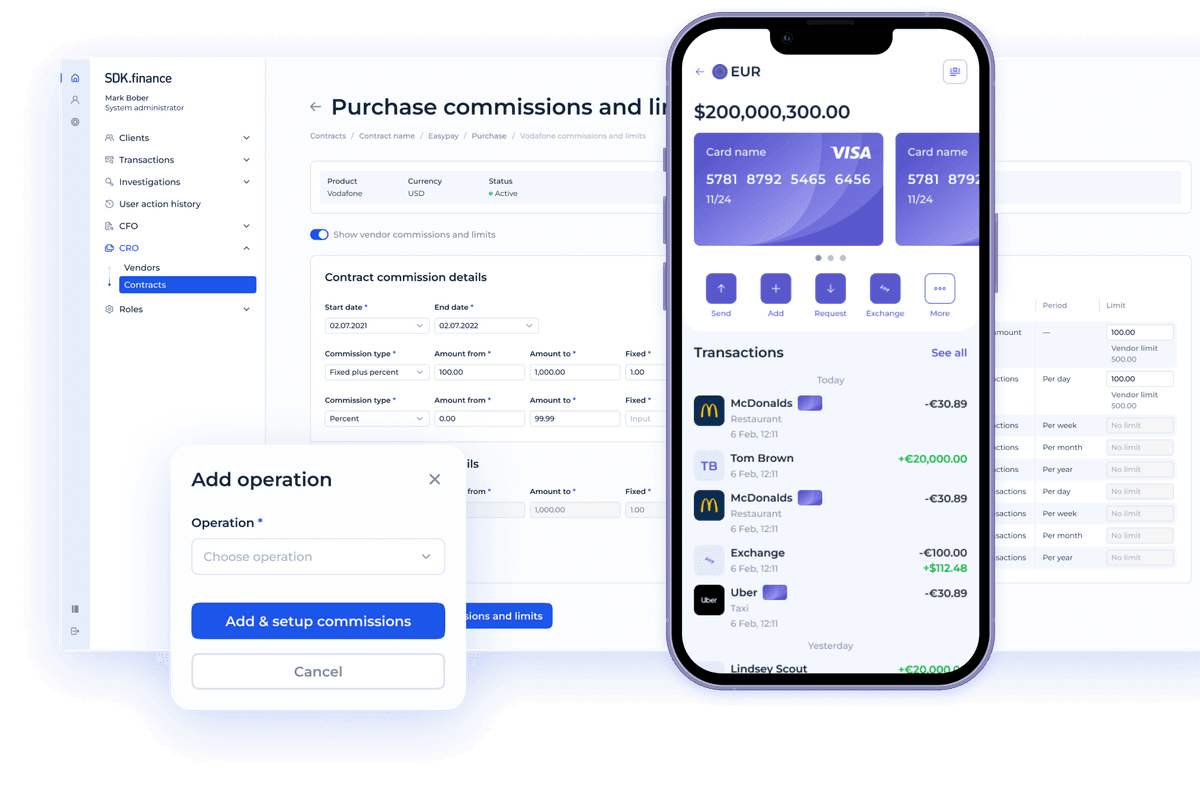
A digital banking platform often requires multiple interconnected functions, including transaction processing, account management, payment workflows, digital wallets, and administrative tools. Developing these capabilities from the ground up can create substantial engineering and maintenance responsibilities. A reusable financial technology foundation can offer an alternative, provided its architecture and available functions match the institution's requirements.
SDK.finance is worth considering for organizations evaluating prebuilt financial software, configurable infrastructure, or a hybrid approach that combines existing components with custom development. It is important to distinguish this model from a conventional software development engagement in which the vendor builds an entirely bespoke system.
Key areas to evaluate:
Digital banking and financial software infrastructure.
Payment processing and transaction-related functionality.
Digital wallet and account-based financial products.
APIs and integration with other financial services.
Customization and software licensing options.
Why consider SDK.finance? Its reusable financial technology foundation may be relevant to teams that want greater control over product development while reducing the need to build every backend component independently. Buyers should examine the available modules, source-code and licensing terms, integration effort, and operational responsibilities before choosing this approach.
Best suited for: Fintech companies, payment providers, and financial institutions building account-based products or evaluating configurable financial software infrastructure.
9. Kindgeek
Kindgeek is a software development company with a focus on fintech and digital product engineering. It is relevant to organizations that need a combination of financial domain knowledge, custom application development, and support in translating a business concept into a working digital product.

Financial institutions developing new banking services must make decisions about product scope, user experience, backend architecture, integrations, and the long-term maintainability of the solution. For smaller institutions and fintech businesses, a development partner may also need to support product discovery and technical planning before implementation begins.
Kindgeek is worth evaluating for projects where the requirements call for tailored fintech software rather than the adoption of a single standardized banking platform. Institutions should establish whether the company has delivered projects with comparable transaction flows, integration complexity, security needs, and operational expectations.
Key areas to evaluate:
Custom fintech software development.
Digital financial product engineering.
Mobile and web application development.
Backend development and system integration.
Product discovery, testing, and ongoing enhancement.
Why consider Kindgeek? Its fintech-oriented development approach may fit organizations that need engineering support throughout the digital product lifecycle. As with any potential banking software partner, its precise role should be established through project references, technical discussions, and a clear definition of deliverables.
Best suited for: Fintech businesses and financial institutions developing tailored digital products or extending existing financial applications.
10. Binariks
Binariks is a software engineering and technology consulting company that works with organizations in financial services and other industries with complex technical requirements. Its fintech-related capabilities make it a relevant option for financial institutions looking for support with custom software development, backend engineering, cloud solutions, and integrations across financial systems.

Digital banking projects often involve interconnected components, including customer-facing applications, account services, payment workflows, identity verification, and existing core banking infrastructure. Developing these components requires careful architectural planning to ensure that information moves reliably between systems and that new functionality can be maintained as the institution grows.
Binariks is worth evaluating for projects that require a combination of financial technology expertise and broader software engineering capabilities. Its potential role may extend beyond building a standalone banking application to supporting the underlying services, integrations, and infrastructure needed to operate a digital financial product. The exact scope should be confirmed against the institution's requirements and the team's relevant project experience.
Key areas to evaluate:
Custom software engineering for financial services.
Backend development and financial platform integrations.
Cloud engineering and application modernization.
API development and connected digital services.
Software testing, quality assurance, and ongoing technical support.
Why consider Binariks? Its combination of software engineering and financial technology experience makes it worth considering for institutions that need tailored development rather than a fully standardized banking product. Buyers should verify the team's direct experience with digital banking workflows, transaction processing, data security, and integration with their existing core banking systems.
Best suited for: Financial institutions and fintech businesses seeking custom financial software, backend engineering, or modernization and integration support for digital banking initiatives.
How to Choose the Right Digital Banking Software Development Partner
Choosing among digital banking software development companies requires more than comparing service descriptions. The right partner depends on whether the institution needs a new banking platform, an improved customer interface, a replacement for legacy infrastructure, or a specialized application connected to existing systems.
1. Define the Banking Product Before Evaluating Vendors
Start by identifying the capabilities the project must deliver. A mobile banking application, a digital onboarding system, a lending platform, and a core banking replacement have substantially different technical requirements. Defining the scope early helps institutions avoid selecting a provider whose principal strengths do not align with the actual project.
2. Distinguish Custom Development From Ready-Made Platforms
Custom development offers greater control over functionality and architecture, but it also places more responsibility on the institution and its development partner. A reusable platform can reduce the amount of foundational software that must be built, although configuration, integration, licensing, and ongoing support still require careful planning.
Institutions should ask vendors which components are available out of the box, which require customization, and which depend on third-party providers. This distinction is particularly important when comparing engineering firms with companies that supply their own banking software.
3. Assess Security, Compliance, and Operational Resilience
Security should be considered from the earliest stages of architecture and development. Relevant evaluation areas include identity and access management, encryption, secure coding, audit trails, vulnerability management, data handling, backup and recovery, and incident response.
Financial institutions must also identify the regulations and supervisory requirements applicable to their jurisdictions and products. A vendor's general experience in fintech does not automatically establish compliance with a particular regulatory framework. Request appropriate evidence, define responsibilities contractually, and involve internal security, compliance, and risk teams before implementation.
For those in the crypto space, it is also vital to partner with digital identity verification companies to ensure robust KYC/AML compliance.
4. Evaluate Integration and Migration Requirements
A new digital banking application may need to communicate with core banking software, payment systems, customer databases, fraud monitoring services, identity verification providers, and reporting tools. Integration complexity can significantly affect delivery schedules, budgets, and operational risk.
For modernization projects, request a clear migration plan covering data mapping, reconciliation, testing, rollback procedures, and continuity of service. A technically sound new application will not deliver the intended value if it cannot interact reliably with the institution's existing systems.
5. Review the Commercial and Support Model
The initial development budget is only one component of the total cost of ownership. Institutions should also consider licensing, cloud infrastructure, third-party services, security assessments, maintenance, future enhancements, and vendor exit costs.
Before signing a contract, clarify intellectual property ownership, source-code access, service-level commitments, documentation requirements, support availability, subcontracting arrangements, and the process for transferring the system to another provider. These details are especially important for mission-critical financial software.
Key Trends Shaping Digital Banking Software Development
API-First and Modular Banking Architecture
Financial institutions increasingly need technology that can connect different services without requiring every component to be replaced simultaneously. API-based integration and modular architecture can help organizations introduce new functionality while retaining selected existing systems. However, modularity also introduces dependencies that must be governed through clear interface standards, version management, and monitoring.
Cloud-Native Development and Legacy Modernization
Cloud-based architectures can support flexible infrastructure management and more frequent software releases, depending on the institution's operational model and regulatory requirements. For established banks, modernization may involve a gradual transition rather than a complete system replacement. Hybrid deployments, phased migration, and carefully defined service boundaries can be relevant options where legacy systems remain essential to daily operations.
Mobile-First and Omnichannel Banking
Mobile applications are an important part of the digital banking experience, but customers may also interact with their bank through web portals, contact centers, and branch services. Institutions increasingly need consistent information and workflows across these channels. Development teams should consider accessibility, usability, authentication, and continuity between customer touchpoints rather than treating each channel as an isolated product.
Automation, Analytics, and AI-Assisted Services
Automation and data analytics can support customer service, operational workflows, fraud investigation, and personalized financial experiences. AI-assisted functionality may also introduce new considerations involving data quality, explainability, privacy, and human oversight. Financial institutions should evaluate these capabilities according to a clearly defined use case and an appropriate risk-management framework instead of adopting them solely as technology trends.
Frequently Asked Questions
1. What do digital banking software development companies do?
Digital banking software development companies help financial institutions design, build, integrate, test, and maintain digital financial systems. Depending on their specialization, they may develop mobile and web banking applications, digital onboarding, payment systems, lending platforms, financial APIs, or core banking components. Some also provide reusable banking software that can be configured for a particular institution.
2. How much does digital banking software development cost?
The cost depends on the project's scope, architecture, integrations, security requirements, deployment model, and maintenance obligations. A focused customer-facing application generally has a different cost profile from a full digital banking platform or a core banking modernization program. Institutions should request itemized proposals that distinguish development, licensing, infrastructure, third-party services, testing, and ongoing support.
3. How long does it take to develop digital banking software?
Timelines vary according to product complexity, integration requirements, regulatory reviews, and the availability of internal stakeholders. A limited application or initial product release may be achievable much sooner than a full banking platform that requires extensive migration and multiple external integrations. A credible delivery plan should include discovery, architecture, testing, security reviews, deployment, and post-launch support rather than focusing exclusively on coding time.
4. What is the difference between a digital banking platform and custom banking software development?
A digital banking platform provides a defined set of banking capabilities that an institution can adopt, configure, or extend. Custom banking software development involves engineering software to meet specific business and technical requirements. The approaches can also be combined: an institution might use a reusable financial backend while commissioning custom mobile applications, integrations, or workflows.
5. What should financial institutions look for in a banking software development company?
Institutions should assess relevant banking experience, technical architecture, security practices, integration capabilities, delivery processes, support arrangements, and commercial terms. They should also request references from comparable projects and establish which responsibilities remain with the vendor, the institution, and any third-party providers. Evidence of successful work in a related industry is useful, but it does not replace verification of the requirements for a particular banking project.

