
.webp)
.png)
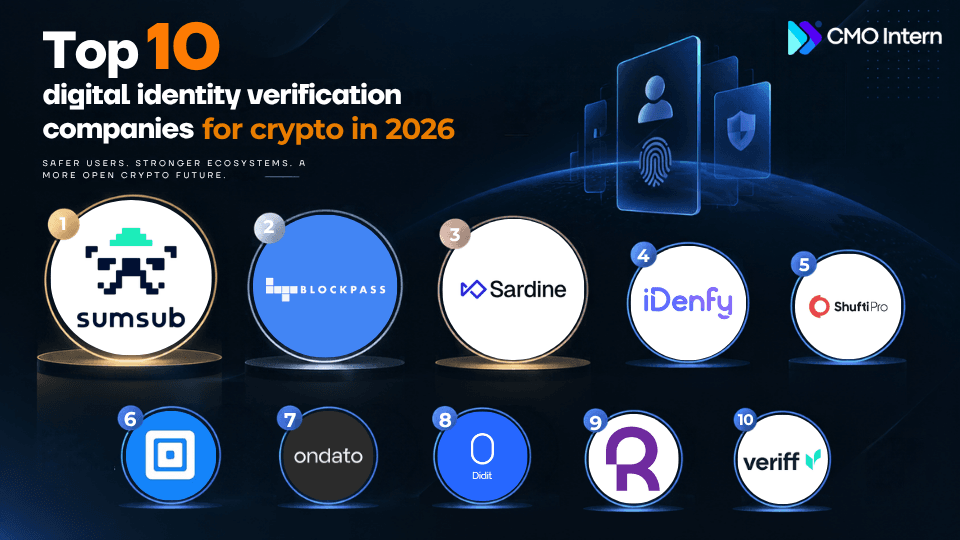
For crypto exchanges, wallets, DeFi platforms, and other digital-asset businesses facing stricter KYC and AML requirements, selecting the right identity verification partner is crucial. This guide presents the Top 10 digital identity verification companies for crypto in 2026, focusing on providers that offer robust solutions for ID authentication, biometric checks, liveness detection, sanctions screening, fraud prevention, KYB, and ongoing monitoring. These specialized providers go beyond basic document scanning to address the unique challenges of the cryptocurrency ecosystem.
At the same time, crypto has some identity challenges that traditional financial services do not always face. Global users may hold accounts across multiple platforms, interact with non-custodial wallets, and move assets across borders within minutes. This makes fast, reusable, privacy-conscious identity verification increasingly important.
This guide examines 10 digital identity verification companies for crypto in 2026, focusing on providers with meaningful capabilities for cryptocurrency exchanges, wallets, Web3 applications, DeFi, tokenization, and other digital-asset use cases. The list intentionally avoids giant technology conglomerates and focuses instead on specialized identity, compliance, and fraud-prevention providers.
What Is Digital Identity Verification for Crypto?
Digital identity verification for crypto is the process of confirming that a person or business is who they claim to be before allowing access to regulated or risk-sensitive services.
A typical crypto identity verification workflow can include:
- Government ID verification
- Passport, national ID, and driver's license checks
- Selfie and face matching
- Liveness detection
- Document authenticity and fraud detection
- Proof of address
- Sanctions and PEP screening
- Adverse media screening
- KYC and KYB checks
- Age and residency verification
- Device and behavioral risk signals
- Ongoing customer monitoring
- Wallet-related risk screening
For exchanges and custodial platforms, these checks can form part of the onboarding and AML compliance process. For Web3 applications, identity verification can also be connected to decentralized credentials, attestations, eligibility checks, token sales, or access-control rules.
The most relevant digital identity verification companies for crypto therefore need to balance three things: compliance, fraud prevention, and user experience.
Top 10 digital identity verification companies for crypto in 2026
1. Sumsub
Sumsub is a global verification and compliance platform that provides identity verification, KYC, KYB, AML screening, fraud prevention, and ongoing monitoring for digital businesses. Its infrastructure is particularly relevant to cryptocurrency exchanges, wallets, fintech platforms, and other businesses operating in regulated digital-asset markets.
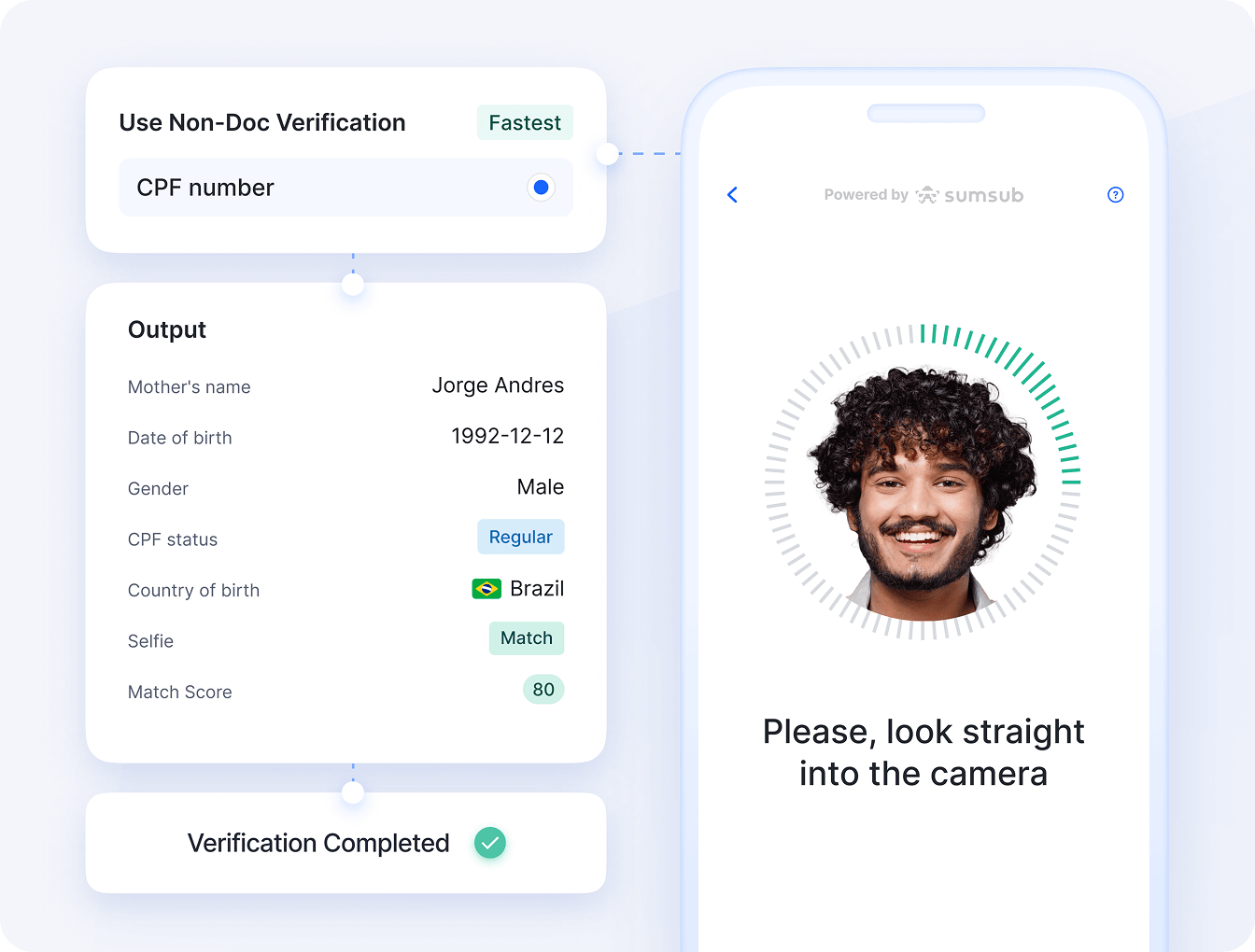
For crypto businesses, Sumsub can support the customer journey from initial identity verification through ongoing compliance checks. Its platform combines document verification, biometric verification, liveness detection, sanctions and PEP screening, and fraud-prevention capabilities within a broader compliance workflow.
One of Sumsub's relevant strengths for crypto is its ability to support both individual and business verification. Exchanges and digital-asset platforms can use KYC for retail users while applying KYB and beneficial-owner checks to institutional or corporate customers.
Key features
- Identity verification
- KYC and KYB
- Document verification
- Facial verification
- Liveness detection
- AML screening
- Sanctions and PEP screening
- Fraud prevention
- Ongoing monitoring
- Business verification
- Global identity coverage
Why consider Sumsub?
Sumsub is a strong fit for crypto businesses looking for a broader compliance infrastructure rather than a standalone ID verification tool. Its combination of KYC, KYB, AML, and fraud-prevention capabilities allows companies to build more comprehensive onboarding and monitoring workflows.
Best suited for: Crypto exchanges, wallets, fintech platforms, Web3 businesses, digital-asset marketplaces, and companies serving international customers.
2. Blockpass
Blockpass is another Web3-focused provider that has built its identity infrastructure around cryptocurrency and blockchain applications. Rather than positioning KYC simply as an onboarding requirement, Blockpass connects identity verification with blockchain-based credentials and compliance workflows.
Its current Web3 compliance suite includes KYC, KYB, AML, Travel Rule capabilities, and on-chain identity solutions for dApps, DeFi applications, exchanges, and other cryptocurrency development companies to scale their growth.
One of its more distinctive products is On-Chain KYC, which allows businesses to verify eligibility without directly receiving or storing the user's underlying personal information. Blockpass describes its system as providing on-chain attestations that can be used by compatible blockchain applications.
The platform also supports verification associated with crypto addresses, including identity attributes and wallet information within its verification framework.
Key features
- KYC and KYB
- AML screening
- On-chain KYC
- Web3 identity credentials
- Exchange compliance
- DeFi compliance
- Unhosted wallet KYC
- Travel Rule infrastructure
Why consider Blockpass?
For crypto businesses, the major advantage is the connection between traditional identity verification and blockchain-native identity infrastructure.
Best suited for: Crypto exchanges, wallets, DeFi applications, dApps, token projects, and blockchain ecosystems.
3. Sardine
Sardine takes a broader approach to identity verification by combining KYC with fraud prevention, transaction risk, and AML capabilities. This makes it relevant for crypto businesses where knowing the customer is only one part of the overall risk problem.
Its identity and compliance infrastructure can incorporate identity information with device, behavioral, and other risk signals. Sardine has also expanded its KYC and KYB capabilities, including international tax-ID verification and business ownership information.
For crypto businesses, this broader risk approach can be useful because fraud may occur even after an account has successfully passed initial KYC. Account takeover, payment fraud, synthetic identities, and suspicious transaction behavior can require additional signals beyond the original identity check.
Sardine's product updates in 2026 also show an increasing focus on crypto-related risk monitoring, including wallet risk changes and broader financial-crime workflows.
Key features
- Identity verification
- KYC and KYB
- AML screening
- Fraud prevention
- Device intelligence
- Behavioral signals
- Transaction risk monitoring
- Crypto wallet risk capabilities
Why consider Sardine?
Sardine can make sense for businesses that want identity verification to operate as part of a larger fraud and financial-crime prevention stack.
Best suited for: Crypto exchanges, on/off-ramps, fintech platforms, payment businesses, and digital-asset companies with significant fraud exposure.
4. iDenfy
iDenfy is a compliance technology provider offering identity verification, KYB, AML screening, and related onboarding capabilities. It is particularly relevant to crypto businesses that need to verify both individual customers and corporate entities.
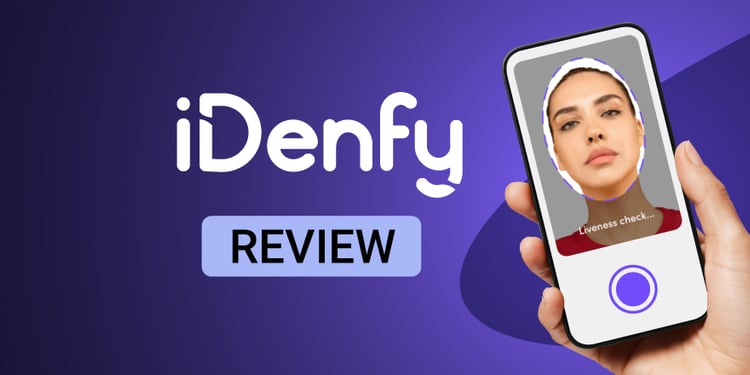
The company's crypto offering covers identity verification for exchanges and other blockchain-related businesses, while its broader platform supports document verification, biometric checks, AML screening, and ongoing compliance workflows.
iDenfy also publishes crypto-specific implementation material and has documented use cases involving companies operating in the digital-asset ecosystem. For example, its Coinzilla case study describes automated individual and corporate onboarding using KYC and KYB workflows.
This combination can be useful when a crypto company needs to onboard retail users while also verifying institutional customers, partners, merchants, or corporate account holders.
Key features
- KYC verification
- KYB verification
- Document verification
- Facial verification
- Liveness detection
- AML screening
- Adverse media screening
- Ongoing monitoring
- API integration
Why consider iDenfy?
Its combination of KYC, KYB, and AML makes iDenfy relevant to crypto businesses with both individual and business customers.
Best suited for: Crypto exchanges, Web3 companies, crypto marketplaces, institutional platforms, and digital-asset businesses requiring both KYC and KYB.
5. Shufti Pro
Shufti Pro is one of the more crypto-focused providers in this list, with dedicated infrastructure for exchanges, wallets, DeFi platforms, and other digital-asset businesses.

Its crypto compliance offering combines identity verification with fraud prevention, AML compliance, and transaction monitoring. The company currently promotes support for more than 240 regions and a range of crypto-specific verification workflows.
Shufti also provides document verification, face verification, liveness, NFC verification, AML screening, and KYB. Its crypto use cases include account onboarding, staking, OTC transactions, wallet security, and token launches.
Another interesting capability is reusable KYC. Shufti's Fast ID product is designed to allow previously verified users to complete certain repeat verification journeys without repeating the entire original KYC process, subject to the applicable workflow and user consent.
Key features
- Crypto KYC
- KYB
- AML screening
- Document verification
- Facial verification
- Liveness detection
- NFC verification
- Wallet screening
- Reusable KYC
- Transaction monitoring
Why consider Shufti Pro?
Shufti Pro is particularly relevant for crypto businesses that need identity verification alongside broader compliance and fraud controls.
Best suited for: Exchanges, wallets, DeFi platforms, token launchpads, OTC platforms, and crypto businesses operating across multiple markets.
6. ComplyCube
ComplyCube provides identity verification and compliance automation across KYC, KYB, AML, and fraud prevention. Although it serves multiple industries, cryptocurrency and digital assets are explicitly included among its supported use cases.

Its platform combines identity verification with document checks, biometric verification, liveness detection, sanctions screening, PEP screening, adverse media checks, customer risk assessment, and ongoing monitoring.
The company expanded its compliance platform in 2026 with additional workflow and fraud-intelligence capabilities, including enhanced deepfake detection and digital identity tools.
ComplyCube also emphasizes international coverage, reporting support for more than 220 countries and territories.
Key features
- Identity verification
- Document verification
- Biometric verification
- Liveness detection
- KYC
- KYB
- AML screening
- Sanctions and PEP screening
- Adverse media
- Ongoing monitoring
- Fraud prevention
Why consider ComplyCube?
Its appeal lies in bringing several compliance functions into one configurable platform. This can be useful for crypto companies that do not want identity verification, AML screening, and ongoing monitoring to operate as completely separate systems.
Best suited for: Crypto platforms, fintech companies, exchanges, marketplaces, and regulated digital businesses.
7. Ondato
Ondato provides digital identity verification, KYC, KYB, AML screening, and ongoing monitoring for regulated industries, including cryptocurrency.
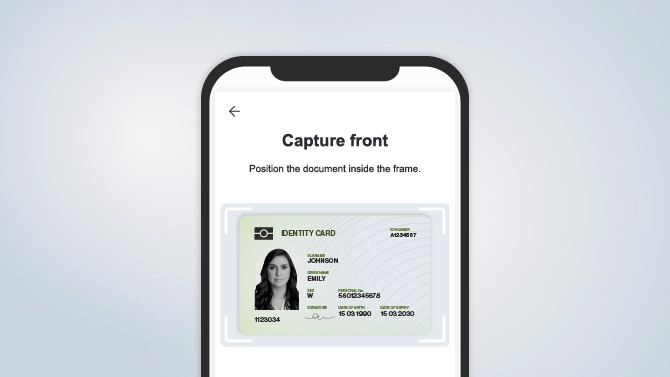
Its identity verification technology combines document verification, biometric checks, liveness detection, and optional NFC-based verification. Ondato states that its standard verification flow can be completed in less than 30 seconds, although actual performance depends on the user's document, geography, workflow, and other conditions.
Crypto is one of the industries specifically addressed by the company. Its crypto offering is designed for exchanges, wallet providers, and token platforms, with customizable verification flows and risk-based checks.
Ondato also provides KYB capabilities for verifying businesses, representatives, and beneficial owners, which can be important for crypto platforms serving institutional or corporate customers.
Key features
- ID verification
- Biometric verification
- Liveness detection
- NFC verification
- KYC
- KYB
- Sanctions screening
- PEP screening
- Adverse media
- Ongoing monitoring
Why consider Ondato?
Ondato is worth considering when a crypto company wants a combination of fast identity verification, configurable compliance workflows, and business verification.
Best suited for: Exchanges, crypto wallets, token platforms, fintech companies, and businesses onboarding both individuals and companies.
8. Didit
Didit is a newer identity and fraud infrastructure provider that has developed specific workflows for crypto businesses. Its current crypto offering combines KYC with wallet screening, making it particularly relevant to on-ramp and digital-asset transaction workflows.
Its crypto on-ramp solution is designed to verify the buyer's identity and screen the destination wallet within the same workflow. The company also provides identity checks, liveness, face matching, AML screening, device and IP signals, and reusable KYC.
For European crypto businesses, Didit has also introduced a workflow focused on MiCA-related onboarding that combines identity verification, AML checks, wallet screening, and evidence collection.
This combination makes Didit interesting for businesses where identity and blockchain transaction risk need to be considered together.
Key features
- KYC
- ID verification
- Liveness
- Face matching
- AML screening
- Wallet screening
- Fraud signals
- Reusable KYC
- KYB
- Crypto on-ramp workflows
Why consider Didit?
Didit's strongest differentiation is the attempt to connect traditional customer identity with crypto wallet and transaction context within one workflow.
Best suited for: Crypto on-ramps, exchanges, Web3 platforms, payment providers, and businesses operating under European crypto compliance frameworks.
9. Regula
Regula approaches identity verification from a strong document-authentication and forensic perspective. Rather than focusing exclusively on KYC workflow orchestration, the company has built expertise around verifying the authenticity of identity documents and extracting trustworthy identity information.

This can be particularly relevant to crypto because identity fraud is not limited to stolen credentials. Altered documents, counterfeit IDs, manipulated photographs, and sophisticated biometric attacks can all create problems during onboarding.
Regula's 2026 research into crypto identity verification highlights document fraud and biometric fraud as significant concerns among crypto businesses.
Its broader identity verification technology covers document authentication, biometric verification, and related identity workflows, making it suitable for organizations that prioritize high-assurance document verification.
Key features
- Document verification
- Document authenticity analysis
- Identity verification
- Biometric verification
- Face matching
- Fraud detection
- KYC workflows
- SDK and API integrations
Why consider Regula?
Regula can be particularly useful when document authenticity is a major consideration and a crypto business needs more than basic OCR and selfie matching.
Best suited for: High-risk exchanges, financial institutions, crypto platforms, and businesses requiring strong document-level identity assurance.
10. Veriff
Veriff is a global identity verification provider with a significant focus on fraud prevention, biometric verification, and digital onboarding. It is larger than some of the Web3-native companies on this list, but it remains a specialized identity technology provider rather than a general-purpose technology conglomerate.
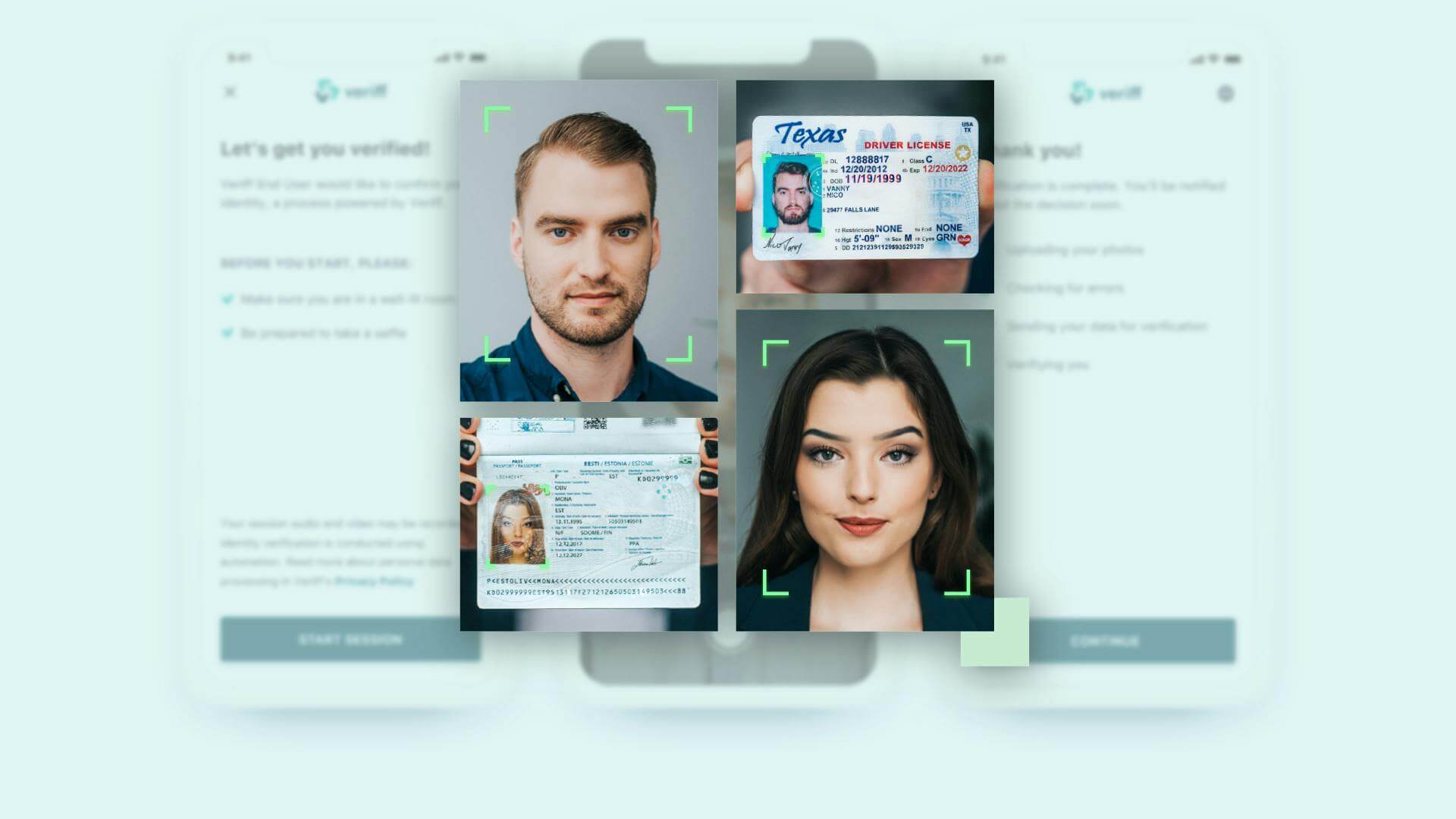
Veriff has a dedicated cryptocurrency identity verification offering for crypto platforms. Its technology combines document-based verification, biometric analysis, liveness-related checks, fraud prevention, and automated decisioning.
The company also provides AML screening capabilities, including customizable screening against sanctions, PEP, and adverse-media sources.
For crypto businesses operating internationally, Veriff's emphasis on global onboarding and fraud prevention can be relevant where the challenge is not simply verifying a document but determining whether the person behind the account is legitimate.
Key features
- Identity verification
- Document verification
- Facial biometrics
- Liveness detection
- Fraud prevention
- AML screening
- PEP and sanctions screening
- Automated decisioning
- Global onboarding
Why consider Veriff?
Veriff is a practical option for crypto businesses that need mature biometric identity verification and fraud-prevention infrastructure at international scale.
Best suited for: Global exchanges, crypto financial platforms, wallets, fintech businesses, and high-volume digital onboarding.
How to Choose a Digital Identity Verification Company for Crypto
Choosing between digital identity verification companies for crypto should not be based only on the number of countries or documents a provider supports. Crypto businesses have several additional requirements that can materially affect the right technology stack.
1. Crypto-specific compliance coverage
A provider should support the compliance requirements relevant to the business model.
For example, an exchange may require:
- KYC
- AML screening
- Sanctions screening
- PEP checks
- Enhanced due diligence
- Ongoing monitoring
- KYB for institutional customers
A Web3 application may have different requirements, such as eligibility verification, proof of personhood, residency restrictions, or reusable credentials.
2. Document coverage
Global crypto platforms may onboard users from dozens or hundreds of jurisdictions.
A strong identity verification system should therefore handle different:
- Passports
- National identity cards
- Driver's licenses
- Residence permits
- Regional identity documents
- Digital IDs
- NFC-enabled documents
Document coverage matters because a system that performs well on common Western passports may still struggle with less common documents or scripts.
3. Liveness and biometric protection
Basic face matching is no longer enough for many high-risk digital onboarding environments.
Crypto platforms should examine whether a provider can address:
- Presentation attacks
- Printed photographs
- Replay attacks
- Face swaps
- Deepfakes
- Synthetic identities
- Injected video
- Spoofed biometric signals
This is increasingly important because fraudsters can use AI-generated or manipulated media to attempt to bypass remote verification systems.
4. Wallet and blockchain compatibility
This is where digital identity verification companies for crypto can differ substantially from conventional fintech IDV providers. Many of these firms also work closely with marketing outsourcing companies to integrate these checks into their infrastructure.
A crypto-native platform may need to connect identity with:
- Wallet addresses
- Wallet ownership
- Sanctioned addresses
- Transaction risk
- Travel Rule workflows
- On-chain credentials
- Token eligibility
- DeFi access rules
Providers such as Blockpass, Fractal ID, Didit, and Shufti Pro have developed capabilities that specifically address parts of this Web3 identity problem.
Key Trends Shaping Crypto Identity Verification in 2026
AI-powered identity fraud detection
Deepfakes, synthetic identities, manipulated documents, and injected media are making traditional document-only verification less reliable.
Crypto companies are therefore increasingly evaluating biometric and behavioral signals alongside document verification.
Reusable KYC
Repeatedly asking the same user to upload a passport and take a selfie can create unnecessary friction.
Reusable KYC allows a verified identity to be reused across appropriate products, entities, or journeys, subject to the provider's architecture and applicable privacy and regulatory requirements.
This is particularly interesting for Web3 ecosystems where one verified identity could potentially interact with multiple applications.
On-chain identity
Web3-native providers are exploring ways to represent verification results as credentials or attestations rather than repeatedly transferring raw personal information between applications.
This could allow a platform to verify something such as:
- User passed KYC
- User is over a certain age
- User is located in an eligible jurisdiction
- User is not on a restricted list
without necessarily exposing the user's entire identity profile to every application.
Identity + wallet risk
The distinction between "who is the user?" and "what is this wallet doing?" is becoming less clear.
Crypto platforms increasingly need both:
Know Your Customer (KYC)
and
Know Your Wallet / Know Your Transaction (KYT)
This is why several newer providers are connecting identity verification with wallet screening and transaction risk.
Frequently Asked Questions
1. What is the best identity verification solution for a crypto exchange?
There is no single solution that fits every exchange. The appropriate provider depends on the exchange's target markets, regulatory obligations, document coverage, fraud profile, KYB requirements, integration model, and need for wallet or transaction screening.
For a crypto-native environment, providers such as Fractal ID, Blockpass, Shufti Pro, Sardine, and Didit offer capabilities specifically relevant to digital assets, while providers such as iDenfy, ComplyCube, Ondato, Regula, and Veriff provide broader identity and compliance infrastructure.
2. Why do crypto exchanges need digital identity verification?
Crypto exchanges may need to verify customer identities to meet applicable KYC and AML obligations, reduce identity fraud, and manage customer risk.
Identity verification can help confirm that the individual opening an account matches the identity document they provide and can form one component of a broader financial-crime compliance program.
3. What should a crypto KYC provider verify?
A typical crypto KYC process can include identity information, government-issued documents, facial verification, liveness detection, address information, sanctions screening, PEP screening, and risk-based additional checks.
The exact requirements depend on the platform, jurisdiction, customer type, and applicable regulations.
4. Can identity verification be connected to crypto wallets?
Yes. Some crypto-focused providers connect identity verification with wallet-related workflows.
For example, Blockpass provides on-chain KYC capabilities, while Didit combines customer KYC with destination-wallet screening in certain crypto workflows.
5. What is Web3 identity verification?
Web3 identity verification refers to identity systems designed specifically for blockchain-based applications and decentralized ecosystems. These systems often require how to build a decentralized identity system for enterprise resources to ensure compliance and security.
Rather than simply verifying a user for one centralized platform, Web3 identity systems may use credentials, attestations, or decentralized identity infrastructure that can potentially be reused across multiple applications.

