


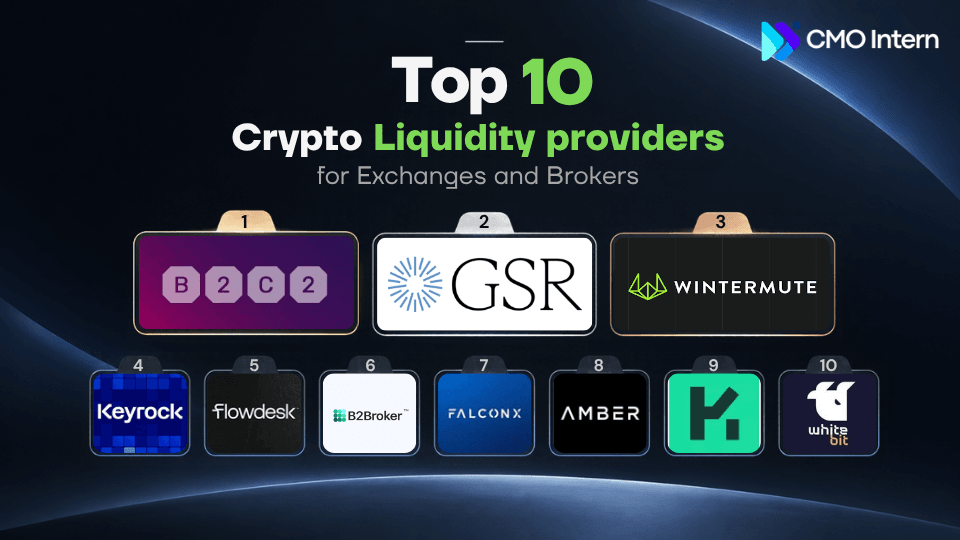
Choosing the right crypto liquidity provider is the focus of this Bài viết mới, as it directly affects an exchange or broker’s trading experience, including bid-ask spreads, order-book depth, execution quality, and the ability to support a wider range of trading pairs. In 2026, the market includes several types of providers, from institutional principal trading firms and crypto-native market makers to liquidity aggregators and infrastructure-focused platforms. If you are looking to scale your operations, you might also consider top 10 white-label exchange providers to streamline your technical setup.
For exchanges and brokers, the best provider is not necessarily the company with the largest trading volume or most recognizable name. Factors such as asset coverage, API connectivity, liquidity depth, settlement structure, geographic reach, onboarding requirements, and support for specific trading venues can be equally important. This guide compares 10 established crypto liquidity providers that are relevant to exchanges and brokers, with a focus on practical capabilities rather than simply ranking firms by size.
Understanding the Market for This Bài viết mới
A crypto liquidity provider supplies or facilitates the buying and selling liquidity that allows traders to execute orders without significantly moving the market. Depending on the provider, this can involve principal liquidity, market making, OTC trading, liquidity aggregation, or a combination of trading and infrastructure services.
For an exchange, strong liquidity can help create deeper order books and more competitive spreads. For a broker, access to multiple liquidity sources can improve execution and allow the platform to support a broader selection of assets and trading pairs. To ensure long-term growth, many platforms also prioritize crypto exchange partnerships to expand their reach.
The exact model differs between providers. Some firms trade directly against counterparties from their own balance sheet, while others aggregate liquidity from multiple venues or combine market making with institutional trading infrastructure.
How We Selected These Crypto Liquidity Providers
This list focuses on providers that have meaningful relevance to exchanges, brokers, institutional trading platforms, or digital-asset businesses. We considered several practical criteria:
- Liquidity model: Principal liquidity, market making, OTC, or aggregation.
- Asset coverage: Range of cryptocurrencies, trading pairs, and supported instruments.
- Exchange and venue connectivity: Access to centralized and decentralized markets where applicable.
- Technology: API, FIX, RFQ, trading infrastructure, and integration options.
- Institutional capabilities: Settlement, execution, treasury, and risk-management infrastructure.
- Market coverage: Geographic and regulatory footprint.
- Business fit: Whether the provider is more suitable for established institutions, growing exchanges, brokers, or emerging platforms.
Because liquidity arrangements are generally negotiated privately, pricing, minimum commitments, spreads, and available inventory can vary by client and jurisdiction. Therefore, these should be verified directly during the onboarding process rather than treated as fixed public specifications.
Top 10 Crypto Liquidity Providers for Exchanges and Brokers
1. B2C2
Best for: Institutional crypto liquidity and principal trading
B2C2 is one of the established names in institutional crypto liquidity, with a business model centered around principal trading and OTC liquidity. Rather than simply routing every order to an external marketplace, a principal liquidity provider can act as the direct counterparty to a client, which can be useful for exchanges and brokers looking for consistent institutional execution.
Its offering is particularly relevant to businesses that require liquidity across major crypto assets while maintaining institutional trading and settlement processes. B2C2 supports both streaming and request-for-quote workflows, making it suitable for different execution environments.
For exchanges and brokers, one of its key advantages is the ability to work with a dedicated institutional counterparty rather than relying exclusively on a fragmented collection of external venues. This can simplify liquidity management and provide a more structured institutional relationship.
Key strengths:
- Principal-based crypto liquidity
- Institutional OTC trading
- Streaming and RFQ execution
- Broad crypto asset coverage
- Suitable for institutional counterparties
Best suited for: Established exchanges, brokers, and institutional trading businesses that need direct crypto liquidity and OTC capabilities.
B2C2 is frequently included among leading institutional liquidity providers, alongside firms such as Cumberland, FalconX, Wintermute, and GSR.
2. GSR

Best for: Market making and broad digital-asset liquidity
GSR has operated in digital assets since 2013 and provides market making and trading services across centralized and decentralized markets. Its broad market coverage makes it relevant to both exchanges and digital-asset projects looking for professional liquidity management.
For an exchange or broker, GSR can be particularly interesting when liquidity requirements extend beyond a handful of major cryptocurrencies. Its capabilities include institutional trading, market making, and connectivity across multiple venues.
GSR is also frequently recognized in current industry comparisons for its combination of market-making experience, institutional infrastructure, and broad venue coverage. Recent industry research places it among the leading firms serving token issuers, exchanges, and institutions.
Key strengths:
- Long-standing crypto market-making experience
- Broad venue connectivity
- Institutional trading capabilities
- CEX and DEX liquidity
- Suitable for both established and emerging digital assets
Best suited for: Exchanges, brokers, institutional trading firms, and projects requiring professional market-making support across multiple venues.
3. Wintermute
Best for: Crypto-native market making and multi-venue liquidity

Wintermute is a crypto-native market maker and trading firm with a strong presence across centralized and decentralized markets. Its positioning makes it particularly relevant to businesses operating across the broader digital-asset ecosystem rather than relying exclusively on traditional exchange liquidity.
For exchanges and brokers, Wintermute can be valuable when liquidity needs span multiple assets and venues. Its market-making infrastructure is designed around algorithmic trading and continuous liquidity provision, while its broader trading operations provide exposure to institutional crypto markets.
Recent 2026 industry comparisons consistently place Wintermute among the leading crypto liquidity and market-making firms, particularly for established tokens and DeFi-related liquidity requirements.
Key strengths:
- Crypto-native market-making infrastructure
- CEX and DEX coverage
- Broad digital-asset exposure
- Algorithmic liquidity provision
- Strong institutional market presence
Best suited for: Established exchanges, brokers, token ecosystems, and platforms that need liquidity across multiple crypto venues.
4. Keyrock
Best for: Algorithmic market making and growing digital-asset platforms

Keyrock is a European digital-asset market maker focused on algorithmic liquidity provision. It has become a notable option for crypto projects and platforms that need structured market-making support without necessarily working with the largest institutional trading firms.
One of Keyrock's strengths is its focus on market-making technology and liquidity strategies rather than simply acting as an OTC desk. This can be useful for exchanges and brokers that need ongoing liquidity management across selected trading pairs.
Industry comparisons in 2026 frequently position Keyrock among established crypto exchange marketing experts, particularly for emerging and mid-market digital-asset projects.
Key strengths:
- Algorithmic market making
- Multi-venue liquidity
- Crypto-native infrastructure
- Support for emerging assets
- Flexible fit for growing platforms
Best suited for: Mid-sized exchanges, brokers, and digital-asset businesses looking for algorithmic liquidity management and market-making support.
5. Flowdesk
Best for: Full-stack liquidity infrastructure and transparent market-making structures

Flowdesk combines crypto market making with broader digital-asset infrastructure. The company is particularly notable for offering different liquidity structures depending on the needs of its clients, making it an option for businesses that want more flexibility in how liquidity support is arranged.
Its infrastructure spans centralized and decentralized venues, while its institutional focus makes it relevant to exchanges, brokers, token issuers, and other professional market participants.
Recent 2026 research has highlighted Flowdesk as one of the leading firms, particularly for clients that value structured engagement models and broader digital-asset infrastructure.
Key strengths:
- Market making
- Multi-venue liquidity
- CEX and DeFi coverage
- Institutional digital-asset infrastructure
- Multiple engagement structures
Best suited for: Exchanges, brokers, token issuers, and institutional platforms looking for liquidity combined with broader digital-asset infrastructure.
6. B2Broker
Best for: Brokers and new exchanges seeking aggregated liquidity
B2Broker takes a different approach from principal market makers. Rather than positioning itself primarily as a direct institutional principal liquidity provider, it focuses heavily on liquidity aggregation, brokerage technology, and infrastructure for brokers and trading platforms.
This makes B2Broker particularly relevant to businesses that are building or expanding a trading platform and need liquidity alongside other components of their technology stack. Its offering can help businesses connect to multiple liquidity sources through aggregation and integration infrastructure.
For smaller or newer exchanges and brokers, this model can be attractive because it can reduce the complexity of building a liquidity network from scratch. However, businesses should distinguish between aggregated liquidity and direct principal liquidity when evaluating execution quality, depth, latency, and counterparty exposure.
Key strengths:
- Liquidity aggregation
- Broker-focused infrastructure
- API and connectivity solutions
- Support for crypto trading environments
- Useful for new or growing platforms
Best suited for: Forex and crypto brokers, new exchanges, and trading platforms looking for a combination of liquidity and infrastructure.
7. FalconX

Best for: Institutional trading and prime brokerage
FalconX provides institutional digital-asset trading and prime brokerage infrastructure, making it relevant to professional exchanges, brokers, funds, and other financial institutions that require more than basic market-making support.
Its model combines liquidity access with institutional trading infrastructure, giving clients access to multiple sources of digital-asset liquidity. This can be particularly valuable for businesses that want to consolidate trading relationships and operational infrastructure.
FalconX is frequently listed among leading institutional liquidity providers because of its combination of trading, prime brokerage, and digital-asset infrastructure capabilities.
Key strengths:
- Institutional liquidity
- Prime brokerage capabilities
- Multi-source liquidity access
- Trading infrastructure
- Support for professional market participants
Best suited for: Institutional brokers, exchanges, funds, and professional digital-asset trading businesses.
8. Amber Group

Best for: Institutional digital-asset services in Asia and global markets
Amber Group provides a range of institutional digital-asset services, including trading and market-making capabilities. Its presence in Asian markets makes it particularly relevant for businesses looking for liquidity partners with experience across the region.
For exchanges and brokers operating in Asia-Pacific, regional market knowledge can be an important consideration alongside liquidity depth and technology. Amber Group can therefore be considered when geographic reach and institutional digital-asset services are important parts of the selection process.
It is included in several 2026 industry comparisons of leading institutional digital-asset providers.
Key strengths:
- Institutional digital-asset services
- Market-making capabilities
- Strong Asia-Pacific relevance
- Broad crypto market exposure
- Professional trading infrastructure
Best suited for: Exchanges and brokers with Asia-Pacific exposure and institutional digital-asset requirements.
9. Kairon Labs
Best for: Crypto projects and exchanges seeking specialized market making
Kairon Labs is a crypto market-making firm focused on providing liquidity and market-making services for digital-asset projects. Its specialization can make it an attractive alternative for platforms that want a provider with a more focused crypto market-making proposition.
The firm is particularly relevant for businesses where token liquidity, exchange listings, and ongoing market support are closely connected. Compared with broad institutional prime brokers, a specialized market maker may provide a more focused service for specific assets and trading pairs.
Kairon Labs continues to appear in 2026 industry comparisons of established crypto market-making providers.
Key strengths:
- Crypto-focused market making
- Token liquidity support
- Exchange-listing experience
- Specialized digital-asset expertise
- Suitable for emerging projects
Best suited for: Growing exchanges, token projects, and crypto businesses seeking specialized market-making services.
10. WhiteBIT

Best for: Businesses seeking exchange-connected liquidity infrastructure
WhiteBIT offers an institutional liquidity provision solution designed for businesses that want to integrate crypto trading or conversion capabilities into their own platforms. Its stated target customers include exchanges, P2P platforms, exchange services, payment providers, and fintech companies.
The model is particularly relevant for businesses that want access to established exchange infrastructure rather than building every component of their liquidity system independently. For brokers and platforms expanding into crypto, this can provide another route to accessing market liquidity and trading functionality.
Businesses considering this model should still evaluate the specific liquidity depth, supported assets, execution conditions, integration requirements, and jurisdictional availability applicable to their use case.
Key strengths:
- Institutional liquidity provision
- Exchange-connected infrastructure
- Crypto trading and conversion support
- Relevant to brokers and fintech platforms
- Suitable for businesses integrating crypto functionality
Best suited for: Brokers, fintech platforms, P2P businesses, and exchanges looking for exchange-connected liquidity infrastructure.
How to Choose a Crypto Liquidity Provider
1. Evaluate Actual Market Depth
Do not evaluate liquidity based only on headline trading volume. What matters for an exchange or broker is how much executable liquidity is available around the market price for the specific assets and trading pairs you intend to support.
A provider may have excellent liquidity for BTC and ETH but considerably less depth for smaller-cap assets. Ask for liquidity data relevant to your actual markets rather than relying on generalized claims.
2. Compare Bid-Ask Spreads
Competitive spreads can directly influence execution quality and trader experience. When comparing providers, examine spreads under realistic market conditions and across the assets your platform plans to list.
Liquidity should be evaluated together with spread, because a large order book is not necessarily useful if executable prices are consistently uncompetitive.
3. Check API and Integration Options
Technical integration can become a major part of the implementation process. Depending on your architecture, you may need REST APIs, WebSocket connections, FIX, RFQ connectivity, exchange bridges, or other infrastructure.
The best provider is one that fits your existing trading stack rather than forcing your platform to rebuild its architecture around the provider.
4. Review Asset and Venue Coverage
An exchange or broker should evaluate whether the provider supports the exact assets and venues it needs.
This is particularly important if you plan to offer smaller-cap tokens, stablecoin pairs, regional assets, or multiple trading venues. Broader coverage can reduce the need to establish separate liquidity relationships for every market.
5. Understand the Liquidity Model
Ask whether the provider is acting as a principal, market maker, aggregator, broker, or another type of intermediary.
These models create different relationships around pricing, execution, inventory, settlement, and counterparty exposure. B2C2, for example, is described as a principal liquidity provider, while B2Broker emphasizes aggregation and brokerage infrastructure.
6. Consider Settlement and Counterparty Risk
Liquidity is only one part of the relationship. Exchanges and brokers should also assess settlement arrangements, collateral requirements, custody, credit exposure, legal entities, jurisdiction, and operational risk.
This is particularly important when dealing with large institutional volumes.
7. Look Beyond the Largest Names
A recognizable brand does not automatically mean it is the right liquidity provider for every platform.
Some large institutional firms may prioritize established counterparties and have more demanding onboarding requirements. A specialized market maker or liquidity aggregator may be more appropriate for a growing exchange, depending on its volume, asset coverage, geography, and technical requirements.
Why Crypto Liquidity Matters for Exchanges and Brokers
Liquidity is one of the fundamental components of a functioning crypto market. When an order book has sufficient depth, traders can execute transactions without creating excessive price movements. When liquidity is thin, even relatively modest orders can cause slippage and wider price deviations.
Current market research also shows that crypto liquidity varies significantly by asset and trading venue. CoinGecko's 2026 liquidity research, for example, highlights substantial differences in market depth between major assets and across centralized exchanges. If you are researching crypto exchanges low cost options, liquidity depth is a critical factor to check.
For exchanges and brokers, this means liquidity should be treated as an ongoing infrastructure decision rather than a one-time integration. As trading volumes, listed assets, and user profiles change, liquidity requirements can change as well.
Frequently Asked Questions
1. What is a crypto liquidity provider?
A crypto liquidity provider supplies or facilitates access to liquidity so traders can buy and sell digital assets with sufficient market depth and competitive execution. Depending on the provider, this can involve principal trading, market making, OTC trading, or liquidity aggregation.
2. Why do exchanges need crypto liquidity providers?
Exchanges need liquidity providers to help maintain active order books, competitive spreads, and sufficient market depth. Strong liquidity can improve execution quality and reduce slippage, particularly for larger trades.
3. What is the difference between a liquidity provider and a market maker?
The terms can overlap, but they are not always identical. A market maker typically continuously provides two-sided buy and sell quotes, while a liquidity provider can refer more broadly to firms that supply or aggregate executable liquidity. Some companies operate in both roles.
4. How do brokers use crypto liquidity providers?
Crypto brokers can connect to liquidity providers to obtain executable prices and trading liquidity without having to build every liquidity source themselves. Depending on the provider, this may be delivered through APIs, aggregation technology, RFQ systems, or institutional trading infrastructure.
5. What should I compare when selecting a crypto liquidity provider?
Key factors include market depth, spreads, supported assets, venue coverage, API connectivity, execution model, settlement terms, counterparty risk, geographic availability, regulatory framework, and onboarding requirements.

