
.webp)
.png)
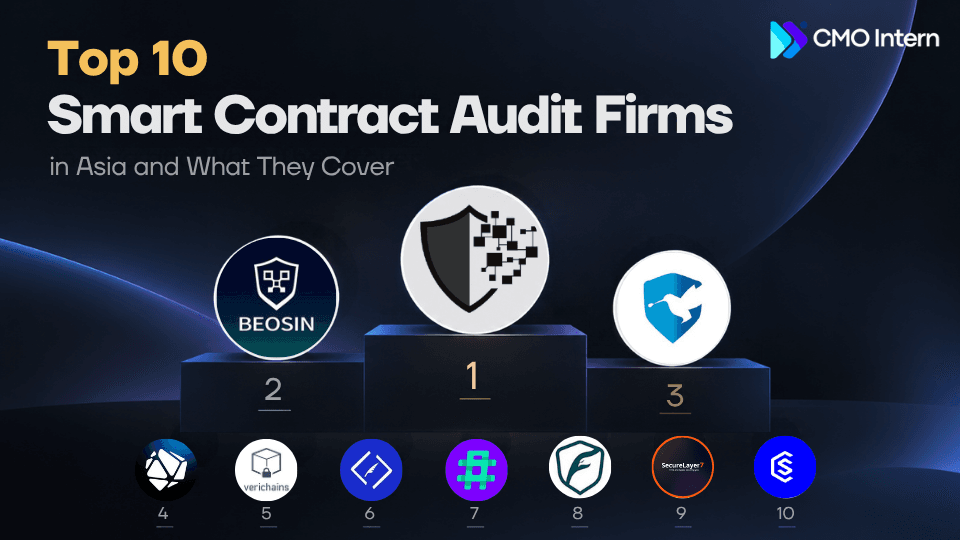
When evaluating the Top 10 Smart Contract Audit Firms in Asia and What They Cover, it is essential to look beyond basic code scanning to ensure your protocol is protected against complex business-logic flaws. As Web3 projects evolve, modern audits must account for upgradeable contracts, bridges, oracles, and cross-chain messaging. A robust security review examines not only individual functions but also how these diverse components interact within your specific architecture.
Asia has developed a particularly active blockchain security market, with established security companies from China, Vietnam, India, Singapore, Australia, and other parts of the region. Some specialize in smart contract security, while others combine auditing with threat intelligence, penetration testing, incident response, or on-chain monitoring.
This list focuses on established or technically specialized firms with a meaningful presence in Asia or the Asia-Pacific market. It is not intended as a universal ranking of which company is "the best." Instead, the firms are compared based on their publicly documented audit capabilities, technical focus, ecosystem coverage, and the types of projects they may be suitable for.
Understanding the Top 10 Smart Contract Audit Firms in Asia and What They Cover
A smart contract audit is a structured security review of blockchain code designed to identify vulnerabilities, implementation mistakes, business-logic flaws, and other risks before or after deployment.
A professional audit can include source-code review, automated analysis, manual code inspection, testing, symbolic execution, fuzzing, threat modeling, and remediation verification. The exact methodology differs between firms.
For example, Verichains describes its smart contract audit process as combining design analysis, automated code scanning, and manual auditing, while also examining business-logic risks such as price manipulation and incorrect liquidation logic. Beosin similarly combines automated analysis, formal verification, sandbox testing, and manual review in its documented audit workflow.
It is also important to remember that an audit is not a guarantee that a protocol cannot be hacked. Audit quality depends on the exact code version, scope, documentation, testing assumptions, deployment configuration, and remediation process. Even security firms themselves emphasize that blockchain cybersecurity auditing has limitations.
With that context in mind, here are 10 firms worth considering when evaluating the Asian smart contract security market.
1. SlowMist
SlowMist is one of the more established blockchain security companies originating from Asia, with its roots in China and a broader international blockchain security operation. Founded in 2018, the company works across blockchain security, threat intelligence, security auditing, incident response, and crypto investigation.
Its smart contract audit practice covers a range of blockchain ecosystems. SlowMist states that it has audited more than 1,500 smart contracts across ecosystems including Ethereum and other EVM chains, EOS, Fabric, Solana, Klaytn, and Aptos. Its audit work includes identifying high- and medium-risk vulnerabilities as well as reviewing areas such as access control, design logic, arithmetic issues, and denial-of-service risks.
One of SlowMist's differentiating characteristics is that smart contract auditing sits within a much broader security ecosystem. Teams that need more than a pre-launch code review may also value capabilities around blockchain threat intelligence, wallet and exchange security, monitoring, and incident investigation.
Best suited for: Web3 projects that want smart contract auditing alongside broader blockchain security and threat-intelligence capabilities.
Key coverage: Smart contracts, blockchain security, wallets, exchanges, threat intelligence, incident response, and on-chain security.
2. Beosin
Beosin is a blockchain security company headquartered in China with a broad focus spanning smart contract auditing, cryptocurrency tracing, compliance-related tools, and blockchain security intelligence.
Its smart contract audit service is designed for Web3 applications and blockchain protocols, combining automated analysis with expert review. Beosin's documented audit methodology has included preliminary source-code review, automated formal verification through its VaaS platform, sandbox deployment and validation, manual line-by-line review, and final reporting.
The company has also published a substantial collection of audit reports covering different types of blockchain projects. Its work extends beyond standard EVM contracts, with documented coverage involving ecosystems such as Solana, WASM-based chains, NEAR, and other public blockchains.
Another advantage is the connection between auditing and post-incident investigation. Beosin's TRACE platform focuses on tracing cryptocurrency transactions and investigating suspicious fund movements across multiple chains.
Best suited for: Web3 protocols that need a combination of automated security analysis, manual review, blockchain coverage, and post-incident investigation capabilities.
Key coverage: Smart contracts, blockchain protocols, formal verification, security analysis, cryptocurrency tracing, and AML-related intelligence.
3. PeckShield
PeckShield is a blockchain security company founded in 2018 with teams based across China and the United States. It has developed a reputation around blockchain security research, vulnerability discovery, smart contract auditing, DeFi security, and real-time threat monitoring.
Its security audit portfolio includes blockchain security audits, smart contract security audits, DeFi security audits, exchange security audits, and digital wallet security audits. The company also provides penetration testing, emergency response, threat monitoring, and smart contract attack prevention.
This broader positioning can be useful for protocols where smart contracts are only one part of the attack surface. A DeFi protocol, for example, may need to consider the interaction between contracts, external integrations, wallets, oracles, and operational infrastructure rather than treating the contract code in isolation.
PeckShield also has a strong security-research orientation, including its historical work on Ethereum vulnerabilities and blockchain security issues.
Best suited for: DeFi protocols, blockchain infrastructure, exchanges, wallets, and projects looking for an auditor with a strong security-research background.
Key coverage: Smart contracts, DeFi, blockchain infrastructure, exchanges, wallets, penetration testing, monitoring, and emergency response.
4. BlockSec
BlockSec is a China-based blockchain security company with roots in Hangzhou and Hong Kong. It is particularly relevant for DeFi protocols because its audit methodology goes beyond basic code-level vulnerability detection.
BlockSec states that its smart contract audits examine smart contract architecture, design patterns, business logic, economic models, token mechanisms, permission controls, upgradeability, governance modules, and integrations with oracles, bridges, and other DeFi protocols.
That broader scope is particularly important for financial smart contracts. A contract may be technically correct at the function level but still contain an economic vulnerability that allows an attacker to manipulate an oracle, exploit an accounting assumption, or abuse an interaction between multiple protocols.
BlockSec also combines auditing with security tooling and real-time monitoring through its wider security ecosystem. Its public audit portfolio demonstrates work across projects involving different DeFi and blockchain architectures.
Best suited for: DeFi protocols, lending platforms, DEXs, bridges, governance systems, and projects where economic or protocol-level logic is a major concern.
Key coverage: Smart contract architecture, business logic, economic models, governance, upgradeability, token mechanisms, oracles, bridges, and DeFi integrations.
5. Verichains
Verichains is particularly notable for Southeast Asian projects because it has a strong operational presence in Vietnam and Singapore. The company describes itself as a security firm operating across traditional cybersecurity, blockchain, and AI security, with blockchain security work dating back to 2017.
Its smart contract audit service combines design analysis, automated code scanning, and manual auditing. Importantly, the review can also cover business-logic vulnerabilities, including price manipulation, slippage problems, liquidation logic, access-control issues, and external-input validation.
Verichains also has a research-heavy profile. Its security team has publicly disclosed vulnerabilities involving blockchain protocols, cryptographic systems, bridges, and smart contracts. Its research into TSS/MPC wallet implementations, for example, demonstrated how vulnerabilities can remain even in systems that have previously undergone security audits.
The firm's broader security services also include penetration testing, cryptography audits, governance and compliance advisory, and blockchain security assessments.
Best suited for: Southeast Asian Web3 projects, financial institutions, blockchain infrastructure, bridges, wallets, and protocols requiring deeper security research.
Key coverage: Smart contracts, blockchain protocols, bridges, cryptography, penetration testing, ZK-related security, and financial infrastructure.
6. QuillAudits
QuillAudits is an India-based Web3 security firm focused heavily on smart contract auditing and blockchain security. Its current audit platform reports more than 1,500 projects secured, over 1 million lines of code audited, and support for more than 50 blockchain networks.
Its audit framework combines senior-led manual code review with independent validation and fuzzing. The company specifically references tools and frameworks such as Echidna, Medusa, Foundry, and Chimera as part of its testing approach.
QuillAudits also covers a broad range of Web3 use cases, including DeFi, token contracts, bridges, vesting contracts, and decentralized applications. Its public audit material provides examples of issues involving liquidations, price feeds, reward calculations, access control, and denial-of-service risks.
This makes it an option worth considering for projects that need broad multi-chain coverage rather than a security engagement centered around one specific blockchain.
Best suited for: Startups, DeFi protocols, token launches, dApps, and multi-chain projects looking for a dedicated smart contract audit provider.
Key coverage: Smart contracts, dApps, DeFi, bridges, token contracts, fuzzing, manual review, and multi-chain security.
7. Hashlock
Hashlock is an Australian blockchain security company specializing in smart contract auditing and manual security analysis. Its positioning is particularly relevant to the Asia-Pacific market, where Australian security firms can serve projects across both Asian and Western blockchain ecosystems.
Hashlock emphasizes manual, line-by-line smart contract auditing supported by offensive security testing. Its documented audit process includes specification analysis, manual code review, vulnerability analysis, offensive testing, development revisions, and a final security report.
The firm has also published audit records involving protocols across areas suchs as DeFi, staking, Layer 1 infrastructure, enterprise blockchain, and decentralized applications. Its current portfolio shows work involving projects such as 1inch, Rocket Pool, SushiSwap, and other Web3 protocols.
For teams that prefer a smaller specialist security partner rather than a massive general-purpose security company, this model can be attractive.
Best suited for: Web3 teams looking for a manual-analysis-heavy audit and a specialist security research partner.
Key coverage: Smart contracts, DeFi, staking, Layer 1 protocols, dApps, and multi-chain Web3 systems.
8. Fairyproof
Fairyproof is a blockchain security company established in 2021 with a focus on blockchain security solutions, smart contract auditing, wallet security, and automated security tools.
Its audit process combines manual source-code review with automated analysis and testing. The company describes reviewing project specifications, conducting line-by-line code analysis, comparing implementation against intended functionality, examining test coverage, and applying techniques such as symbolic execution.
Fairyproof has published audit work involving ecosystems such as Ethereum, BNB Smart Chain, Polkadot, HECO, Waves, and Cosmos. Its scope therefore extends beyond a single EVM-focused workflow.
The firm's broader toolset also includes static analysis, bytecode decompilation, project profiling, security testing, and bug bounty-related services.
Best suited for: Blockchain projects that want smart contract auditing combined with automated security analysis and broader blockchain security testing.
Key coverage: Smart contracts, blockchain clients, wallets, EVM ecosystems, Polkadot, Cosmos, static analysis, and symbolic execution.
9. SecureLayer7
SecureLayer7 is an India-based cybersecurity firm with a dedicated smart contract auditing practice. Its current blockchain security services cover both EVM and non-EVM ecosystems, making it particularly interesting for teams building across multiple blockchain architectures.
Its audit offering includes manual review across EVM environments as well as Solana, Cosmos, Sui, Aptos, Stellar, and Starknet. The firm emphasizes proof-of-exploit testing, where findings are reproduced through transactions or test cases rather than simply being listed as theoretical vulnerabilities.
For EVM projects, its documented scope includes Solidity, Vyper, Yul, ERC-4337, ERC-4626, EIP-7702, L2 bridges, proxy patterns, and MEV-related risks.
This makes SecureLayer7 particularly relevant for technically sophisticated projects that want their auditors to examine newer Ethereum standards and application-specific attack surfaces.
Best suited for: EVM, L2, Solana, Cosmos, Move-based, and other multi-chain projects requiring technical manual review.
Key coverage: Solidity, Vyper, Yul, EVM, Solana, Cosmos, Sui, Aptos, Starknet, Stellar, L2s, bridges, and account abstraction.
10. SecuriChain
SecuriChain is a Singapore-based blockchain security provider offering smart contract auditing alongside penetration testing and managed security services. Its smart contract audit service covers smart contracts, blockchain protocols, token contracts, and custom blockchain applications.
The company's stated process follows a conventional security-audit workflow: defining the scope, automated testing, manual code analysis, an initial report, verification of fixes, and a final report. This combination can be useful for teams that want a security engagement covering both code-level vulnerabilities and broader application security.
Its Singapore presence also makes it a relevant option for projects operating within Southeast Asia, particularly teams that prefer working with a regional cybersecurity provider rather than an overseas specialist.
Best suited for: Southeast Asian blockchain projects that need smart contract auditing alongside broader cybersecurity and penetration-testing services.
Key coverage: Smart contracts, blockchain protocols, token contracts, penetration testing, application security, and managed security.
How to Choose the Right Smart Contract Audit Firm in Asia
There is no single audit firm that is ideal for every protocol. The right choice depends heavily on the architecture, assets at risk, deployment timeline, and type of security evidence the project needs.
1. Start with your blockchain architecture
An EVM-based token contract does not necessarily require the same expertise as a Solana program, Move module, Cosmos application, or cross-chain bridge.
Before contacting an auditor, identify the exact networks and programming languages involved. Firms such as QuillAudits, SecureLayer7, Beosin, and Verichains demonstrate broader multi-chain capabilities, while other providers may have deeper specialization in particular ecosystems.
2. Look beyond automated vulnerability scanning
Automated tools are useful for detecting known vulnerability patterns, but they cannot replace human reasoning about protocol design and business logic.
A strong audit should consider questions such as:
- Can privileged roles be abused?
- Can an attacker manipulate an oracle?
- Can assets be withdrawn under unexpected conditions?
- Can a proxy be upgraded incorrectly?
- Can economic incentives be manipulated?
- Can a cross-chain message be replayed?
- Can two individually safe contracts become vulnerable when interacting?
- Does the deployed contract actually match the audited code?
This is one reason firms such as BlockSec and Verichains emphasize protocol-level and business-logic analysis rather than relying solely on automated scanners.
3. Check whether the firm publishes audit reports
Public reports can tell you much more about an auditor than a marketing page.
When evaluating an audit provider, look for examples showing:
- The types of vulnerabilities identified
- Severity classification
- Technical explanations
- Proof-of-concept testing
- Remediation recommendations
- Re-audit or fix-verification procedures
- The blockchain and programming language involved
A firm with publicly documented reports gives potential clients a better opportunity to understand how it actually conducts security reviews.
4. Consider the firm's security research
Security research can be an important differentiator. A company that actively studies new exploit techniques may be better positioned to identify vulnerabilities that do not fit conventional checklists.
Verichains, PeckShield, SlowMist, and BlockSec, for example, all have publicly documented security research or broader threat-analysis capabilities in addition to auditing.
5. Ask what happens after the first report
An audit should not necessarily end when the first PDF is delivered.
Ideally, the process should include remediation discussions and verification that important vulnerabilities have actually been fixed. This is particularly important for complex protocols where changing one contract may affect another part of the system.
The strongest engagement is therefore not simply:
Code → Audit → PDF
but rather:
Scope → Threat Modeling → Audit → Findings → Remediation → Re-Test → Final Report
Frequently Asked Questions
1. What are the best smart contract audit firms in Asia?
There is no universally best firm because audit requirements differ by protocol. SlowMist, Beosin, PeckShield, BlockSec, Verichains, and QuillAudits are among the established names with documented blockchain security and smart contract audit capabilities. Hashlock, Fairyproof, SecureLayer7, and SecuriChain provide additional options depending on project architecture and regional requirements.
2. How long does a smart contract audit take?
The timeline depends on the size and complexity of the codebase. A relatively small token contract may require significantly less time than a DeFi protocol involving lending, governance, oracles, bridges, and upgradeable contracts. Projects should prioritize sufficient review time over choosing an auditor solely because it offers the fastest delivery.
3. Is a smart contract audit enough to guarantee security?
No. An audit reduces risk but cannot guarantee that a protocol will never be exploited. New vulnerabilities can emerge after deployment, and risks may exist outside the audited code. Verichains explicitly notes that even an audit with no identified vulnerabilities does not constitute a 100% security guarantee.
4. Should a DeFi project get a smart contract audit?
In most cases, a professional security review should be considered an important part of a DeFi project's pre-launch security process. DeFi protocols often contain complex interactions involving liquidity, pricing, collateral, liquidation, governance, and external integrations, making business-logic analysis especially important.
5. Should projects get more than one audit?
For high-value or technically complex protocols, multiple independent reviews can provide additional assurance because different researchers may identify different classes of vulnerabilities. However, the value of a second audit depends on whether it genuinely introduces a different methodology, reviewer perspective, or technical specialization rather than simply repeating the same checklist.

