
.webp)
.png)
How to perform a smart contract security audit effectively
Performing a smart contract security audit requires a multi-layered approach that combines automated static analysis with rigorous manual logic verification. Because smart contracts are immutable once deployed on blockchains like Ethereum, identifying vulnerabilities before execution is the only way to protect user funds and protocol integrity.
Automated analysis and static code scanning
Before manual review begins, automated tools establish a baseline by scanning for known vulnerability patterns. Developers should integrate tools like Slither or Mythril into their CI/CD pipelines to catch common issues such as reentrancy, integer overflows, or uninitialized state variables early in the development cycle.
Slither is highly effective for detecting architectural flaws and generating call graphs, while Mythril utilizes symbolic execution to explore complex state-dependent execution paths. While these tools are essential for rapid feedback, they often produce false positives and cannot understand the specific business intent of a protocol, making them a starting point rather than a complete security solution.
Manual code review and logic verification
Automated scanners cannot interpret the intended business logic of a protocol, which is why manual code review remains the most critical phase of the audit. Auditors perform a line-by-line inspection to verify that the code behaves exactly as specified in the project’s documentation.
This process involves tracing state changes across multiple functions to identify edge cases that automated tools might overlook, such as improper access control or flawed reward distribution mechanisms. During this phase, auditors look for subtle bugs like front-running vulnerabilities, sandwich attacks, or incorrect use of the delegatecall opcode.
A manual review also includes verifying that the contract adheres to established standards, such as ERC-20 or ERC-721, and ensuring that external dependencies or oracle integrations are handled securely. By manually stress-testing the contract's logic, auditors uncover deep-seated architectural risks that automated scanners are fundamentally incapable of detecting.

Identifying common vulnerability patterns
A systematic audit begins by mapping the codebase against known attack vectors. Rather than relying solely on automated scanners, auditors must manually trace state transitions and arithmetic operations to identify logic flaws that static analysis tools frequently overlook. When conducting these assessments, teams must also consider the broader blockchain cybersecurity auditing requirements to ensure long-term protocol health.
Reentrancy and integer overflow mitigation
Reentrancy remains a critical threat to decentralized finance protocols. To detect this, auditors examine external calls to untrusted contracts. If a contract updates its internal state—such as decrementing a user's balance—only after an external call, an attacker can recursively call the function to drain funds.
Prevention requires strict adherence to the Checks-Effects-Interactions pattern: validate inputs, update state variables, and perform external interactions last. Using ReentrancyGuard modifiers from OpenZeppelin provides a standardized defense, but auditors must verify that these modifiers are applied to all sensitive functions.
Regarding arithmetic, while Solidity 0.8.x includes built-in overflow protection, legacy codebases or specific use cases requiring unchecked blocks remain vulnerable. Auditors must inspect any unchecked arithmetic to ensure that bounds checking is handled manually. If an operation could result in an integer overflow or underflow, the contract must explicitly revert or wrap the logic to prevent unexpected state changes.
Access control and authorization flaws
Access control vulnerabilities often stem from misconfigured ownership or overly permissive function visibility. Auditors must verify that sensitive functions—such as those used for minting tokens, pausing contracts, or withdrawing treasury funds—are protected by appropriate modifiers like onlyOwner or role-based access control (RBAC). A common oversight is the failure to initialize ownership correctly, leaving the contract vulnerable to unauthorized takeover.
Beyond basic ownership, auditors must scrutinize msg.sender validation in multi-step processes. If a contract delegates authority to a secondary address, ensure that the delegation mechanism itself cannot be hijacked. Furthermore, check for functions marked as public or external that lack any authorization logic. If a function is intended for internal use only, it must be marked as internal or private to prevent external actors from triggering sensitive logic.
Testing environments and simulation strategies
A robust audit requires moving beyond static code analysis to observe how contracts behave under adversarial conditions. Developers should maintain a local development environment that mirrors the target blockchain's state, using tools like Hardhat or Foundry to fork the mainnet. This allows for testing against real-world protocol interactions, such as liquidity pools on Uniswap or lending markets on Aave, without deploying to a live network.
Fuzzing techniques for edge case discovery
Fuzzing is the process of bombarding contract functions with randomized, invalid, or extreme inputs to trigger unexpected state changes. Automated fuzzing tools are essential for identifying vulnerabilities that manual review often misses, such as rounding errors or logic errors in access control.
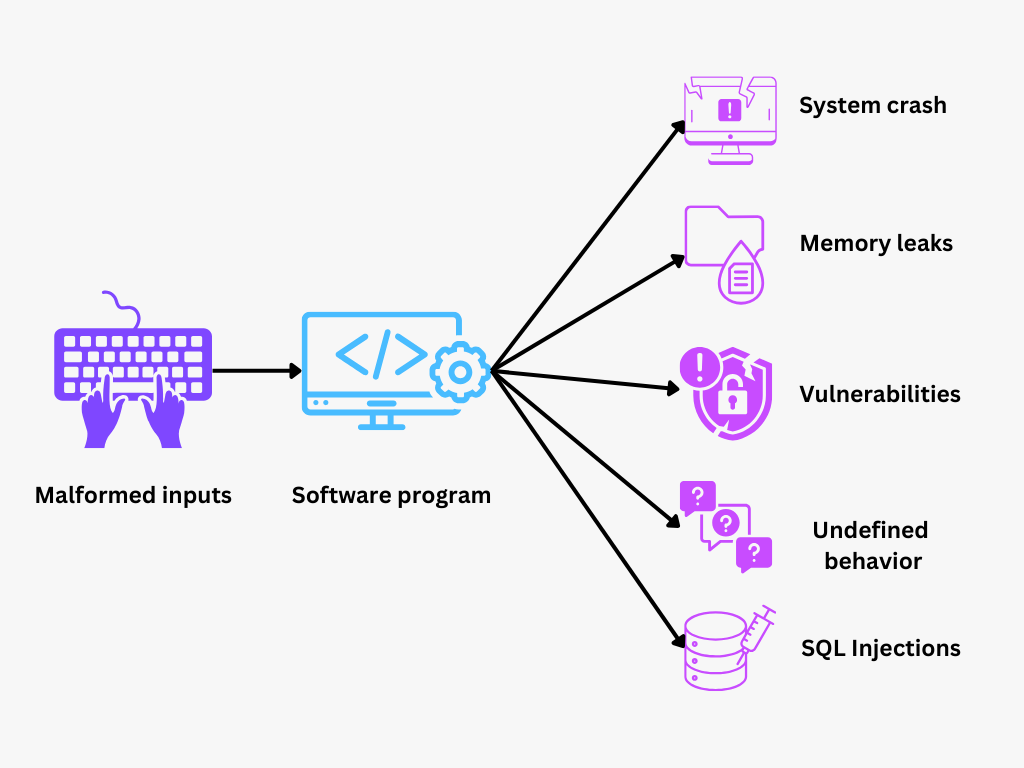
Echidna and Foundry are industry standards for property-based testing. With Echidna, you define invariants—properties that should always remain true regardless of the input— in your Solidity code. The fuzzer then generates thousands of transactions to attempt to break these invariants.
For example, if you are auditing a vault contract, you would define an invariant stating that the total supply of shares must always be less than or equal to the total assets held by the contract. If Echidna finds a sequence of inputs that violates this, it provides the exact transaction trace to reproduce the failure.
Foundry’s built-in fuzzer, utilized via the forge test command, provides an integrated experience. By using the vm.assume cheatcode, you can constrain the fuzzer to specific ranges, ensuring that tests focus on high-risk areas like slippage calculations or fee logic. When performing a smart contract security audit, prioritize fuzzing functions that handle external calls or complex mathematical operations, as these are the most common vectors for reentrancy attacks and rounding errors.
Limitations and inherent risks
Even the most rigorous security assessment cannot guarantee that a smart contract is entirely bug-free. Audits represent a snapshot in time. Once a contract is deployed, any subsequent upgrades or interactions with external protocols can introduce new vulnerabilities that were not present during the initial review.
Managing residual risk
Treat an audit as one layer of a defense-in-depth strategy rather than a final stamp of approval. Implement a robust bug bounty program using platforms like Immunefi to incentivize white-hat hackers to find issues post-deployment. Maintain a comprehensive monitoring system using tools like Forta to track suspicious transaction patterns in real-time. By accepting that code is never perfectly secure, you can build systems that are resilient enough to survive even if a specific vulnerability is discovered after launch. For those interested in BingX security features explained, exchange-level safeguards are just as vital as on-chain code audits, especially when considering security and privacy concerns with roboteacher data in broader institutional contexts.
Frequently Asked Questions
What are the first steps for a smart contract security audit?
The first step is to establish a clear understanding of the contract's business logic and intended behavior by reviewing the technical documentation and design specifications before touching the source code. This is essential for unveiling high performing protocols that prioritize safety from the ground up.
Can automated tools replace manual audits?
No. Automated tools are effective at catching known vulnerability patterns like reentrancy or integer overflows, but they cannot identify complex logic errors or business-specific vulnerabilities that require human context.

