
.webp)
.png)
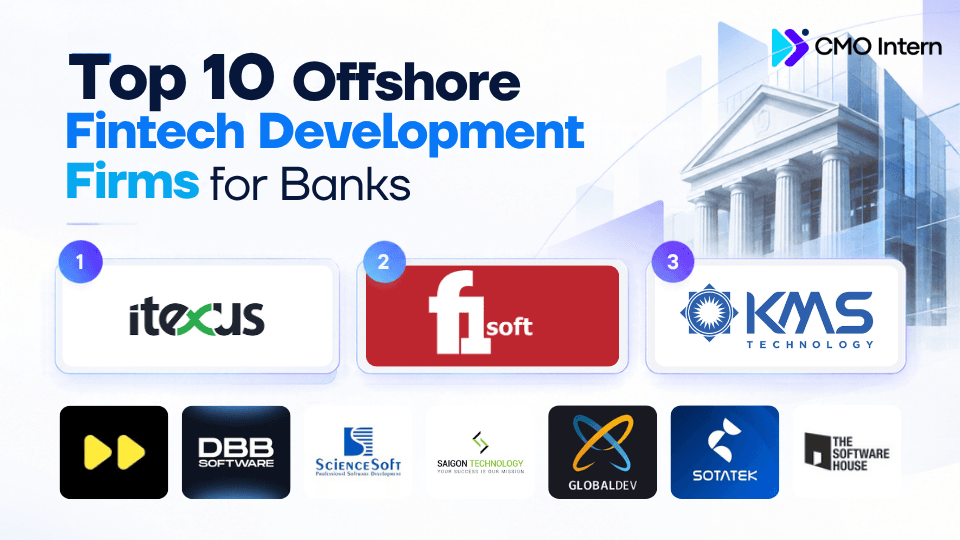
Banks often partner with the Top 10 offshore Fintech Development Firms for Banks to accelerate digital transformation when internal hiring cannot keep pace with project demands. Digital banking, payment infrastructure, lending platforms, open banking, fraud detection, customer onboarding, and legacy-system modernization all require specialized engineering skills. Yet hiring enough fintech developers internally can take months, especially when a project requires experience with financial workflows, security, compliance, APIs, cloud infrastructure, and high-volume transaction systems.
That is where offshore fintech development firms can become strategically useful. Instead of waiting to build an entire local engineering team, banks can work with an external development partner that already has financial technology expertise and can provide dedicated engineers, product teams, QA specialists, architects, DevOps professionals, or complete delivery teams.
Recent 2026 fintech-development comparisons increasingly emphasize the same issue: a credible financial software partner needs more than generic coding ability. Banking experience, compliance-aware architecture, security, integration capabilities, production experience, and the ability to support a live system are becoming increasingly important selection criteria. Global Dev
This list focuses on 10 established but not mega-scale technology firms with relevant fintech, banking, payments, or financial-services capabilities. The goal is not to identify the largest outsourcing companies in the world, but to highlight firms that banks and financial institutions can realistically consider when internal hiring cannot keep up with delivery requirements.
Selecting the Top 10 offshore Fintech Development Firms for Banks
Offshore development should not simply mean hiring developers at a lower cost. For banks, the consequences of choosing the wrong development partner can be considerably higher than in ordinary software projects.
A banking platform may involve sensitive customer information, transaction processing, authentication, third-party integrations, fraud controls, audit requirements, and legacy infrastructure. A development team therefore needs to understand how financial systems behave in production rather than simply knowing how to build a web or mobile application.
The strongest cryptocurrency development companies typically demonstrate several capabilities: experience with financial products, secure software engineering, API and third-party integration, cloud architecture, QA and testing, legacy modernization, and an engagement model that allows the bank to scale engineering capacity when required.
This is particularly relevant when the internal problem is not a lack of strategy but a lack of people. A dedicated offshore team can become an extension of an existing engineering organization, allowing a bank to accelerate a specific workstream without waiting for dozens of permanent hires.
Top 10 Offshore Fintech Development Firms
1. Itexus
Best for: Digital banking, lending, payments, wealth management, and custom fintech platforms
Itexus is one of the more fintech-focused firms on this list. Its publicly described work covers banking, payments, lending, trading, wealth management, digital wallets, financial analytics, and related financial applications. Its banking capabilities also include digital onboarding, KYC automation, card management, open banking, fraud monitoring, and core-banking integration.
That breadth makes Itexus particularly relevant to banks that are not simply building a new mobile application but need several financial capabilities to work together. A bank modernizing its customer-facing channels, for example, may need APIs connecting existing banking infrastructure with new mobile experiences, identity verification, payment services, analytics, and administrative systems.
Itexus can also be considered when the project requires a dedicated development model rather than a one-off outsourced build. Its positioning around fintech gives financial institutions a more specialized alternative to generalist software vendors.
Why consider Itexus: Its strongest advantage is the concentration of fintech use cases across banking, lending, payments, trading, and wealthtech.
Potential fit: Banks modernizing digital channels, lenders building digital products, fintech businesses expanding financial platforms, and financial institutions that need additional engineering capacity.
2. F1Soft
Best for: Digital banking, omnichannel banking, payments, wallets, and financial inclusion

F1Soft is a particularly interesting option because financial technology is central to its business rather than simply one vertical among many. The company states that it works with more than 50 banks and financial institutions and has developed solutions spanning digital banking, digital lending, payments, remittance, omnichannel banking, and digital wallets.
Its BankXP omnichannel banking platform, for example, is positioned around connecting mobile, web, branch banking, and third-party services. F1Soft also describes digital onboarding, KYC checks, payments, transfers, loan applications, and card integrations as components of its banking solutions.
This makes F1Soft particularly suitable for financial institutions looking for more than staff augmentation. Its experience is closely tied to the actual banking environment, which can be valuable when the objective is to implement or modernize a financial platform.
Why consider F1Soft: Strong banking specialization and a product-oriented approach to digital financial services.
Potential fit: Banks pursuing digital transformation, institutions expanding mobile and omnichannel banking, and organizations looking for established financial technology platforms.
3. KMS Technology
Best for: Banking modernization, secure fintech engineering, payments, and enterprise financial software

KMS Technology combines a substantial engineering operation in Vietnam with international delivery experience. The company has a dedicated financial-services practice covering fintech development, compliance-aware engineering, security, modernization, and high-performance transaction platforms.
Its financial-services work includes examples such as expanding payment options for an online trading business and supporting banking-related digital products. KMS also describes its approach as covering both on-premises and cloud-native architectures, which is particularly relevant for banks that cannot simply abandon existing infrastructure.
For organizations with an existing engineering department, KMS can be attractive because the engagement does not necessarily require outsourcing the entire product. A bank can use external engineering capacity for modernization, testing, cloud migration, application development, data work, or other specialized initiatives.
KMS Technology has also built a long-running reputation in software outsourcing from Vietnam, including recognition in Vietnam's software and IT-services outsourcing sector.
Why consider KMS Technology: A strong combination of engineering maturity, offshore delivery, financial-services expertise, and modernization capabilities.
Potential fit: Established banks that need additional engineering capacity while maintaining control over product architecture and internal teams.
4. DashDevs
Best for: Digital ban

king, payments, open banking, fintech products, and dedicated teams
DashDevs is a fintech specialist rather than a general software outsourcing company that happens to serve financial clients. Its services include fintech consulting, dedicated fintech teams, banking software development, mobile banking, payment applications, open banking, and financial product development.
The company also offers different collaboration models, including dedicated teams, staff augmentation, project-based outsourcing, and its own Fintech Core platform. This gives buyers several ways to address a hiring bottleneck: a bank can add specific specialists, build a dedicated team, or use a more structured product-development engagement.
DashDevs is particularly relevant for organizations that need financial-domain knowledge alongside software engineering. Its publicly described banking work covers areas such as KYC, AML, payments, digital banking, and open banking.
Why consider DashDevs: Strong fintech specialization and flexible models for banks that need to increase development capacity without building an entire internal team.
Potential fit: Digital banks, fintech companies, financial institutions launching new products, and banks modernizing customer-facing financial services.
5. DBB Software
Best for: Custom banking platforms, payment systems, mobile banking, and AI-enabled financial software
DBB Software is a Ukraine-based custom software development company with a dedicated fintech practice. Its fintech services cover mobile banking, investment platforms, payment systems, and other financial applications. The company states that it has more than 100 professionals and focuses on secure, scalable, and compliant financial software.
Its banking offering also covers areas such as core banking platforms, account and transaction management, and digital banking transformation. DBB describes an architecture approach based on modern, scalable systems rather than forcing every project into a single monolithic structure.
For banks struggling to recruit specialized engineers quickly, DBB can be considered when the requirement is a focused engineering team rather than a massive outsourcing contract. Its smaller scale compared with global IT conglomerates can also make the engagement more direct.
Why consider DBB Software: A combination of custom software engineering and specific fintech and banking capabilities.
Potential fit: Financial institutions that need custom development, digital banking functionality, payment systems, or additional engineering capacity.
6. ScienceSoft
Best for: Banking modernization, financial applications, analytics, and long-term software engineering

ScienceSoft is a mature software engineering and IT consulting company with experience across financial services. Its relevance for banks comes from its ability to work across application development, modernization, data, analytics, cybersecurity, and enterprise software rather than focusing exclusively on one fintech product category.
This broader capability can matter when a bank's technology problem is larger than a single application. For example, a modernization program may require application redevelopment, data migration, integration work, QA, cloud engineering, and analytics at the same time.
ScienceSoft therefore represents the type of offshore or distributed technology partner that may be more appropriate for established financial organizations with several connected technology initiatives rather than an early-stage fintech looking only for an MVP.
Why consider ScienceSoft: Broad financial-services engineering capabilities combined with experience in complex enterprise software environments.
Potential fit: Banks modernizing legacy systems, financial institutions managing multiple technology workstreams, and organizations that need a broader engineering partner.
7. Saigon Technology
Best for: Offshore development teams, fintech outsourcing, ODCs, and financial software modernization

Saigon Technology is particularly relevant to the "can't hire fast enough" problem because its delivery model is explicitly built around offshore engineering. The company reports development centers in Ho Chi Minh City and Da Nang and offers dedicated teams, staff augmentation, offshore development centers, fixed-price development, and build-operate-transfer models.
Its fintech services cover financial software development, digital banking, payment-related systems, and other BFSI applications. The company also positions compliance and security as part of the engineering process rather than something that should be addressed after development.
This makes Saigon Technology particularly interesting for banks that already have product leadership and architecture internally but need more engineers to increase delivery throughput.
The offshore model can be especially useful for long-running programs. Instead of repeatedly recruiting individual developers, a bank can establish a stable external team around a defined product area or create an offshore development center for a larger initiative.
Why consider Saigon Technology: Strong alignment with offshore delivery and multiple engagement models for scaling engineering capacity.
Potential fit: Banks seeking dedicated teams, staff augmentation, offshore development centers, or long-term financial software engineering.
8. Globaldev
Best for: Lending platforms, payments, embedded finance, and dedicated engineering teams
Globaldev is an Eastern European software development and staff-augmentation company with a documented fintech focus. Its fintech portfolio includes lending and payments-related software, while its broader delivery model supports dedicated engineering teams and custom software development.
The company can be useful for financial institutions that need to add engineering capacity while retaining ownership of the product roadmap. This model is different from purchasing a pre-built banking platform: the external engineers become part of the delivery organization and work on the bank's specific architecture and requirements.
Globaldev's Eastern European location can also make it relevant for European financial organizations that want access to regional engineering talent while maintaining relatively convenient working-hour overlap.
Why consider Globaldev: A balance between fintech experience, dedicated engineering capacity, and Eastern European delivery.
Potential fit: Lending businesses, payment companies, banks developing custom financial products, and organizations looking for additional engineering resources.
9. SotaTek
Best for: Fintech applications, blockchain-enabled finance, digital assets, and custom software
SotaTek is a Vietnam-based technology company with international software delivery experience and capabilities spanning fintech, blockchain development, custom software, and digital platforms.
Its positioning makes it more suitable for financial institutions whose roadmap extends beyond conventional banking applications. Projects involving blockchain infrastructure, digital assets, tokenization, smart contracts, or financial applications that integrate emerging technologies may benefit from a partner with experience across both fintech and Web3 engineering.
For traditional banks, however, the key question should be whether the specific team assigned to the project has sufficient experience with regulated financial systems. Blockchain expertise alone should never be treated as a substitute for banking-domain knowledge.
Why consider SotaTek: Useful for projects where traditional fintech engineering intersects with blockchain or digital-asset technology.
Potential fit: Fintech companies, innovation teams, financial institutions exploring blockchain, and businesses building financial applications with emerging technology components.
10. The Software House
Best for: Custom financial applications, product engineering, and modernization
The Software House is a Poland-based software development company that can be considered by banks looking for a European engineering partner without immediately moving to a massive global systems integrator.
Its strength is the custom software-development side of financial technology: building and evolving applications, backend systems, APIs, cloud infrastructure, and digital products. This makes it particularly relevant when the bank already understands its business requirements but needs additional engineering capacity to execute them.
For banks, this distinction is important. Not every modernization project requires a replacement core banking system. Sometimes the real requirement is a new customer portal, API layer, mobile application, integration platform, or internal financial workflow.
Why consider The Software House: A product-engineering orientation that can complement internal bank technology teams.
Potential fit: Banks and financial companies building custom applications, modernizing customer-facing systems, or expanding engineering capacity.
What Banks Should Check Before Hiring an Offshore Fintech Team
1. Ask for Financial Services Evidence
Do not accept "we have fintech experience" as sufficient evidence. Ask what financial products the team has actually delivered. Payments, lending, digital banking, wealth management, trading, and insurance involve different workflows and risks.
A company that has built five payment systems may be a better fit for a payment modernization project than a much larger software vendor with hundreds of generic applications but limited payments experience.
2. Check Compliance and Security Experience
Compliance should influence architecture from the beginning. Depending on the market and product, this can involve PCI DSS, KYC/AML requirements, GDPR, open-banking rules, local banking regulations, auditability, data residency, and internal security controls.
Recent fintech marketing agencies guidance increasingly treats compliance-aware delivery as a core vendor-selection criterion rather than an optional feature.
3. Understand Who Actually Builds the Product
One of the most important questions is simple: Who will be on the team?
Ask whether the proposed developers are employees, contractors, subcontractors, or a mixture. Clarify who owns architecture decisions, who performs code review, who handles QA, and what happens if a key engineer leaves.
A strong offshore partner should be able to explain its delivery structure before the contract is signed.
4. Evaluate the Engagement Model
Banks can choose among several models:
- Dedicated team: Best for long-term product development.
- Staff augmentation: Best when the internal team needs specific specialists.
- Project-based outsourcing: Best when scope and deliverables are clearly defined.
- Offshore development center: Suitable for large, sustained engineering programs.
- Build-operate-transfer: Useful when the bank eventually wants to own the offshore team.
There is no universal winner. The model should reflect the bank's product lifecycle and internal management capability.
5. Test Their Legacy-Modernization Experience
A bank rarely starts with a clean architecture.
Legacy databases, old APIs, proprietary systems, third-party banking platforms, and tightly coupled applications often sit behind the customer experience. A partner that only knows greenfield development may struggle when the first requirement becomes "integrate this 15-year-old system without breaking production."
Ask potential vendors how they approach strangler architectures, API layers, migration strategies, data synchronization, testing, and phased modernization.
Why Offshore Fintech Development Is Becoming More Relevant
The fintech outsourcing landscape has changed. Banks are no longer outsourcing only isolated development tasks. They increasingly need external engineering partners to support digital transformation, cloud migration, payment integration, digital onboarding, data platforms, cybersecurity, and continuous product development.
At the same time, the geographic distribution of software talent gives banks more options. Vietnam and India offer large engineering talent pools, while Eastern Europe remains a major technology hub for financial software and distributed engineering teams. LATAM can be attractive for organizations prioritizing time-zone overlap with North America.
This creates a more strategic role for offshore development. Instead of asking, "How can we outsource this application?" banks can ask, "Which parts of our technology roadmap can be accelerated by an external engineering team?"
That shift produces a better outsourcing strategy.
Frequently Asked Questions
1. What is an offshore fintech development firm?
An offshore fintech development firm provides software engineering services from a country or region different from the bank's primary location. The team may build financial applications, payment systems, digital banking platforms, APIs, lending products, data platforms, or modernization solutions.
2.Why do banks use offshore fintech development companies?
Banks typically use offshore development partners to access specialized engineering talent, increase development capacity, accelerate modernization projects, and reduce the time required to recruit large technical teams internally.
3. Is offshore development safe for banking software?
It can be, provided the bank conducts appropriate vendor due diligence. Security architecture, data handling, access controls, regulatory requirements, development practices, auditability, and contractual responsibilities should all be evaluated before development begins.
4. Should a bank choose staff augmentation or a dedicated fintech team?
Staff augmentation works well when the bank already has strong product and engineering leadership but lacks specific skills. A dedicated team is generally more suitable when an external partner will own a larger product-development workstream over a longer period.
5. What fintech skills should banks look for in an offshore team?
Banks should prioritize experience relevant to their product, including digital banking, payments, lending, KYC/AML, fraud prevention, API integration, cloud architecture, cybersecurity, data engineering, QA automation, and legacy-system modernization.

