
.webp)
.png)
Core operational differences between devops and traditional IT
DevOps functions as a cultural and technical integration of software development and IT operations, whereas traditional IT relies on siloed departments where developers write code and hand it off to a separate operations team for deployment. In a traditional model, the operations team is incentivized by system stability and change aversion, often creating a bottleneck through manual ticket-based approvals.
DevOps removes these handoff barriers by embedding operational concerns into the development lifecycle, utilizing automated CI/CD pipelines to ensure that infrastructure is treated as code rather than a static environment.
Velocity versus stability trade-offs in rapid deployment cycles
The primary tension in scaling engineering teams lies in balancing the speed of feature delivery with the reliability of the production environment. Traditional IT mitigates risk through long release cycles and manual quality assurance gates, which inherently slow down the feedback loop. Conversely, DevOps teams prioritize velocity by implementing automated testing suites and canary deployments, which allow for smaller, more frequent releases.
This shift in risk management changes how teams handle failure. In a traditional environment, a deployment failure is often viewed as a process breakdown, leading to stricter controls and more manual oversight. In a mature DevOps model, the risk profile is managed through:
- Automated Rollbacks: Utilizing tools like ArgoCD or Spinnaker to instantly revert to a known-good state if performance metrics deviate from established thresholds.
- Observability-Driven Development: Integrating telemetry tools like Datadog or Prometheus directly into the deployment pipeline to catch regressions before they impact the entire user base.
- Error Budgets: Defining a clear threshold for acceptable downtime, which allows developers to push for speed until the budget is exhausted, at which point the focus shifts entirely to system stability.
By shifting from a "gatekeeper" mentality to a "guardrail" mentality, engineering teams can maintain high deployment frequency without sacrificing the integrity of the production environment. The trade-off is not between speed and stability, but rather in the investment required to automate the safety nets that make rapid deployment possible.
Measurable competitive advantages of devops adoption
Engineering teams achieve a competitive edge when they shift from reactive firefighting to proactive system reliability. This transition occurs when deployment frequency moves from monthly manual releases to multiple daily automated updates.
By integrating continuous integration and continuous delivery (CI/CD) pipelines, organizations reduce their mean time to recovery (MTTR) and minimize the blast radius of production incidents. The primary indicator of success is not just speed, but the ability to maintain high velocity without compromising system stability or developer experience.
Scaling infrastructure through infrastructure as code
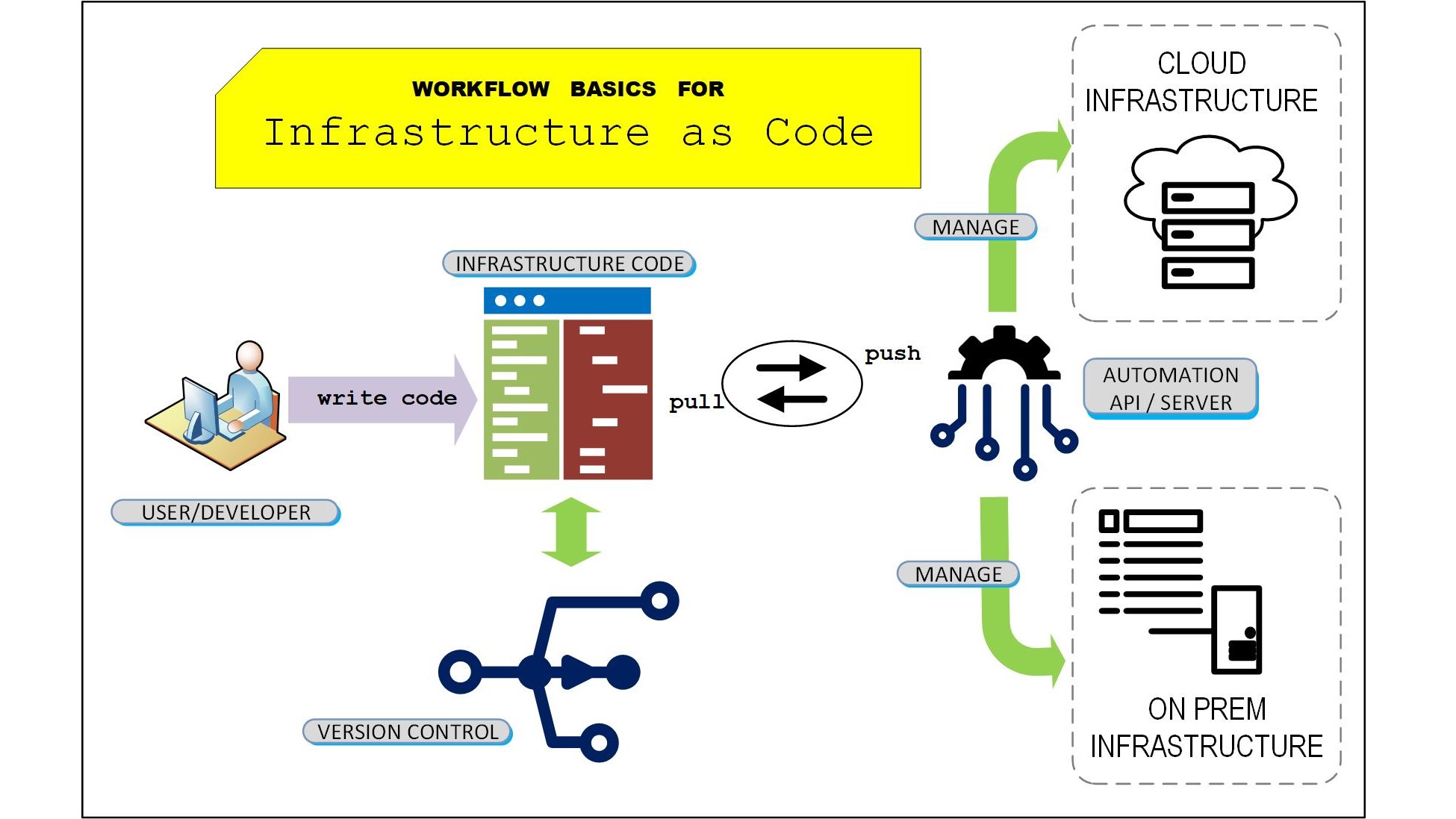
The transition from manual server provisioning to automated state management represents the most significant leap in operational maturity. Manual configuration—often referred to as "snowflake" servers—creates fragile environments that are impossible to replicate reliably. When teams adopt Infrastructure as Code (IaC) using tools like Terraform, Pulumi, or AWS CloudFormation, they treat their infrastructure with the same rigor as application source code.
This shift enables three critical operational improvements:
- Environment Parity: Developers can spin up ephemeral environments that mirror production, eliminating the "it works on my machine" syndrome.
- Version Control for Infrastructure: Changes are tracked via Git, allowing teams to audit who changed a load balancer configuration or security group, and why.
- Automated Drift Detection: Modern IaC tools continuously compare the desired state defined in code against the actual state in the cloud provider. If a manual change occurs in the console, the system alerts the team or automatically reverts the unauthorized modification.
Moving to automated state management requires an upfront investment in writing modules and templates. However, the long-term payoff is the ability to scale from managing ten servers to thousands without a linear increase in headcount. By codifying the infrastructure, you remove the human dependency from the provisioning process, allowing engineers to focus on architectural improvements rather than repetitive configuration tasks.
Limitations and overhead of devops adoption
Transitioning to a high-maturity DevOps model requires significant upfront investment in infrastructure and cultural alignment. Many engineering teams underestimate the friction caused by shifting responsibilities from siloed operations teams to developers.
This transition often results in a temporary dip in velocity as engineers learn to manage deployment configurations, monitor production environments, and troubleshoot infrastructure-as-code (IaC) scripts alongside their feature work.
Hidden costs of toolchain maintenance
The promise of automated workflows often masks the reality of toolchain sprawl. Managing a modern CI/CD pipeline is not a one-time setup; it is an ongoing engineering commitment. Teams frequently find themselves dedicating 15% to 20% of their sprint capacity to maintaining the pipeline itself rather than shipping product features.
Specific overhead drivers include:
- Plugin and dependency updates: Tools like Jenkins or self-hosted GitLab runners require constant patching to address security vulnerabilities. Failing to update these leads to technical debt that eventually halts deployment capabilities.
- Configuration drift: As environments scale, keeping development, staging, and production configurations synchronized becomes complex. Without rigorous automated testing of infrastructure changes, teams spend hours debugging environment-specific issues that do not exist in the local development setup.
- Observability noise: Implementing comprehensive logging and monitoring tools like Datadog or Prometheus is essential, but configuring meaningful alerts is labor-intensive. Poorly tuned alerts lead to fatigue, where engineers ignore critical system warnings, effectively negating the benefits of the monitoring stack.
Scaling engineering teams must account for these operational costs in their capacity planning. If the overhead of maintaining the automation exceeds the time saved by the automation, the team has reached a point of diminishing returns. Successful scaling requires treating the DevOps pipeline as a product, complete with its own roadmap, backlog, and dedicated maintenance cycles to prevent the infrastructure from becoming a bottleneck to delivery.
Criteria for selecting the right delivery model
Selecting a delivery model requires balancing operational overhead against the need for deployment velocity. Engineering leaders must evaluate whether their current infrastructure supports decentralized ownership or if a centralized platform team is necessary to maintain stability during rapid scaling.
Assessing team size and technical maturity
Team size dictates the communication overhead of your deployment pipeline. For teams under 20 engineers, a monolithic repository with a unified CI/CD pipeline often reduces friction. As teams grow beyond this threshold, the cognitive load of managing a single pipeline becomes a bottleneck, necessitating a shift toward micro-services and decentralized devops ownership.
Technical maturity is measured by the team's ability to handle incident response and self-service infrastructure. If developers require a ticket-based system to provision environments, the organization is at a low maturity level. High-maturity teams utilize Infrastructure as Code (IaC) tools like Terraform or Pulumi, allowing developers to manage their own resources within guardrails defined by security teams.
When evaluating your delivery model, consider these three operational trade-offs:
- Standardization vs. Flexibility: Centralized teams enforce strict standards, which improves security but slows down experimentation. Decentralized models increase speed but risk configuration drift across services.
- Tooling Consolidation: Using a single vendor (e.g., GitHub Actions or GitLab CI) simplifies onboarding but creates vendor lock-in. Multi-tool environments offer specialized capabilities but increase the burden on platform engineers to maintain integrations.
- Deployment Frequency: High-frequency teams require automated canary deployments and robust observability stacks like Datadog or Prometheus. If your team lacks automated testing coverage, moving to a high-velocity delivery model will likely increase the rate of production outages.
Ultimately, the right model is the one that minimizes the time between code commit and production verification without requiring manual intervention from a dedicated operations specialist.
Alternative operational models for small-scale teams
Scaling engineering teams often face a binary choice: build a dedicated DevOps function or leverage abstraction layers to minimize overhead. For teams under 20 engineers, the cost of hiring specialized site reliability engineers (SREs) can consume the entire infrastructure budget, often leading to premature optimization.
Instead, many organizations adopt platform-as-a-service (PaaS) or serverless architectures to shift the burden of maintenance to third-party providers.
Outsourcing complexity to managed cloud providers
Managed services like AWS Fargate, Google Cloud Run, or Vercel allow developers to deploy code without managing underlying virtual machines or Kubernetes clusters. When comparing the cost of internal DevOps teams versus managed infrastructure, the trade-off centers on control versus velocity.
- Internal DevOps Team: Requires hiring at least two senior engineers to ensure 24/7 coverage. Total annual cost often exceeds $300,000 in salary and benefits. This model provides maximum control over networking, security compliance, and custom CI/CD pipelines but demands significant time investment in maintenance.
- Managed Infrastructure Services: Costs scale linearly with usage. While the per-request price is higher than raw compute instances, the total cost of ownership (TCO) is significantly lower for small teams. You eliminate the need for dedicated headcount focused on patching kernels or managing cluster upgrades.
The primary risk of outsourcing complexity is vendor lock-in. Migrating from a proprietary managed service to a self-hosted environment requires a complete rewrite of infrastructure-as-code (IaC) configurations. Teams should evaluate their long-term growth trajectory; if the product requires highly specialized hardware or complex networking topologies that managed services cannot support, building an internal DevOps capability early is a necessary investment. For standard web applications, however, managed services provide a faster path to production with predictable operational costs.
Measuring success in a devops environment
Scaling engineering teams requires moving beyond subjective assessments of team health. True maturity relies on quantitative data that reflects both velocity and stability. Without a standardized measurement framework, teams often fall into the trap of optimizing for vanity metrics, such as the number of commits or lines of code written, which fail to correlate with actual business value.
DORA metrics as a baseline for performance
The DevOps Research and Assessment (DORA) framework provides the industry standard for evaluating engineering efficiency. By focusing on four key metrics, teams can objectively categorize their maturity level from low to elite performers.
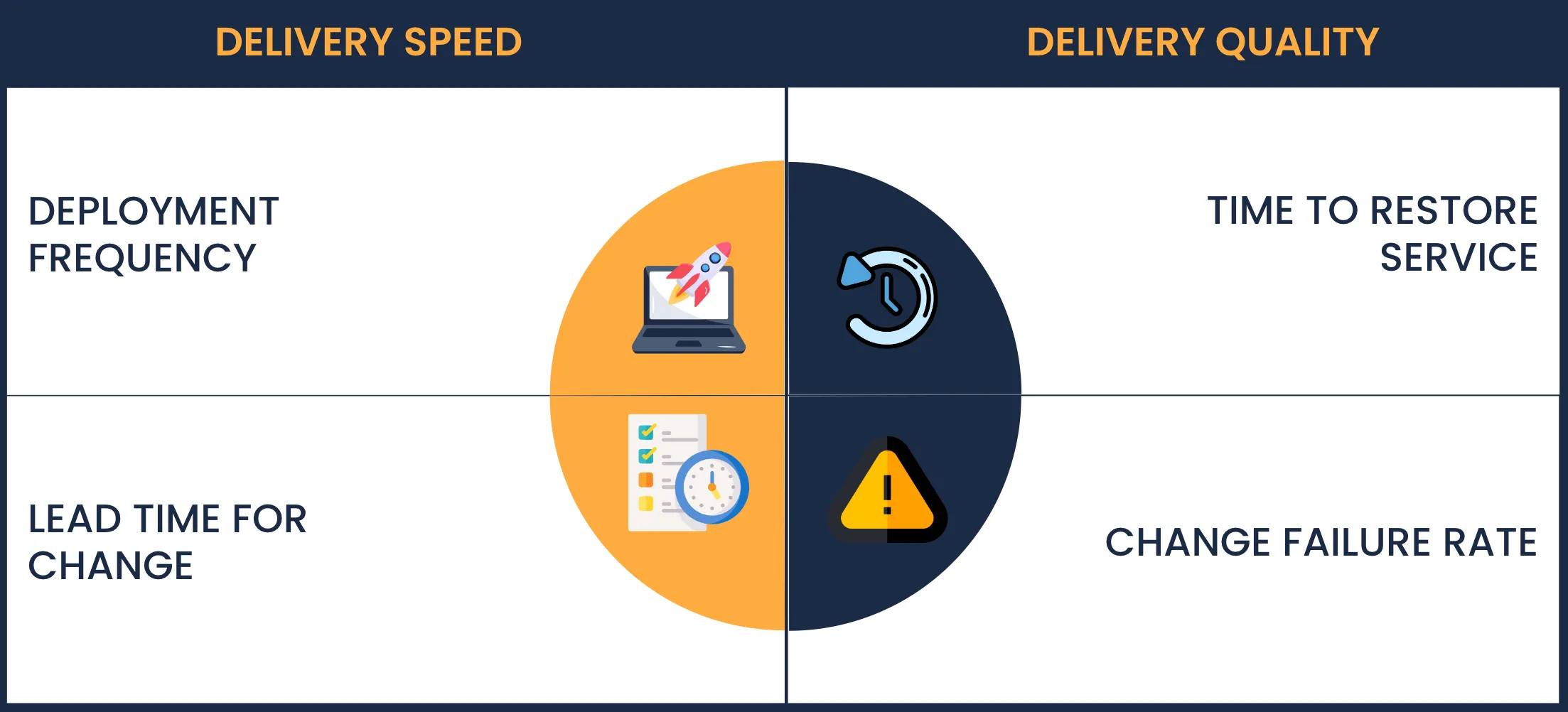
- Deployment Frequency: This measures how often your team successfully releases code to production. High-performing teams deploy multiple times per day, whereas low-performing teams often struggle with monthly or quarterly release cycles.
- Lead Time for Changes: This tracks the duration from code commit to code running in production. A shorter lead time indicates a streamlined CI/CD pipeline and minimal manual intervention.
- Change Failure Rate: This percentage represents how often deployments result in degraded service or require hotfixes. A low failure rate is the primary indicator of robust automated testing and canary deployment strategies.
- Failed Service Recovery Time: This measures the mean time to restore service (MTTR) when a failure occurs. It tests the resilience of your monitoring, alerting, and incident response processes.
To implement these, engineering managers should integrate tools like LinearB, Sleuth, or Faros.ai directly into their version control and CI/CD pipelines. These tools aggregate data from GitHub, Jira, and Jenkins to provide real-time dashboards.
If your team is currently in the "low" category, prioritize reducing the Change Failure Rate before attempting to increase Deployment Frequency. Pushing code faster through a broken pipeline only compounds technical debt and increases operational burnout. Use these metrics as a diagnostic tool to identify bottlenecks in your delivery lifecycle rather than as a performance management weapon against individual developers.
Common pitfalls during cultural integration
Scaling engineering teams often leads to the mistaken belief that DevOps is a specific job title rather than a cultural shift. Organizations frequently attempt to "buy" maturity by hiring a dedicated team to handle CI/CD pipelines, which inadvertently creates a new bottleneck. This approach isolates operational knowledge, effectively recreating the wall between development and operations that the methodology was designed to dismantle.
Avoiding the devops engineer silo
Preventing the centralization of knowledge requires a shift from specialized roles to embedded expertise. When one team owns the infrastructure, developers lose the incentive to understand the deployment lifecycle, leading to a "throw it over the wall" mentality. To avoid this, engineering leaders should implement the following strategies:
- Embedded Champions: Instead of a standalone team, integrate engineers with strong operational backgrounds into product squads. Their role is to mentor peers on infrastructure-as-code (IaC) rather than performing the work for them.
- Shared On-Call Rotations: Require developers to participate in the on-call rotation for the services they build. This creates a direct feedback loop, forcing teams to prioritize observability and error handling during the development phase.
- Standardized Tooling Platforms: Build internal developer platforms (IDPs) using tools like Backstage or Crossplane. These platforms provide self-service capabilities, allowing developers to provision resources independently while adhering to centralized security and compliance guardrails.
The goal of cultural integration is to make operational excellence a baseline requirement for every engineer. If a team relies on a single "DevOps expert" to resolve deployment failures, the organization has failed to scale its maturity. True success is measured by the ability of any squad to ship code from commit to production without external intervention. By shifting the focus from hiring specialists to upskilling the entire engineering organization, teams can maintain velocity without sacrificing system stability.
Future-proofing your infrastructure strategy
Scaling engineering teams requires moving beyond basic CI/CD pipelines toward automated governance and self-healing systems. Infrastructure as Code (IaC) must evolve from simple configuration management into immutable infrastructure patterns where components are replaced rather than patched. This shift minimizes configuration drift and ensures that environments remain consistent across development, staging, and production.
Evolution from monolithic to microservices deployment
Architectural decisions dictate the necessity of advanced devops practices because microservices introduce complexity that manual operations cannot manage. In a monolithic architecture, deployment is a singular event. When you transition to microservices, you face a distributed systems challenge where service discovery, inter-service communication, and observability become primary bottlenecks. If your team manages more than five independent services, the overhead of manual deployments will inevitably stall your release velocity.
Advanced teams mitigate this by implementing service meshes like Istio or Linkerd to handle traffic management, security, and telemetry without modifying application code. This architectural layer allows for canary deployments and blue-green releases, which are essential for maintaining uptime when scaling. Without these automated deployment strategies, the risk of a single service failure cascading through the entire ecosystem increases significantly.
To future-proof your stack, prioritize the following technical shifts:
- Policy as Code: Use tools like Open Policy Agent (OPA) to enforce security and compliance standards automatically during the build process.
- Observability over Monitoring: Move from simple uptime alerts to distributed tracing using OpenTelemetry to identify latency bottlenecks in complex service chains.
- GitOps Workflows: Adopt tools like ArgoCD or Flux to ensure your cluster state always matches the configuration stored in your version control system, eliminating manual kubectl interventions.
The transition to these advanced practices is not merely about adopting new tools; it is about reducing the cognitive load on your engineers. By abstracting infrastructure complexity, you allow developers to focus on feature delivery while the platform team manages the reliability of the underlying orchestration layer.
Frequently Asked Questions
Primary indicators of high devops maturity
High maturity is characterized by automated CI/CD pipelines, infrastructure as code (IaC), robust observability, and a culture of blameless post-mortems. These practices result in lower change failure rates and faster mean time to recovery (MTTR).
Evaluation of full automation for early-stage startups
Not necessarily. Early-stage startups often benefit more from manual, repeatable processes that allow for rapid pivoting. Over-investing in complex DevOps tooling too early can create technical debt and slow down feature delivery.

