
.webp)
.png)
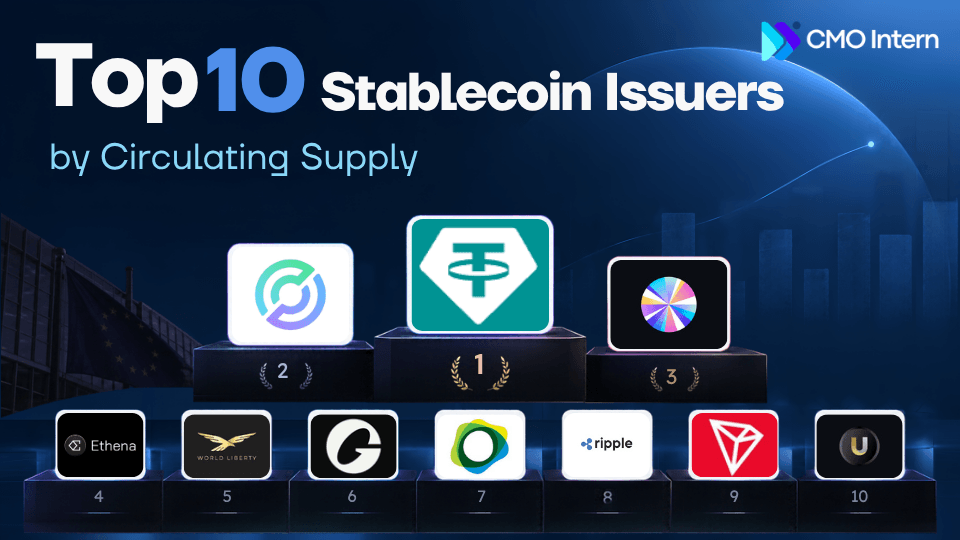
The Top 10 Stablecoin Issuers by Circulating Supply represent the core infrastructure of the digital asset economy, facilitating everything from decentralized finance to cross-border payments. Unlike volatile cryptocurrencies, these assets maintain a stable value by tracking the US dollar, though their reliability depends on distinct reserve structures, redemption mechanisms, and transparency standards. Understanding these issuers is essential for evaluating the competitive landscape and the risks inherent in different stablecoin models.
Circulating supply indicates how much of a stablecoin is outstanding in the market, offering insight into adoption and distribution. It does not, by itself, establish whether an issuer has sufficient reserves, whether holders can redeem tokens directly, or how resilient a stablecoin might be during market stress.
As of October 2026, Tether and Circle remain the dominant names in the US dollar stablecoin sector, while Sky, Ethena, Paxos, World Liberty Financial, and Ripple represent different approaches to expanding the market. This ranking examines ten notable issuers and protocols, considering their circulating supply, underlying models, market roles, and key factors that users should evaluate before drawing conclusions about their reliability.
Top 10 Stablecoin Issuers by Circulating Supply
1. Tether
Representative stablecoin: USDT
Tether is the largest stablecoin issuer by circulating supply, with USDT serving as a major source of dollar-denominated liquidity across centralized exchanges, decentralized applications, and international cryptocurrency markets. Its extensive circulation across multiple blockchain networks makes it an important settlement asset for traders, market makers, and users who want to move dollar-linked value without relying on conventional banking transfers for every transaction.
USDT follows a fiat-backed model. Tether reports that its reserves include cash and cash equivalents, short-term US Treasury securities, and other disclosed asset categories. The precise composition of these reserves matters because assets can differ in liquidity, valuation risk, and accessibility during periods of market stress. A large circulating supply demonstrates widespread adoption, but it should not be treated as independent proof of reserve quality.
Tether's competitive advantage lies in its established trading liquidity, broad network distribution, and integration into the cryptocurrency ecosystem. These characteristics can make USDT convenient for transferring funds between platforms and accessing digital asset markets. Nevertheless, users and institutions should review the issuer's latest reserve disclosures, third-party assurance reports, redemption requirements, and applicable legal arrangements rather than relying solely on its market position.
2. Circle
Representative stablecoin: USDC
Circle issues USDC, one of the most widely used dollar-pegged stablecoins in cryptocurrency markets and digital financial infrastructure. Its circulating supply places it firmly behind USDT, but USDC occupies an important position in institutional settlement, decentralized finance, and applications that prioritize documented reserve arrangements and compliance-oriented operations.
USDC is designed to maintain its dollar peg through reserve assets intended to support redemption at face value. Circle has historically emphasized cash holdings, short-term US Treasury exposure, and regular third-party reserve attestations. These disclosures provide useful information about reserve coverage at specified reporting dates, although an attestation should not automatically be interpreted as a comprehensive audit of every operational, custody, or counterparty risk.
Circle's distribution across multiple blockchain networks helps developers integrate USDC into payment applications, exchanges, lending protocols, and tokenized financial products. Its role is particularly relevant for businesses seeking a dollar-denominated settlement asset with established reporting practices. Even so, users should consider banking counterparties, redemption eligibility, network-specific liquidity, and the legal terms governing their holdings.
3. Sky Protocol
Representative stablecoin: USDS
Sky Protocol, formerly associated with MakerDAO, represents a different approach to stablecoin issuance. Its USDS stablecoin belongs to a decentralized financial ecosystem that also includes DAI, an established collateral-backed digital dollar. Rather than relying exclusively on a conventional corporate issuer holding cash reserves, Sky uses protocol rules, collateral arrangements, smart contracts, and governance mechanisms to support its stablecoins.
USDS has expanded the ecosystem's dollar-denominated liquidity and provides users with access to a protocol-based model for creating and managing stable value. Its collateral framework can include crypto assets and exposure to real-world financial assets, depending on the relevant mechanisms and portfolio arrangements. This structure introduces risks that differ from those of traditional fiat-backed stablecoins, including collateral volatility, liquidation performance, smart-contract vulnerabilities, and governance decisions.
The protocol's on-chain activity can offer visibility into collateral positions and system parameters, but not every underlying asset or off-chain arrangement is necessarily verifiable directly from blockchain data. Users should distinguish between the transparency of smart-contract activity and the independent verification of off-chain collateral. Sky is particularly relevant to DeFi participants who want to understand how collateralized stablecoin systems operate beyond the conventional issuer-and-bank model.
4. Ethena
Representative stablecoin: USDe
Ethena operates a synthetic dollar system through USDe, which differs fundamentally from a conventional stablecoin backed solely by cash and short-term government securities. Its model uses crypto assets and derivatives positions designed to maintain a delta-neutral exposure. The system seeks to offset certain price movements in its underlying assets through hedging arrangements, rather than depending entirely on a traditional reserve portfolio.
USDe has attracted attention within decentralized finance because its architecture connects stable-value exposure with crypto-native trading strategies. Its supply reflects demand for this alternative model, including its use in trading, collateral arrangements, and associated financial products. However, the mechanism supporting USDe introduces a distinct risk profile that cannot be evaluated using the same criteria applied to a fully fiat-backed token.
Important considerations include funding rates, derivatives exchange exposure, collateral custody, liquidity during market disruptions, and the operational effectiveness of hedging positions. A prolonged shift in funding conditions or disruption at a trading venue could affect the economics of the system. Ethena is therefore a significant example of innovation in digital dollars, but its model should not be confused with a bank-deposit-backed stablecoin or assumed to provide equivalent protections.
5. World Liberty Financial
Representative stablecoin: USD1
World Liberty Financial is associated with USD1, a dollar-pegged stablecoin designed to participate in cryptocurrency trading and digital financial applications. The project adds another competitor to a market in which distribution, liquidity, reserve arrangements, and integration partnerships can be as important as the technical design of the token itself.
An important distinction is that the project associated with a stablecoin's brand is not necessarily the regulated legal entity responsible for issuing the token or holding its reserves. USD1's issuance and operational arrangements involve BitGo, so evaluating the asset requires examining the responsibilities of the relevant issuing and custody entities rather than attributing every function to World Liberty Financial alone.
The main questions for users and institutional counterparties concern reserve composition, redemption rights, the legal identity of the issuer, custody arrangements, and the availability of liquidity across supported networks. Distribution partnerships may accelerate adoption, but they do not independently establish reserve quality or guarantee that holders can redeem tokens under every market condition.
USD1 is worth monitoring as a relatively newer participant in the stablecoin sector. Its long-term competitive position will depend on sustained circulation, reliable redemption infrastructure, transparent disclosures, and adoption beyond short-term market attention.
6. Paxos / Global Dollar Network
Representative stablecoin: USDG
USDG, known as Global Dollar, is associated with the Global Dollar Network and issued by Paxos. The project aims to expand dollar-denominated digital payments and stablecoin distribution through an ecosystem involving multiple market participants. Its position reflects growing interest in stablecoin infrastructure that combines regulated issuance with partnerships across exchanges, fintech services, and other distribution channels.
Paxos has experience issuing and administering dollar-linked digital assets, and its broader stablecoin operations include reserve management and regulatory compliance processes. For USDG, users should examine the specific token's reserve disclosures, redemption terms, legal issuer, and jurisdictional arrangements instead of assuming that all assets managed by the same organization have identical characteristics.
One potentially important element of the Global Dollar Network model is the relationship between distribution incentives and the economics of stablecoin adoption. Partnerships can increase the number of places where a token is available, but the durability of that growth depends on whether users continue to hold and transact with the asset after promotional incentives change.
USDG is a useful case study in how stablecoin competition increasingly depends on the combination of reserve credibility, accessible distribution, and a sustainable network of commercial partners.
7. Paxos
Representative stablecoin: PYUSD
Paxos also issues PYUSD, the dollar-pegged stablecoin distributed under the PayPal USD brand. Although the token benefits from its association with PayPal's payment ecosystem, Paxos is the issuing entity. This distinction matters when assessing legal obligations, reserve administration, and the mechanisms available to token holders.
PYUSD is designed to maintain a one-dollar value through reserve backing, with disclosed arrangements intended to support redemption. Its distribution across supported payment and blockchain environments gives it a different market profile from stablecoins whose activity is concentrated primarily on cryptocurrency exchanges. Adoption depends on practical access, wallet and platform integration, transaction costs, and the usefulness of the token for actual payments.
When evaluating PYUSD, users should review the latest reserve attestations, supported networks, redemption eligibility, and platform-specific terms. Availability through a payment service does not mean that every user has identical access to direct issuer redemption, nor does it eliminate the risks associated with blockchain transfers or third-party platforms.
Paxos's position in the market is especially interesting because it operates across multiple stablecoin arrangements. Comparing PYUSD with USDG and USDP can help readers understand how one issuing organization may support different distribution strategies and market segments without making those tokens interchangeable in every operational or legal respect.
8. Ripple
Representative stablecoin: RLUSD
Ripple introduced RLUSD to support dollar-denominated activity across blockchain-based financial services, including institutional transactions and cross-border settlement. Its position reflects the demand for stablecoins that can connect digital asset markets with payment infrastructure and financial applications.
RLUSD is designed as a fiat-backed stablecoin, with reserve arrangements intended to support its dollar peg. The token operates within Ripple's broader digital asset ecosystem and is available on supported blockchain networks. Its market growth depends on adoption by exchanges, payment providers, financial institutions, and applications that can benefit from a stable settlement asset.
For businesses considering RLUSD, the relevant evaluation criteria include the quality and frequency of reserve disclosures, the legal entity responsible for issuance, redemption requirements, network availability, and liquidity in the markets where the token will be used. Institutional branding or a regulated operating structure can be relevant, but neither should replace an examination of the actual documentation and contractual protections.
RLUSD remains a notable competitor because it targets use cases where predictable settlement value and integration with financial infrastructure matter. Its long-term ranking will depend on whether those use cases generate durable demand rather than circulation driven mainly by trading activity.
9. TRON DAO Ecosystem
Representative stablecoin: USDD
USDD is a dollar-pegged stablecoin associated with the TRON ecosystem. It seeks to provide a stable-value asset for decentralized finance, trading, and blockchain-based transfers. Its market position reflects demand for dollar-denominated liquidity within an ecosystem that supports a range of digital asset applications.
USDD's backing and stabilization arrangements should be evaluated separately from those of conventional fiat-backed stablecoins. Depending on the system's current design and disclosures, users may need to examine collateral holdings, reserve management, market mechanisms, and the governance framework used to respond to changes in demand or collateral value.
A stablecoin's reported supply does not reveal how efficiently its peg is maintained or how much liquidity would remain available during an abrupt increase in redemptions. Users should therefore examine price deviations, collateral information, redemption mechanisms, and the availability of liquid trading markets alongside circulating supply.
USDD is relevant to the stablecoin landscape because it illustrates how ecosystem-specific distribution and protocol-level mechanisms can sustain a dollar-linked asset. Its risk assessment, however, should account for the particular design and governance arrangements rather than assuming that every dollar-pegged token has the same degree of reserve backing.
10. United Stables
Representative stablecoin: U
United Stables is associated with U, a stablecoin project seeking to provide dollar-linked liquidity within the digital asset ecosystem. Its appearance among the notable stablecoins by supply illustrates the continuing expansion of the market beyond the best-known issuers.
For projects at this stage of market development, circulating supply should be interpreted alongside liquidity depth, supported networks, holder concentration, and the transparency of the underlying issuance model. A token can reach a meaningful supply level through exchange listings, protocol integrations, or incentives without necessarily demonstrating broad and persistent payment adoption.
Before relying on U for trading or settlement, users should verify its current reserve or collateral model, the identity of the responsible issuing entity, redemption conditions, and the availability of independent assurance. It is also important to distinguish between total outstanding supply and the amount readily available for trading on a particular network or exchange.
United Stables provides an example of the competitive pressure facing established stablecoin issuers. To maintain its position, an emerging project must demonstrate not only that it can attract circulation, but also that it can sustain liquidity, transparency, and operational reliability as market conditions change.
What Determines a Stablecoin Issuer's Market Position?
Circulating supply is a useful indicator of adoption, but it is only one part of a broader assessment. A meaningful comparison of stablecoin issuers should consider several factors that influence the utility and resilience of their products.
- Reserve quality and transparency: Fiat-backed stablecoins depend on the assets and arrangements supporting redemption. Users should review reserve composition, disclosure frequency, the scope of third-party assurance, and whether the available documentation clearly identifies outstanding liabilities. Attestations and full financial audits serve different purposes and should not be treated as equivalent.
- Redemption access: A stablecoin's stated dollar peg does not guarantee that every holder can redeem directly with the issuer. Minimum redemption amounts, identity verification, geographic restrictions, fees, and contractual eligibility can affect how easily a token can be converted into fiat currency.
- Blockchain distribution and liquidity: Stablecoins operating across multiple networks can serve a wider range of applications, but liquidity is not necessarily uniform across chains. Bridged tokens may introduce additional smart-contract or custodian risks, while thin trading markets can increase transaction costs during periods of volatility.
- Issuance and stabilization model: Fiat-backed, crypto-collateralized, and synthetic stablecoins rely on different mechanisms. Evaluating them requires understanding the assets, counterparties, contracts, or governance processes that support their intended value.
- Regulatory and operational structure: The identity and jurisdiction of the legal issuer can affect reporting obligations, redemption rights, and the protections available to users. It is important to distinguish a brand, a protocol, a distributor, a custodian, and the entity legally responsible for issuance.
Frequently Asked Questions
1. What is a stablecoin issuer?
A stablecoin issuer is the company, trust entity, or other organization legally responsible for issuing a stablecoin. In decentralized systems, issuance may instead be governed by a protocol and its smart contracts. The brand promoting a token and the entity responsible for its issuance are not always the same.
2. Which stablecoin issuer has the largest circulating supply?
Tether remains the largest issuer by circulating supply, primarily through USDT. Circle ranks second through USDC. Their relative supplies can change over time as demand, redemptions, and market conditions shift.
3. Does a higher circulating supply mean a stablecoin is safer?
No. Circulating supply indicates the amount outstanding, not the quality of the reserves or the effectiveness of redemption arrangements. A comprehensive assessment should also consider collateral, liquidity, independent assurance, legal rights, operational risks, and the mechanisms used to maintain the peg.
4. What is the difference between fiat-backed and crypto-backed stablecoins?
Fiat-backed stablecoins generally rely on traditional financial assets, such as cash and short-term government securities, to support redemption. Crypto-backed stablecoins use digital assets as collateral and may require overcollateralization or liquidation mechanisms to manage volatility. Each model has different risks, including banking and custody exposure for fiat-backed tokens and collateral volatility or smart-contract risk for crypto-backed systems.
5. Why do stablecoin supply rankings change?
Supply changes when issuers mint new tokens, holders redeem existing tokens, or demand shifts between competing assets. Figures may also differ between data providers because of differences in token coverage, chain aggregation, valuation, and the treatment of bridged or wrapped assets.

