


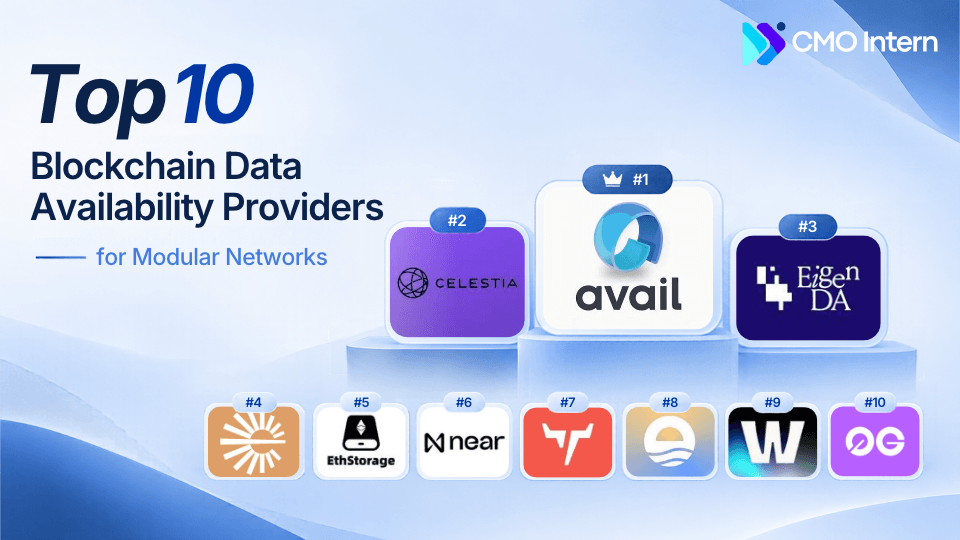
The top 10 platforms blockchain data availability providers for modular networks include specialized infrastructure projects like Celestia, Avail, and EigenDA that enable secure data access for rollups and appchains. As modular blockchain architecture continues to evolve, infrastructure developers are increasingly separating execution, settlement, consensus, and data availability into specialized components. This approach allows blockchain networks to optimize individual functions instead of relying on a single layer to handle every responsibility.
Data availability (DA) has become an important part of this infrastructure. Rollups, application-specific chains, and modular networks need to publish transaction data so that participants can retrieve the information required to verify network activity, reconstruct states, and maintain the security of their systems. Without reliable data availability, even a high-performance execution environment can face limitations in transparency, verification, and recovery.
This has created opportunities for specialized blockchain data companies. Some operate dedicated DA networks, while others offer services connected to existing blockchain ecosystems, restaking infrastructure, decentralized storage, or specialized application environments. Their architectures differ in how data is distributed, verified, stored, and made accessible to network participants.
In this article, we explore 10 blockchain data availability providers for modular networks in 2026. The list includes established infrastructure projects and specialized providers that address different requirements across rollups, appchains, modular blockchain stacks, and decentralized applications.
The companies are presented alphabetically rather than as a definitive performance ranking. Their inclusion does not imply that every provider offers the same type of DA guarantee or is suitable for every blockchain architecture.
What Is Blockchain Data Availability?
Blockchain data availability refers to the ability of network participants to access the transaction data required to verify blockchain activity. In modular blockchain systems, data availability is commonly separated from execution, allowing rollups and application-specific networks to publish data through specialized infrastructure.
For example, a rollup may execute transactions in its own environment while publishing transaction data to an external DA layer. The execution environment processes transactions, while the DA layer helps ensure that the information required for verification and reconstruction can be retrieved.
Data availability should not be confused with permanent data storage. A DA network may guarantee that data is available during a defined period without necessarily providing indefinite archival storage. Developers must therefore consider both availability guarantees and long-term data retention when selecting infrastructure.
Why Data Availability Matters for Modular Networks
Data availability is particularly important for modular networks because their architecture distributes responsibilities across multiple layers. A rollup may depend on an external DA provider instead of publishing all transaction data directly to its settlement layer.
This separation can reduce the cost of publishing data and support higher throughput, depending on the architecture and network conditions. However, it also introduces additional design considerations involving verification, trust assumptions, data retention, and recovery procedures.
For optimistic rollups, transaction data may be necessary for participants to reconstruct state transitions and challenge invalid claims. For validity-proof systems, data availability remains important for reconstructing application state and maintaining access to relevant transaction information.
The appropriate DA solution depends on a comprehensive blockchain analysis of the network's security model, settlement environment, performance requirements, and operational constraints.
How We Evaluated Blockchain Data Availability Providers
This Toplist focuses on infrastructure relevance rather than token prices, speculative market performance, or unsupported claims about technical superiority.
The following criteria were considered when reviewing the providers:
Data availability architecture: Whether the provider operates a dedicated DA network, a DA service, a decentralized storage system, or an integrated infrastructure stack.
Verification model: How applications and network participants establish that data has been published and can be retrieved, including sampling, commitments, proofs, or validator-based recovery.
Modular network compatibility: Whether the infrastructure is designed for rollups, application-specific chains, modular execution environments, or related blockchain workloads.
Scalability and performance design: The mechanisms used to distribute data, manage throughput, and support growing workloads without assuming that theoretical capacity guarantees real-world performance.
Security and trust assumptions: The role of validators, operators, committees, consensus mechanisms, and underlying blockchain networks, requiring in-depth blockchain analysis.
Developer integration: The availability of documentation, interfaces, integration pathways, and infrastructure designed for blockchain builders.
Ecosystem relevance: The provider's relationship with modular blockchain infrastructure, rollup development, decentralized applications, and emerging data-intensive use cases, impacting blockchain ecosystems.
The following companies and projects represent different approaches to blockchain data availability. Some are dedicated DA networks, while others provide specialized or adjacent infrastructure that can support particular modular architectures.
Top 10 Blockchain Data Availability Providers for Modular Networks
1. Avail
Avail is a modular blockchain infrastructure project focused on providing data availability for rollups, application-specific chains, and other blockchain systems. Its DA network is designed to separate data publication from execution, allowing developers to build blockchain environments without requiring every application to operate its own independent data availability infrastructure.
Avail DA uses erasure coding and data availability sampling to support verification without requiring light clients to download entire blocks. Its architecture also incorporates cryptographic commitments, allowing participants to verify data availability through proofs associated with published data.
The network's modular approach is relevant to developers building rollups and application-specific blockchain environments that need an external DA layer. Instead of coupling execution and data publication within one blockchain, applications can use Avail as part of a broader modular infrastructure stack.
Avail also has a broader infrastructure direction through Avail Nexus, which focuses on cross-chain connectivity and unified application experiences. This distinction matters because Avail's ecosystem includes both data availability infrastructure and separate interoperability capabilities.
For developers evaluating Avail, the primary considerations include its verification model, validator security, integration requirements, data retrieval procedures, and relationship with the intended settlement environment. The choice should be based on the application's security requirements rather than throughput claims alone.
Key considerations: Modular DA architecture, erasure coding, data availability sampling, cryptographic commitments, and support for rollup-oriented infrastructure.
2. Celestia
Celestia is a modular blockchain network built specifically around data availability and consensus. It allows developers to separate transaction execution from the infrastructure responsible for publishing and making transaction data available.

Its architecture is particularly relevant to sovereign rollups and modular blockchain systems. Rather than requiring every execution environment to operate a complete blockchain stack, developers can use Celestia as a dedicated data availability layer.
Celestia's technical design includes data availability sampling (DAS) and Namespaced Merkle Trees (NMTs). DAS allows light nodes to sample portions of erasure-coded block data to verify availability without downloading the entire block. Namespaced Merkle Trees allow applications to retrieve data associated with their namespaces and verify that the requested data belongs to the published block.
These mechanisms are designed to support modular execution environments that need access to transaction data while avoiding unnecessary downloads of unrelated application data.
Celestia is also relevant to developers building sovereign rollups, where execution and application logic can remain independent of the DA layer. Its architecture gives developers flexibility in choosing how their execution environment, settlement system, and data availability infrastructure interact.
However, choosing Celestia also means evaluating its independent consensus and validator security assumptions. Applications must understand the network's data retrieval model, relevant retention requirements, and how its DA guarantees fit their settlement architecture.
Key considerations: Dedicated modular DA network, data availability sampling, Namespaced Merkle Trees, sovereign rollup infrastructure, and independent consensus assumptions.
3. EigenDA
EigenDA is a data availability service developed within the EigenLayer ecosystem. It is designed to support rollups and blockchain applications that require scalable data publication while integrating with Ethereum-related restaking infrastructure.

Unlike dedicated DA blockchains that operate their own consensus networks, EigenDA uses a service-oriented architecture. Its operators participate in data distribution and availability processes, while its security and verification model is connected to EigenLayer's broader infrastructure.
EigenDA is particularly relevant to Ethereum-oriented modular networks. Developers can evaluate it when building rollups or application-specific chains that need an external DA service without introducing a completely separate DA blockchain into their architecture.
Its design includes erasure coding, cryptographic commitments, and operator-based data distribution. These mechanisms help distribute data across participating infrastructure and support verification through the service's available proof and certification pathways.
The important consideration is that EigenDA's trust assumptions differ from those of a dedicated DA blockchain. Developers should review operator participation, certificate verification, data retrieval, service availability, and the relationship between EigenDA and Ethereum settlement.
EigenDA should therefore be evaluated according to the application's required security model and integration environment, rather than treated as interchangeable with every sampling-based DA network.
Key considerations: Ethereum-oriented infrastructure, EigenLayer integration, operator-based data distribution, cryptographic commitments, and rollup-focused DA services.
4. Espresso
Espresso is blockchain infrastructure focused on shared sequencing and coordination for rollups and modular blockchain systems. Its infrastructure direction is relevant to applications that need coordinated transaction ordering across multiple execution environments.

Espresso's broader architecture includes Espresso DA, which provides data availability functionality within its infrastructure ecosystem. This makes the project relevant to developers evaluating systems that combine sequencing, rollup coordination, and data publication.
Shared sequencing addresses a different problem from data availability. Sequencing determines transaction ordering, while DA concerns whether the data required to verify and reconstruct transactions can be retrieved. These functions can complement each other, but they should not be treated as identical.
For modular blockchain developers, Espresso may be relevant when evaluating infrastructure that coordinates multiple rollups or supports shared transaction ordering. Its DA capabilities should be assessed separately from its sequencing functionality.
The practical evaluation should include the data distribution model, operator assumptions, verification pathways, integration requirements, and the availability of relevant network documentation.
Espresso is therefore an infrastructure option for developers exploring coordinated modular environments, particularly where shared sequencing and DA-related functionality are part of the broader architecture.
Key considerations: Shared sequencing, rollup coordination, modular infrastructure, Espresso DA, and the distinction between transaction ordering and data availability.
5. EthStorage
EthStorage is an Ethereum-oriented storage infrastructure project focused on addressing data storage and scalability requirements within the Ethereum ecosystem.
Its approach is relevant to developers exploring decentralized storage mechanisms that can support blockchain applications and data-intensive workloads. Rather than treating every storage requirement as a simple extension of transaction execution, EthStorage focuses on infrastructure designed to address data storage and access.
For modular networks, storage infrastructure can complement data availability by supporting applications that need to retrieve information beyond the immediate publication window of a DA layer.
This distinction is important. Data availability and long-term storage solve related but different problems. A rollup may publish transaction data through one DA mechanism while relying on separate infrastructure for historical data access, application files, or other storage requirements.
EthStorage should therefore be evaluated according to the application's actual storage architecture. Developers need to consider data retrieval, storage guarantees, verification mechanisms, integration requirements, and the relationship between the storage system and the blockchain environment.
Its Ethereum-oriented direction makes it a relevant project for developers exploring decentralized storage infrastructure within Ethereum-connected applications.
Key considerations: Ethereum-oriented storage, decentralized data access, blockchain application infrastructure, and complementary storage requirements beyond short-term DA.
6. NEAR DA
NEAR DA is a data availability solution designed to support rollups and blockchain applications that need an external data publication mechanism.
Its architecture draws on NEAR infrastructure, allowing developers to evaluate data availability without necessarily operating a separate dedicated DA blockchain.
The solution is relevant to modular developers exploring alternatives to traditional rollup data publication. Depending on the application, a DA service connected to an existing blockchain ecosystem may offer a different integration path from a standalone DA network.
NEAR DA's design should be considered alongside its data publication and retrieval procedures, verification model, network security assumptions, and current ecosystem integrations.
Developers should also distinguish NEAR DA from the broader NEAR Protocol. NEAR's execution environment and its DA functionality serve different infrastructure roles, even when they share an ecosystem.
For modular applications, the main question is whether NEAR DA's data handling model and security assumptions fit the requirements of the intended rollup or execution environment.
Its inclusion in this list reflects its relevance to external DA infrastructure rather than a claim that it provides the same guarantees or architecture as Celestia or Avail.
Key considerations: NEAR ecosystem infrastructure, rollup-oriented data availability, external data publication, and application-specific integration requirements.
7. Nubit
Nubit is a blockchain infrastructure project focused on data availability and data-oriented applications. Its architecture is relevant to developers exploring specialized DA infrastructure for modular networks and applications that generate significant amounts of data.

Data availability providers need to address more than transaction throughput. They must also consider how data is distributed, how participants verify availability, and how applications retrieve the information they need.
Nubit's infrastructure direction makes it relevant to modular developers evaluating alternative DA architectures. Its potential fit depends on the network's current implementation, verification mechanisms, security assumptions, and the availability of supported integration pathways.
For developers, the most important evaluation areas include data publication, retrieval procedures, verification requirements, network participation, and operational readiness.
Nubit should be assessed based on its current documentation and production capabilities rather than assuming that every planned feature or research direction is available to applications today.
Its inclusion reflects the broader development of specialized data availability infrastructure beyond the most established modular DA networks.
Key considerations: Specialized DA infrastructure, data-oriented applications, modular network integration, and current implementation readiness.
8. Sunrise
Sunrise is a blockchain infrastructure project that incorporates data availability functionality into its broader network architecture.
Its DA design includes off-chain blob data, erasure coding, and integrations with decentralized storage systems. Rather than requiring every large data payload to be placed directly into on-chain block data, its architecture uses metadata references and off-chain data handling.
This approach is relevant to applications that need to manage larger data payloads while reducing the amount of data directly included in blockchain transactions.
Sunrise's design illustrates an important distinction between publishing data, storing data, and verifying access to data. These functions can be distributed across different components, depending on the application's architecture.
For modular developers, Sunrise may be worth evaluating when the network's data publication and storage model aligns with the requirements of the application.
The evaluation should include how erasure-coded data is distributed, how references are verified, how retrieval works, and what guarantees are provided by the underlying storage components.
Developers should also assess the network's current deployment status and production suitability before relying on it for critical application infrastructure.
Key considerations: Off-chain blob data, erasure coding, decentralized storage integration, and blockchain-native data handling.
9. Walrus
Walrus is a decentralized storage and data infrastructure project associated with the Sui ecosystem. It focuses on storing and retrieving large data objects through a decentralized network designed for data-intensive applications.

Its relevance to modular blockchain systems comes from the relationship between data availability and storage. Applications that publish transaction data or large content objects may need separate mechanisms for ensuring that information can be retrieved over time.
Walrus is particularly relevant to developers building applications that require decentralized data storage, including applications that manage media, large files, or other data-heavy assets.
However, decentralized storage should not automatically be treated as equivalent to a DA layer used by rollups. The security requirements, verification pathways, retrieval guarantees, and integration model can differ significantly.
For developers, the important question is whether Walrus provides the specific data publication and availability properties required by their application, or whether it is better suited to a complementary storage role.
Its architecture should be evaluated according to the intended data type, storage duration, retrieval requirements, and relationship with the application's blockchain environment.
Key considerations: Decentralized storage, data-intensive applications, Sui ecosystem infrastructure, and complementary storage requirements.
10. 0G
0G is a decentralized infrastructure project focused on data availability, storage, and AI-oriented workloads. Its broader architecture is designed to support applications that require data-intensive infrastructure rather than relying exclusively on traditional blockchain transaction processing.

For modular blockchain developers, 0G is relevant because AI applications and decentralized systems can generate data requirements that extend beyond conventional rollup transaction data.
Its infrastructure direction includes data availability and storage components, making it important to distinguish the individual services from the broader 0G ecosystem.
Applications may need different guarantees for publishing data, retrieving information, verifying availability, and maintaining access to stored content. These requirements should be evaluated separately when assessing the architecture.
0G may be relevant to developers exploring decentralized AI infrastructure, modular systems, or applications that combine blockchain execution with data-intensive processing.
Its suitability depends on the current availability of the required services, their integration pathways, the verification model, and the application's security assumptions.
Key considerations: AI-oriented infrastructure, decentralized data availability, storage-related services, and data-intensive modular applications.
How to Choose a Data Availability Provider for a Modular Network
Selecting a DA provider should begin with the application's architecture rather than a generic ranking of networks.
1. Identify the Required Data Availability Model
The first step is determining what data must be published and who needs to retrieve it.
A rollup may need transaction data that allows participants to reconstruct state and verify execution. An application-specific chain may have different requirements depending on its execution and settlement design.
Developers should identify whether they need a dedicated DA blockchain, a service connected to an existing ecosystem, or decentralized storage that complements the DA layer.
These options are not interchangeable. Each provides different infrastructure responsibilities and security assumptions.
2. Evaluate Verification and Security Assumptions
A provider's security model determines how applications establish that data is available.
Some networks use data availability sampling, while others rely on operator attestations, cryptographic commitments, validator-based recovery, or different verification mechanisms.
Developers should evaluate the role of network operators, the ability to independently verify data availability, the relevant consensus model, and the assumptions required for data retrieval.
The key question is not simply whether a provider uses cryptographic technology. It is whether the complete verification process matches the application's security requirements.
3. Consider Throughput and Data Costs
DA requirements vary significantly between applications.
A rollup publishing relatively small transaction batches may have different needs from a data-intensive application generating large volumes of information.
Developers should evaluate the provider's current throughput, pricing structure, capacity management, and behavior under actual network conditions.
Published throughput figures should be interpreted carefully. Maximum capacity, measured throughput, and sustained production performance are different metrics.
A useful evaluation should also consider the cost of retrieving data, operating infrastructure, and maintaining access for the required period.
4. Review Data Retention and Recovery
Data availability does not necessarily mean permanent storage.
Applications may require historical transaction data to remain accessible beyond the DA provider's standard availability period. This is particularly important for rollups that depend on historical data for reconstruction, auditing, or dispute resolution.
Developers should determine how long data remains available, whether archival infrastructure is required, and how data can be recovered if a service becomes unavailable.
For applications with long-term storage requirements, a separate decentralized storage solution may be necessary.
5. Check Integration and Operational Readiness
A provider's architecture may appear suitable in theory but still require significant engineering work to integrate.
Developers should review available APIs, SDKs, documentation, supported execution environments, and existing integrations.
They should also assess network maturity, operational reliability, monitoring requirements, and the availability of relevant production infrastructure.
A practical evaluation should include testing data publication, verification, retrieval, and recovery under realistic application conditions.
Frequently Asked Questions
1. What is a blockchain data availability provider?
A blockchain data availability provider offers infrastructure that helps blockchain networks publish and retrieve transaction data. Depending on its architecture, the provider may operate a dedicated DA network, a DA service, or complementary data infrastructure.
2. Why do modular blockchains need data availability layers?
Modular blockchains separate responsibilities such as execution, settlement, consensus, and data availability. A dedicated DA layer allows rollups and application-specific chains to publish transaction data without necessarily operating their own complete data availability infrastructure.
3. Are data availability layers the same as decentralized storage?
No. Data availability focuses on ensuring that published data can be retrieved and verified according to a network's guarantees. Decentralized storage focuses on storing and retrieving data over time. Some projects offer both capabilities, but their guarantees and architectures can differ.
4. What is the difference between Celestia and Avail?
Celestia and Avail are dedicated modular DA networks, but they use different technical architectures and verification mechanisms. Celestia uses data availability sampling and Namespaced Merkle Trees, while Avail uses cryptographic commitments and data availability sampling. Developers should compare their security assumptions, integration requirements, and data retrieval models.
5. Is EigenDA a separate blockchain?
EigenDA is a data availability service connected to the EigenLayer ecosystem rather than a dedicated standalone DA blockchain in the same sense as Celestia or Avail. Its architecture and security assumptions should therefore be evaluated separately from those of independent DA networks.

