
.webp)
.png)
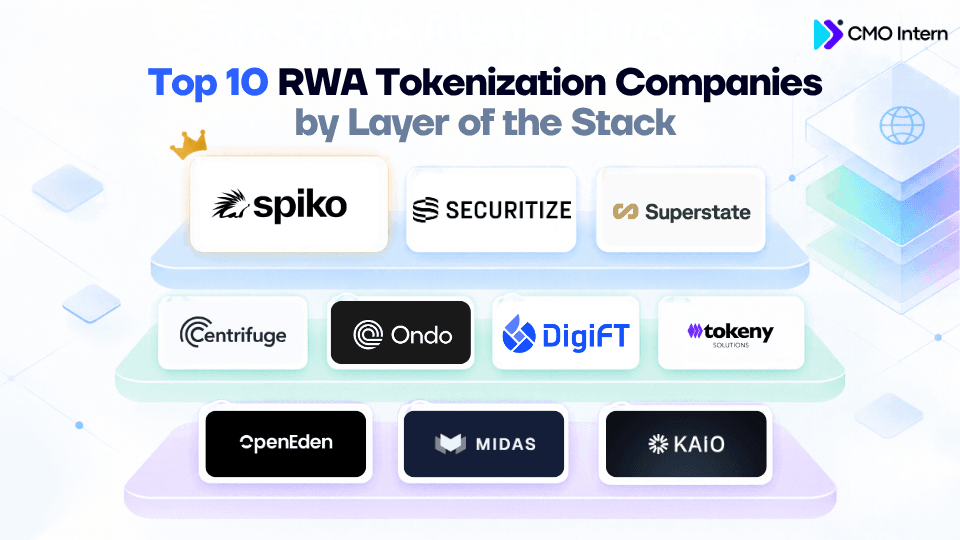
The Top 10 tokenized money market fund platforms in 2026 are leading the integration of traditional cash-management products with blockchain-based settlement and transparency. These platforms represent fund shares or short-duration fixed-income exposure on-chain, providing institutional investors with programmable liquidity and efficient access to digital-asset infrastructure.
The market is broader than simply putting a conventional money market fund on a blockchain. Some platforms issue their own tokenized funds, while others provide the technology, compliance layer, distribution infrastructure, or regulated marketplace that allows asset managers to bring money market and Treasury products onchain.
The Bank for International Settlements describes tokenized money market funds as securities that can circulate on public blockchains while providing money-market returns and regulatory protections, although the structure also introduces liquidity, operational, and compliance considerations.
This list focuses on established or emerging companies with meaningful activity in tokenized money market funds, Treasury-backed cash products, or the infrastructure supporting them. It intentionally avoids mega-cap financial and technology companies that dominate the broader market but offer less useful differentiation for a specialist industry comparison.
Top 10 tokenized money market fund platforms in 2026
1. Spiko
Spiko is one of the most directly focused tokenized money market fund platforms in the market. Unlike general-purpose RWA infrastructure providers, Spiko built its platform around tokenized financial instruments, with money market funds forming the core of its initial product offering.
The company launched its EUR and USD tokenized money market funds in 2024. Its funds use blockchain-based registries while remaining regulated investment funds under the European framework. Spiko says its funds invest in ultra-short-term government debt and that the fund shares can be transferred using blockchain infrastructure.
Spiko also reported reaching $1 billion in assets under management in February 2026, roughly 18 months after launching its first approved tokenized money market funds.
Its infrastructure has continued to expand beyond basic tokenization. Spiko integrated Chainlink infrastructure to bring fund NAV data onchain and later partnered with Société Générale–Forge and Morpho to support additional liquidity use cases for its tokenized MMF shares.
Why it stands out: Spiko is particularly relevant for organizations looking specifically for regulated, blockchain-based money market fund infrastructure rather than a generic platforms powering future RWA tokenization.
2. Securitize
Securitize is one of the most established institutional tokenization platforms in the market, providing infrastructure for issuing, administering, distributing, and trading tokenized funds and securities.
Its relevance to tokenized money market funds is strongly connected to BlackRock's BUIDL, for which Securitize provides important tokenization and distribution infrastructure. The platform has also expanded into broader tokenized fund administration, regulated trading, custody, and settlement.
In 2026, Securitize reported approximately $4.3 billion in tokenized AUM as of June 30, alongside more than 660 active funds being serviced by its fund-services business. It also received regulatory approval allowing its broker-dealer subsidiary to provide custody and atomic settlement capabilities for tokenized securities.
The company's infrastructure extends beyond Treasury products into private credit, structured credit, equities, and other investment strategies. That broader scope makes Securitize particularly relevant for asset managers considering tokenization as part of a larger digital-capital-markets strategy.
Why it stands out: Securitize offers one of the more comprehensive institutional stacks, covering issuance, compliance, fund administration, distribution, trading, and settlement.
3. Superstate
Superstate focuses on bringing investment funds and other financial assets onto blockchain networks while maintaining conventional legal and regulatory structures.
Its flagship USTB, the Superstate Short Duration US Government Securities Fund, provides tokenized exposure to short-duration U.S. government securities. The fund uses tokenized shares that can operate across supported blockchain networks, while investors can also hold book-entry shares.
Superstate's platform has increasingly positioned tokenized funds as infrastructure rather than simply as investment products. Its FundOS offering is designed to help asset managers tokenize private funds, mutual funds, and ETFs, with stablecoin integration and blockchain-based distribution forming part of the broader proposition.
The USTB structure also demonstrates how tokenized cash-management products can connect with DeFi. Superstate reports integrations with lending protocols and supports onchain minting and redemption workflows.
Why it stands out: Superstate sits between a fund issuer and a tokenization infrastructure provider, making it relevant to both investors and asset managers exploring platforms blockchain data structures.
4. Centrifuge
Centrifuge approaches tokenization from an onchain asset-management infrastructure perspective. Rather than concentrating exclusively on money market funds, it provides infrastructure for tokenizing and managing a broader range of institutional assets.
Its platform supports tokenized funds, Treasuries, private credit, and other institutional investment products. Centrifuge describes its infrastructure as providing asset tokenization, reporting, portfolio operations, and connectivity to DeFi liquidity.
The platform has also expanded its direct access to tokenized funds. Its current ecosystem includes the Janus Henderson Treasury Fund (JTRSY) alongside other institutional funds covering AAA CLOs, private credit, and equities.
This makes Centrifuge particularly interesting for asset managers that want tokenized money-market or Treasury exposure to exist as part of a larger onchain portfolio rather than as a standalone product.
Why it stands out: Centrifuge combines tokenization with portfolio infrastructure and DeFi connectivity, making it useful for more complex institutional RWA strategies.
5. Ondo Finance
Ondo Finance is strongly associated with tokenized Treasury and cash-management products. Its product ecosystem includes OUSG, designed to provide institutional exposure to short-term U.S. Treasuries, and USDY, a yield-bearing tokenized instrument backed by short-duration assets and bank deposits.

OUSG is particularly relevant to the tokenized money market fund category because it is designed around short-duration Treasury exposure and supports 24/7 minting and redemption for eligible investors.
Ondo has also worked on connecting tokenized liquidity with institutional financial infrastructure. In late 2025, Ondo announced plans with State Street Investment Management and Galaxy Asset Management for the State Street Galaxy Onchain Liquidity Sweep Fund, with OUSG intended to serve as an anchor investor.
Ondo's approach illustrates an important direction for tokenized cash products: rather than simply digitizing a traditional fund share, the product can be designed to interact with stablecoins, blockchain settlement, and 24/7 liquidity infrastructure.
Why it stands out: Ondo focuses heavily on making traditional Treasury exposure usable within digital-asset markets and institutional onchain workflows.
6. DigiFT
DigiFT takes a different approach by focusing on the regulated marketplace and distribution layer for tokenized real-world assets.
The company operates as a regulated digital-asset exchange and has built infrastructure covering tokenization, investor onboarding, permissioning, distribution, and redemption. DigiFT received recognition as a Recognised Market Operator and a Capital Markets Services license from the Monetary Authority of Singapore in 2023.
Its relevance to tokenized money market funds became particularly visible in 2026. DigiFT and Theoriq announced a pilot involving a regulated tokenized money market fund that could be used as collateral in an onchain lending market. The project specifically explored how tokenized MMF assets could enter DeFi while remaining within the compliance framework governing the underlying asset.
This is significant because the next stage of tokenized funds is not necessarily just issuance. The ability to use compliant fund shares as collateral, liquidity, or settlement assets could become an important part of institutional adoption.
Why it stands out: DigiFT focuses on the regulated trading and distribution infrastructure surrounding tokenized assets, including tokenized fund products.
7. Tokeny
Tokeny is a tokenization infrastructure provider focused heavily on compliant issuance and management of regulated securities.

One of its most relevant use cases for this category is the tokenization of Fasanara Capital's Money Market Fund, launched on Polygon in January 2025. The fund, known as FAST, was developed through a broader infrastructure stack involving Tokeny, Apex Group, Chainlink, Fireblocks, and other partners.
Tokeny's role illustrates how a tokenized money market fund does not necessarily need to be created from scratch by a blockchain-native asset manager. A traditional investment manager can use a specialized tokenization platform for issuance, compliance, investor controls, and blockchain integration.
Tokeny also uses the ERC-3643 standard, which is designed to embed identity and compliance controls into tokenized securities. Its industry case studies specifically identify tokenized MMFs as one of the use cases supported by the platform.
Why it stands out: Tokeny is especially relevant for asset managers that need blockchain platforms supply chain compliance rather than a consumer-facing investment application.
8. OpenEden
OpenEden specializes in bringing short-duration U.S. Treasury exposure onchain. Its flagship TBILL product provides tokenized exposure to a pool of short-dated U.S. Treasury Bills.
The TBILL structure represents an investor's economic interest in a regulated professional fund. The underlying Treasury portfolio is managed by BNY Investment Management, while the token is issued through the fund structure and can be held in eligible investor wallets.
OpenEden also emphasizes 24/7 blockchain-based liquidity and has expanded TBILL to additional blockchain networks. In September 2026, the company announced the deployment of TBILL and another tokenized fixed-income product on BNB Chain.
The platform is particularly relevant to Web3-native treasury managers and institutions looking to put idle stablecoins or digital assets to work through regulated short-duration government securities.
Why it stands out: OpenEden has a focused proposition around tokenized Treasury liquidity and onchain cash management rather than trying to cover every RWA category.
9. Midas
Midas is an onchain investment-product platform focused on bringing traditional yield strategies into blockchain-based formats.
Its mTBILL product is structured to track the performance of short-term U.S. Treasury Bills. In 2026, Midas expanded distribution through integrations such as Ledger Wallet, making mTBILL available through the wallet's investment interface.
Midas also places significant emphasis on transparency. Its platform provides information about product exposure, reserves, attestations, and liquidity. Its September 2026 transparency data showed mTBILL alongside a wider range of tokenized investment products and reported proof-of-reserve and NAV-related attestations.
mTBILL is better described as a tokenized Treasury strategy than a conventional money market fund. Nevertheless, products like mTBILL increasingly compete for the same onchain cash-management use cases as tokenized MMFs.
Why it stands out: Midas focuses on making yield-bearing investment strategies composable and accessible within the broader digital-asset ecosystem.
10. KAIO
KAIO is an institutional RWA platform designed to connect tokenized investment funds with blockchain-based liquidity and DeFi applications.
Its product ecosystem includes CASH, a tokenized representation of the BlackRock ICS US Dollar Liquidity Fund, alongside other institutional funds. KAIO describes its infrastructure as enabling regulated RWAs to gain utility through secondary markets, collateralization, and cross-network access.
The CASH product is particularly relevant to this category because it is based on a money market fund investing in high-quality fixed-income securities, short-term money-market instruments, and deposits.
KAIO's positioning reflects a broader shift in the market: tokenization is increasingly being treated as the first step, with collateral utility, secondary liquidity, and interoperability becoming equally important.
Why it stands out: KAIO focuses on turning institutional tokenized funds into usable onchain financial assets rather than treating tokenization as a simple digital wrapper.
What Makes Tokenized Money Market Fund Platforms Different?
The most important difference between platforms is where they sit in the financial stack.
Some companies are fund issuers. Others are tokenization providers, regulated exchanges, distribution platforms, or infrastructure providers.
1. Fund issuance
- Platforms such as Spiko, Superstate, Ondo, and OpenEden are closely associated with specific tokenized investment products.
- They typically control or participate directly in product structuring, investor onboarding, subscriptions, redemptions, and portfolio management arrangements.
2. Tokenization infrastructure
- Companies such as Securitize and Tokeny provide infrastructure that can allow traditional asset managers to bring existing investment strategies onchain.
- This model can be attractive to established fund managers that do not want to build their own blockchain infrastructure.
3. Regulated distribution
- DigiFT demonstrates another model: providing regulated market infrastructure through which investors can access tokenized assets.
- This becomes increasingly important as institutions move beyond primary issuance and start looking for compliant secondary markets and liquidity.
4. DeFi connectivity
- Centrifuge, KAIO, Superstate, and other platforms emphasize the ability to use tokenized funds within blockchain-based financial applications.
- This can include collateral, lending, trading, automated strategies, and other financial workflows.
The Future of Tokenized Money Market Funds
The next stage of the market is likely to move beyond simply putting a money market fund onchain.
The more interesting development is the emergence of tokenized cash-management assets that can function across multiple financial systems.
A single tokenized fund share could potentially represent an investment position while also serving as collateral, a settlement asset, or part of an automated treasury strategy.
Research from the 2026 tokenized-MMF industry shows that institutional interest is moving from experimentation toward actual implementation, with firms examining areas such as collateral use, onboarding, routing, and reconciliation.
At the same time, the market still faces important challenges. Regulatory restrictions, investor eligibility, liquidity mismatches, wallet controls, custody, and interoperability remain central considerations. The BIS has also highlighted that tokenized MMFs can inherit conventional money-market risks while introducing additional operational and AML/CFT considerations associated with blockchain-based distribution.
For that reason, the strongest platforms in this category are not necessarily the ones that simply put the largest amount of assets onchain. The infrastructure behind issuance, compliance, custody, liquidity, settlement, and interoperability is becoming equally important. Many of these firms also rely on crypto fundraising platforms to monitor fund flows and investor activity.
Frequently Asked Questions
1. What is a tokenized money market fund?
A tokenized money market fund is a money market fund whose shares or economic interests are represented using blockchain-based tokens. The underlying portfolio can still consist of traditional assets such as Treasury bills, government securities, repos, or other short-term instruments.
2. How do tokenized money market funds work?
Investors typically complete an eligibility and onboarding process before receiving tokenized fund shares. The token represents an interest in the underlying investment vehicle, while blockchain infrastructure handles some aspects of ownership records, transfers, settlement, or distribution.
3. Are tokenized money market funds the same as stablecoins?
No. A stablecoin is generally designed to maintain a stable reference value, usually around a fiat currency. A tokenized money market fund represents an investment interest in an underlying portfolio and is generally structured as a security or fund interest.
4. Are tokenized money market funds regulated?
The answer depends on the specific product, issuer, jurisdiction, and fund structure. Some tokenized funds are regulated investment funds, while others use securities or special-purpose structures with different regulatory requirements.
5. What assets back tokenized money market funds?
Depending on the product, the underlying portfolio may include U.S. Treasury bills, government securities, repos, deposits, or other short-duration instruments. Investors should review the specific fund documentation rather than assuming all tokenized cash products have identical portfolios.

