


Deciding between RICE vs ICE scoring for SaaS prioritization often comes down to the maturity of your data infrastructure versus your need for development velocity. RICE provides a rigid, quantitative audit trail for mature products, while ICE offers a lightweight, intuition-based approach for teams operating in high-uncertainty environments.
Understanding the core mechanics of RICE vs ICE scoring for SaaS prioritization
Both frameworks aim to strip subjectivity from the roadmap, but they approach the problem from different angles. RICE forces you to account for the breadth of your user base, whereas ICE focuses on the immediate potential of a feature relative to the effort required to build it.
The RICE formula: (Reach × Impact × Confidence) / Effort
RICE is designed for teams that have access to reliable product analytics. Reach measures the number of users affected by a feature per quarter. Impact is a subjective score (usually 0.25 to 3) representing the value added. Confidence acts as a percentage-based multiplier (e.g., 100% for data-backed, 50% for gut feeling) to penalize guesswork. Effort is measured in person-months. 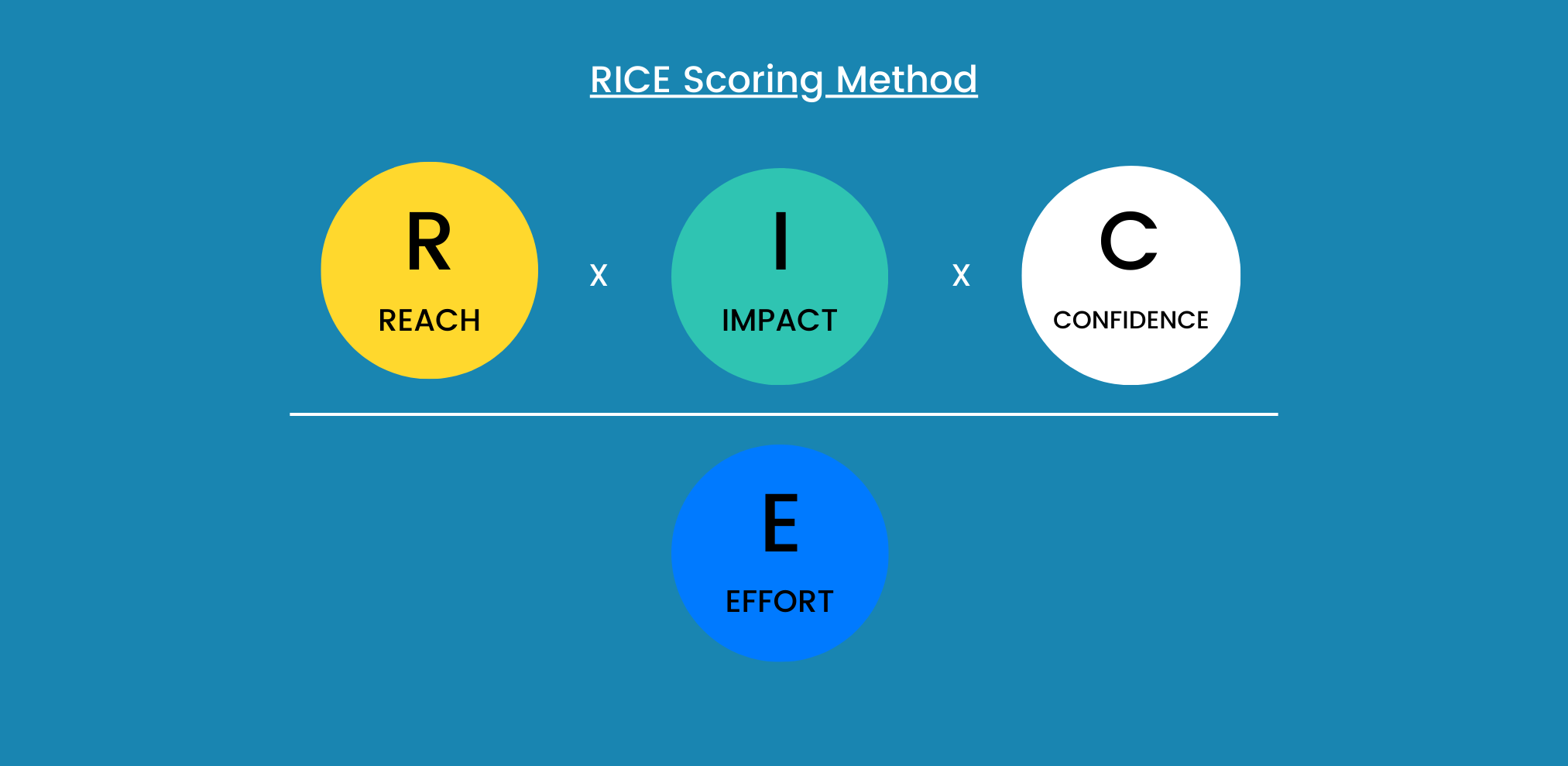
The ICE formula: Impact × Confidence × Ease
ICE is significantly faster to calculate because it removes the Reach variable. Impact and Confidence remain similar to RICE, but Ease replaces Effort. Ease is typically scored on a scale of 1 to 10, where 10 is the easiest to implement. This model is ideal for teams that need to pivot quickly and cannot afford the time required to calculate precise reach metrics.
Data requirements and implementation
The primary difference in RICE vs ICE scoring for SaaS prioritization is the analytical rigor required. RICE is a data-heavy exercise, while ICE is a consensus-driven exercise.
When to use RICE
Use RICE when you need to justify resource allocation to stakeholders or investors. Because it requires specific inputs like user counts from tools such as Mixpanel or Amplitude, it creates a defensible paper trail. It is most effective for established SaaS products where historical conversion data is abundant. 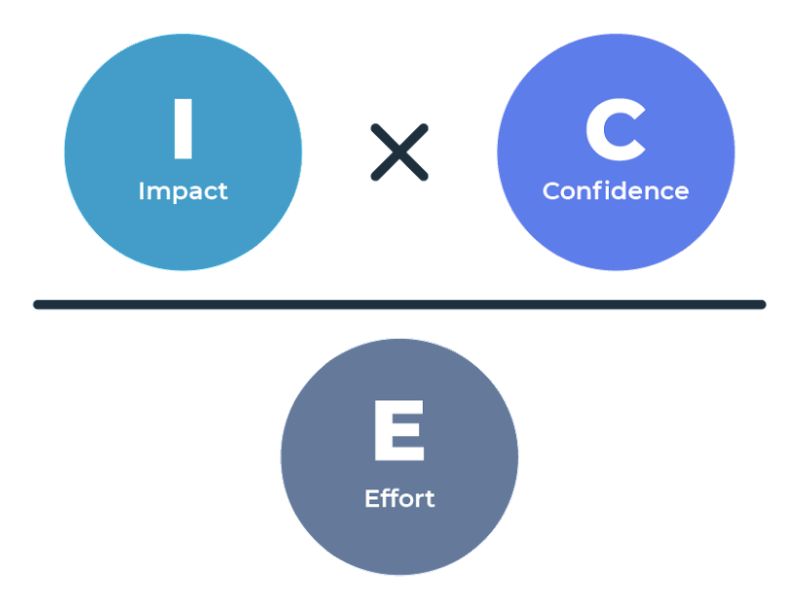
When to use ICE
ICE is the superior choice for early-stage startups or internal tooling teams where user counts are either irrelevant or difficult to calculate. When the cost of delay exceeds the cost of a potentially wrong decision, ICE allows teams to maintain momentum. For those scaling from a dorm room SaaS project, these frameworks are essential for maintaining focus.
Practical Trade-offs in Execution
Choosing between these models often reveals deeper operational truths about your team. If your product managers spend more time debating the 'Reach' variable than building features, your data pipeline is likely too fragmented to support RICE.
Conversely, if your team uses ICE but finds that 'Ease' is consistently inflated to prioritize low-value technical debt, you may lack the necessary engineering oversight to keep the roadmap honest. Successful teams often start with ICE to build a rhythm of shipping, then transition to RICE once they have enough historical data to make the 'Reach' and 'Impact' variables meaningful rather than speculative.
Operationalizing the Scoring Process
To ensure consistency, create a shared rubric for your scoring inputs. For RICE, define 'Reach' as the number of unique active users who will interact with the feature within a 90-day window. Understanding these metrics is vital when applying best product management frameworks for early stage SaaS to your development cycle.
For 'Impact', use a scale of 3 (massive), 2 (high), 1 (medium), 0.5 (low), and 0.25 (minimal). By documenting these definitions in a tool like Notion or Confluence, you prevent team members from assigning arbitrary numbers based on personal preference. This documentation acts as a source of truth during quarterly planning sessions.
Common pitfalls and bias mitigation
Both frameworks are susceptible to human bias. If your team consistently inflates confidence scores to push favorite features, the model becomes useless.
Implementing these alongside a solid saas market strategy ensures that your prioritization aligns with broader business goals. If you find yourself struggling to gain traction, consider consulting saas marketing agencies to help refine your product positioning.
Standardizing your scoring
To prevent analysis paralysis, standardize your scoring definitions. For example, define an Impact score of 3 as "significant revenue increase" and 1 as "minor UI tweak."
If your team spends more time debating the difference between a 2 and a 3 than discussing the feature itself, you are over-engineering the process. Keeping up with current saas marketing trends can help you decide when to simplify your approach. For advanced guidance, look into a saasrise premier saas growth program.
Frequently Asked Questions
What is the best product management framework for SaaS?
There is no single best framework; the right choice depends on your team's size, data maturity, and development speed requirements.
How do I choose a prioritization framework for my SaaS product?
Choose RICE if you have access to robust user data and need to justify decisions to stakeholders. Choose ICE if you are in an early stage and need to prioritize speed and agility.
Can you use multiple product management frameworks at once?
Yes, many teams use a hybrid approach, applying RICE for major feature releases and ICE for smaller, iterative improvements or bug fixes.
What is the role of a framework in product-led growth?
Frameworks provide a consistent, objective language for teams to align on what creates the most value for users, which is essential for scaling product-led growth.
How do frameworks help in SaaS roadmap planning?
They remove personal bias and politics from the planning process, ensuring that development resources are allocated to features with the highest potential return.

