
.webp)
.png)
Transition from centralized silos to self-sovereign patient records
Decentralized identity for healthcare records shifts the locus of data control from institutional databases to the patient, utilizing blockchain-based distributed ledgers to verify identity without requiring a central authority. In traditional clinical settings, patient records exist as fragmented silos across disparate Electronic Health Record (EHR) systems, forcing providers to rely on inefficient Health Information Exchanges (HIEs) or manual record transfers.
By adopting a decentralized model, clinical data management moves toward a verifiable, interoperable framework where the patient acts as the primary custodian of their own medical history. Understanding the decentralized identity vs traditional identity management landscape is the first step for any healthcare organization looking to modernize their data architecture.
Technical mechanisms of patient-controlled access
The core of this transition lies in replacing traditional database permissions—which rely on administrative access lists—with cryptographic proof. In a centralized system, an IT administrator grants a clinician read-write access to a database row.
In a decentralized identity architecture, the patient holds a private key that authorizes access to specific data objects stored in an encrypted off-chain repository. When a clinician requests access to a patient's diagnostic history, the process follows a specific cryptographic flow:
- Credential Issuance: A laboratory or hospital acts as an 'Issuer,' signing a Verifiable Credential (VC) that confirms a specific test result or diagnosis, which is then stored in the patient's digital wallet.
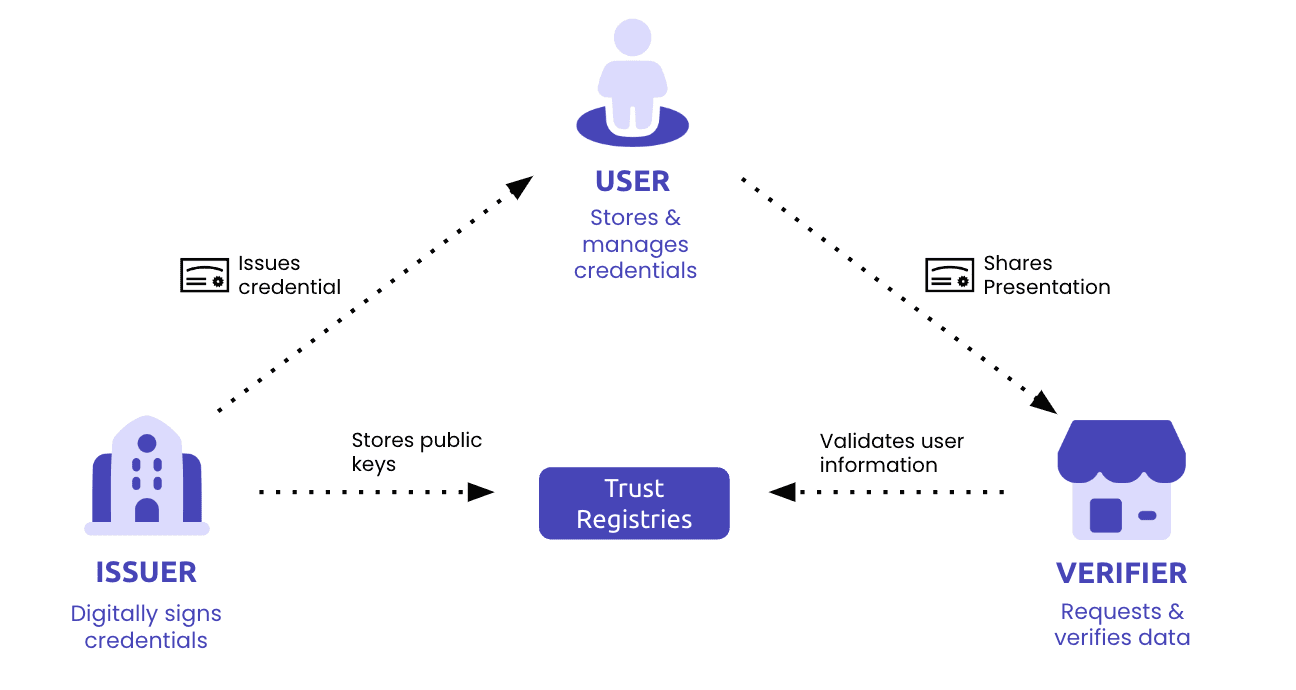
- Zero-Knowledge Proofs: Instead of sharing an entire medical file, the patient presents a cryptographic proof to the provider. This allows the clinician to verify the authenticity of the data without the patient revealing extraneous information, such as unrelated past conditions.
- Permissioned Decryption: The patient uses their private key to sign a transaction that grants the provider temporary decryption rights to the specific data block. This eliminates the need for the provider to maintain a local copy of the entire patient history, significantly reducing the surface area for data breaches and simplifying compliance with regulations like HIPAA.
This mechanism effectively decouples the identity of the patient from the storage location of the records. Because the provider only holds the decryption key for the duration of the clinical encounter, the administrative burden of managing long-term access permissions is largely automated through smart contracts.
This ensures that data availability is strictly aligned with the current provider-patient relationship.
Operational challenges in implementing decentralized identity for healthcare records
Transitioning to decentralized identity (DID) for clinical data management requires moving away from the traditional "walled garden" approach where a single institution holds the master patient index. While this shift promises improved interoperability and patient control, the operational friction lies in the transition phase where decentralized protocols must coexist with monolithic, centralized databases. For those planning the rollout, following a structured Decentralized Identity Implementation Guide is essential to mitigate risks.
Legacy system integration hurdles
Most Electronic Health Record (EHR) systems, such as Epic or Cerner, were built on centralized database architectures that rely on proprietary patient identifiers. Integrating decentralized identity for healthcare records requires a middleware layer capable of mapping blockchain-based W3C Verifiable Credentials to existing HL7 FHIR resources.
The primary technical bottleneck is the latency involved in resolving DIDs across a distributed ledger compared to the near-instantaneous query speeds of a local SQL database. Organizations must deploy "identity agents" that act as translators, converting cryptographic proofs into formats that legacy systems can validate without requiring a complete overhaul of the underlying clinical infrastructure.
Regulatory compliance and data sovereignty
The core promise of decentralized identity is that the patient holds the private keys to their data, yet this creates significant friction with HIPAA and GDPR mandates. Under HIPAA, the "covered entity" is legally responsible for the security of Protected Health Information (PHI).
If a patient loses their private key, the recovery mechanism must be robust enough to satisfy audit requirements without creating a centralized "backdoor" that violates the principle of self-sovereign identity. Furthermore, GDPR’s "right to be forgotten" presents a unique challenge in a blockchain context. Because distributed ledgers are immutable, storing actual clinical data on-chain is a compliance failure.
Operational teams must ensure that only the cryptographic hash or the pointer to the data resides on the ledger. The actual PHI remains in off-chain, encrypted storage that can be deleted upon request, ensuring that the decentralized identity framework remains compliant with regional data sovereignty laws.
Impact on clinical interoperability and data accuracy
Decentralized identity for healthcare records fundamentally shifts the paradigm of data exchange by moving away from centralized, siloed master patient indexes. In current systems, interoperability often fails because disparate electronic health record (EHR) platforms rely on proprietary matching algorithms that frequently result in duplicate records or fragmented patient histories. When evaluating the right tools for this shift, IT teams should research the best decentralized identity software development kits to ensure compatibility with existing clinical workflows.
Reduction of patient matching errors
The primary driver of medical errors in modern health systems is the failure to correctly link a patient to their specific clinical data. Decentralized identifiers (DIDs) solve this by providing a globally unique, tamper-proof reference point for an individual. Unlike traditional Social Security number-based matching, which is prone to clerical errors and privacy concerns, DIDs function as a persistent anchor that travels with the patient.
When a patient presents at a new facility, the decentralized identity framework allows the system to query the patient’s verifiable credentials. Because the identity is anchored on a distributed ledger, the receiving hospital does not need to rely on probabilistic matching—a process that often guesses identity based on name, date of birth, and address. Instead, the system performs a deterministic verification.
This eliminates the 'overlay' problem, where data from two different patients is accidentally merged into a single record, and the 'underlay' problem, where a single patient’s data is split across multiple files. Beyond simple identification, this architecture ensures that the data attached to the identity is accurate at the point of origin.
Because the patient holds the private keys to their identity, they can authorize the sharing of specific, signed clinical documents. This creates a 'chain of custody' for medical records. If a laboratory sends a blood test result, it is cryptographically signed by the lab and linked to the patient’s DID. If the data is altered during transit or storage, the digital signature becomes invalid, immediately alerting the clinician to a potential data integrity issue.
Strategic considerations for healthcare IT leadership
Transitioning to a decentralized model requires more than technical implementation; it demands a shift in data governance and risk management. CIOs must evaluate how decentralized identity for healthcare records integrates with existing Electronic Health Record (EHR) systems without creating data silos. The primary objective is to balance patient sovereignty with the clinical necessity of data availability during emergency care scenarios. Leaders should also consider how to build a decentralized identity system for enterprise environments to ensure scalability and long-term security.
Evaluation of vendor maturity and standards
Not all identity solutions are built on interoperable foundations. When vetting vendors, prioritize those strictly adhering to W3C Verifiable Credentials (VC) and Decentralized Identifiers (DID) specifications. This adherence ensures that identity proofs generated within your ecosystem remain portable and verifiable across different health networks, preventing vendor lock-in.
Key evaluation criteria for IT leadership include:
- Cryptographic agility: Does the vendor support rotating keys and updating cryptographic algorithms without invalidating existing patient credentials?
- Schema governance: How does the solution handle standardized schemas for medical data? Proprietary schemas often defeat the purpose of decentralized interoperability.
- Recovery mechanisms: Decentralized identity relies on private keys. If a patient loses access to their digital wallet, the vendor must provide a secure, HIPAA-compliant recovery process that does not rely on a central authority holding the master key.
Leadership should also assess the maturity of the vendor’s integration with existing Trust Frameworks. A decentralized identity system is only as useful as the network of participants—labs, pharmacies, and specialists—who recognize the credentials. Prioritize vendors that participate in industry consortia like the CARIN Alliance or the HL7 FHIR accelerator programs.
These groups define the practical implementation guides that turn theoretical W3C standards into functional clinical workflows. By focusing on these technical benchmarks, IT departments can mitigate the risk of deploying orphaned technologies that fail to achieve the necessary scale for regional or national health data exchange.
Frequently Asked Questions
Distinctions between decentralized identity and traditional electronic health records
Traditional records are stored in centralized databases controlled by providers. Decentralized identity uses blockchain-based identifiers (DIDs) to give patients control over their own data, allowing them to grant or revoke access to specific records across different providers without a central authority.
Primary operational challenges for hospitals adopting decentralized identity
The main challenge is interoperability with legacy Electronic Health Record (EHR) systems. Integrating decentralized identity requires a middleware layer that can translate blockchain-based verification into formats like HL7 FHIR that existing clinical software can process.
- Financial framework for Decentralized Identity Implementation Guide
- Economic evaluation of how to build a Decentralized Identity System for enterprise
- Financial evaluation framework for the best Decentralized Identity software development kits
- Financial evaluation of Decentralized Identity vs Traditional Identity Management

