
.webp)
.png)
Contextualizing goal setting at a mid-stage SaaS company
Mid-stage SaaS companies often hit a growth plateau when engineering and product teams prioritize output—such as shipping a specific number of features—over measurable user outcomes. Adopting SaaS product management frameworks shifts this focus by anchoring development cycles to high-level business results rather than a static product roadmap.
Instead of measuring success by the completion of a sprint, teams evaluate progress based on how specific product changes influence core business health metrics like Net Revenue Retention (NRR) or Daily Active Users (DAU).
Defining the product-led growth objective
Moving from feature delivery to user retention requires a fundamental change in how product managers define their primary objectives. In a feature-focused model, a team might set a goal to "Release the new dashboard analytics module by Q3." This is an output-based metric that fails to account for whether users actually find value in the data.
A retention-focused objective, by contrast, targets the behavioral change required to sustain growth. For example, a team might set an objective to "Increase user stickiness within the core workflow." The key results supporting this objective would then be:
- Improve the 7-day retention rate of new users from 25% to 35%.
- Reduce the time-to-first-value (TTFV) for new sign-ups from 4 minutes to 90 seconds.

- Increase the average number of daily actions taken in the primary dashboard from 3 to 7.
By shifting to these metrics, the product team stops treating the dashboard as a box to be checked. They instead treat it as a lever for retention. If the team releases the dashboard module but retention fails to move, the OKR framework forces an honest assessment of the product strategy.
This transparency prevents the common trap of "feature factory" syndrome, where teams ship code that does not move the needle on user engagement or long-term subscription health.
Implementing the OKR framework for SaaS product teams
Successful implementation requires shifting from output-based roadmaps to outcome-driven cycles. Product teams often fail by treating OKRs as a project management checklist rather than a strategic compass.
To avoid this, define Objectives as qualitative, time-bound goals that describe the desired state of the product, while Key Results act as the measurable evidence of progress toward that state.
Mapping key results to product telemetry
Key Results must be anchored in verifiable product data rather than vanity metrics. When using tools like Mixpanel or Amplitude, avoid tracking simple page views. Instead, focus on behavioral cohorts that signal value realization.
For example, if your Objective is to improve user retention, a Key Result should be: "Increase the percentage of users who complete the core 'activation' workflow from 25% to 40% by the end of Q3." By pulling this data directly from your telemetry stack, you remove ambiguity from the review process.
If the data shows a stagnant conversion rate, the team can immediately pivot their sprint focus to address specific friction points in the user journey identified by the funnel analysis.
Balancing technical debt with feature velocity
SaaS teams frequently struggle to reconcile the pressure for new feature releases with the necessity of maintaining a stable, scalable architecture. The OKR framework manages this tension by explicitly allocating capacity within the Objective structure.
Rather than treating technical debt as an afterthought, create a dedicated Objective focused on system health, such as "Improve platform reliability to support 99.99% uptime." The associated Key Results should be quantifiable, such as "Reduce average API latency from 300ms to 150ms" or "Decrease the number of critical P0 bugs by 50%."
By treating infrastructure improvements as first-class citizens alongside feature growth, product managers ensure that velocity does not come at the cost of long-term scalability. This transparency allows stakeholders to see the direct correlation between engineering stability and the ability to ship future features faster.
Identifying friction points in quarterly cycles
Quarterly planning often collapses when teams treat the OKR framework for SaaS product teams as a static to-do list rather than a dynamic strategy tool. Friction typically manifests when product managers confuse output-based tasks—such as "launching three new features"—with outcome-based objectives like "increasing user retention by 5%."
When teams prioritize shipping over solving, they create technical debt and bloated product surfaces that fail to move the needle on business growth. Effective teams audit their cycles by mapping every Key Result back to a specific customer behavior change.
If a Key Result cannot be traced to a measurable improvement in the user journey, it is likely a project disguised as an objective. This misalignment forces teams to work harder on tasks that do not contribute to the product's long-term market fit.
The danger of vanity metrics in key results
Vanity metrics provide a false sense of progress by highlighting volume over impact. In SaaS product teams, common traps include tracking "total sign-ups" or "feature adoption rates" without filtering for active, high-value users. While these numbers look impressive in a slide deck, they often mask underlying churn or poor engagement quality.
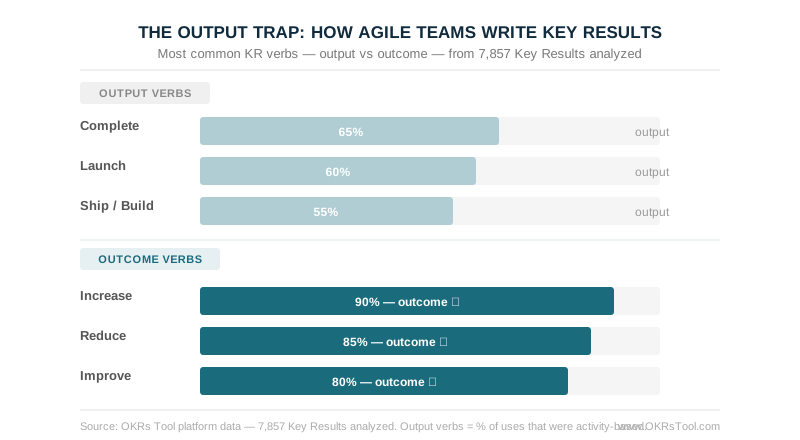
To avoid this, replace activity-based metrics with behavioral indicators that signify genuine value creation:
- Switch from: "Number of new users onboarded" To: "Percentage of new users who complete the core activation workflow within 48 hours."
- Switch from: "Total features released" To: "Reduction in support tickets related to the primary workflow."
- Switch from: "Daily active users" To: "Percentage of users who perform the critical path action at least three times per week."
When you optimize for activity, you incentivize the engineering team to ship code regardless of its utility. When you optimize for value, you force a rigorous debate about which features actually solve user problems. This shift in focus is the primary mechanism for maintaining velocity without sacrificing the quality of the product experience.
Refining the feedback loop for product squads

Effective execution of the OKR framework for SaaS product teams relies on a cadence of continuous discovery habits for SaaS product managers rather than rigid adherence to quarterly plans. High-performing squads hold bi-weekly syncs specifically to review leading indicators—such as feature adoption rates, churn velocity, or API latency—rather than waiting for end-of-quarter outcomes.
If the data shows that a specific user journey is not converting as expected, the team must treat the Objective as a hypothesis that requires adjustment.
Adapting objectives mid-quarter
When initial product hypotheses fail to move the needle, teams often fall into the trap of pushing harder on failing tactics. Instead, adopt a formal pivot protocol. First, confirm whether the failure stems from poor execution or a flawed premise. If the user research indicates the problem is misaligned with customer pain points, the Key Result must be modified or replaced immediately.
To execute a mid-quarter pivot without losing alignment, follow these steps:
- Data Audit: Review the last two weeks of usage data. If the Key Result is tracking below 30% of the target by mid-quarter, flag it as 'at risk.'
- Hypothesis Review: Re-examine the underlying assumption. Did the feature fail because of technical friction or because the value proposition was unclear?
- Scope Adjustment: If the premise is sound but the execution is stalled, narrow the scope to a smaller subset of users to achieve a 'quick win' that validates the direction.
- Stakeholder Alignment: Communicate the change to leadership. Frame the pivot as an optimization based on real-time customer feedback rather than a failure of strategy.
Maintaining this agility prevents the 'sunk cost fallacy' where teams spend weeks building features that do not impact core metrics. By treating OKRs as living documents, product managers ensure that engineering resources remain focused on high-impact outcomes rather than outdated roadmap items.
Evaluating the long-term impact on team autonomy
Implementing an OKR framework for SaaS product teams often creates a tension between top-down strategic alignment and bottom-up execution. When managed correctly, OKRs shift the focus from output—such as shipping a specific feature—to outcomes, like increasing user retention by 5%. This transition empowers product managers and engineers to choose the most effective technical solutions without waiting for executive micro-management.
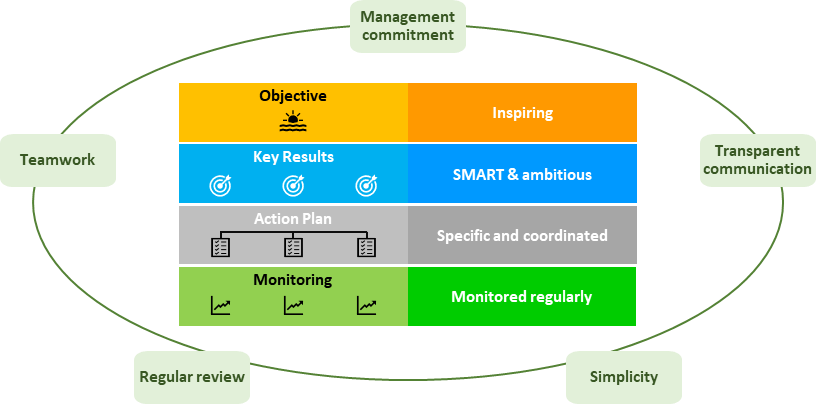
However, autonomy risks eroding if leadership treats OKRs as a rigid task list rather than a directional compass. To maintain team agency, adopt these three operational guardrails:
- Define the 'What,' not the 'How': Leadership should set the Objective (e.g., "Achieve market leadership in mid-market CRM"), but product teams must define the Key Results and the specific roadmap items required to hit those benchmarks. If leadership dictates the feature set, the OKR framework becomes a glorified project management tool, stifling innovation.
- Establish a 'No-Penalty' Review Cycle: SaaS environments are inherently volatile. If a team consistently hits 100% of their Key Results, they are likely setting goals that are too easy. Encourage teams to aim for 70% achievement. This threshold signals that the team is taking calculated risks, which is essential for maintaining a competitive edge in product development.
- Decouple OKRs from Performance Reviews: Linking OKR attainment directly to individual compensation creates a perverse incentive to sandbag goals. When teams fear failure, they prioritize safe, incremental updates over disruptive product improvements. Use OKRs to measure organizational health and strategic focus, while using separate, qualitative assessments for individual career growth.
The long-term success of this framework depends on the feedback loop between the product team and the executive suite. If the team identifies a shift in market conditions—such as a competitor launching a disruptive integration—they must have the autonomy to pivot their Key Results mid-quarter.
A rigid adherence to an outdated OKR cycle is the fastest way to kill the agility that SaaS companies depend on to survive. By focusing on measurable outcomes rather than feature counts, teams gain the freedom to iterate rapidly while remaining tethered to the company's broader financial and strategic goals.
Frequently Asked Questions
Primary benefits of the OKR framework for SaaS product teams
The OKR framework provides a clear mechanism for connecting high-level business goals to daily product development tasks, ensuring that engineering and design efforts directly contribute to measurable outcomes like churn reduction or feature adoption. When prioritizing these tasks, teams often find that RICE vs ICE scoring for SaaS prioritization helps clarify the most impactful work.
Strategies for avoiding common pitfalls in goal setting
Successful teams avoid 'output-based' OKRs (e.g., 'ship 5 features') and instead focus on 'outcome-based' OKRs (e.g., 'increase user retention by 10%'). They also limit the number of objectives to 3-5 to maintain focus, often using how to implement Jobs to be Done in SaaS to ensure those objectives align with real customer needs.
- Financial framework for managing what is phishing 3.0 and how to protect against it
- Vendor selection framework for best practices for preventing phishing 3.0
- Strategic defense priorities for spear phishing vs whaling vs BEC
- Technical audit criteria for assessing the impact of phishing 3.0 on businesses

