
.webp)
.png)
The myth of the weekly customer interview quota
Adopting effective continuous discovery habits for SaaS product managers requires prioritizing the depth of customer insights over arbitrary weekly interview quotas. Many product teams operate under the assumption that discovery necessitates a fixed cadence, such as conducting five customer interviews every week.
This rigid approach often leads to "discovery theater," where teams prioritize checking a box over gathering genuine insights. When discovery becomes a volume-based KPI, product managers frequently settle for shallow conversations that confirm existing biases rather than challenging them.
True continuous discovery is not about the quantity of calls; it is about the frequency of exposure to customer friction points and the speed at which those insights influence the SaaS product roadmap.
Quality thresholds for discovery data
Not every conversation yields actionable product signals. To avoid wasting time on noise, product managers must apply a quality threshold before logging feedback into their discovery repository. A conversation provides actionable data only when it moves beyond user opinion and into observed behavior or specific pain-point articulation.
Use these three criteria to determine if a discovery session is worth your team's time:
- Contextual specificity: The user describes a recent, specific instance where they encountered a problem, rather than speaking in generalities about how they "usually" work.
- Workaround identification: The user explains the current, often inefficient, method they use to solve the problem. If they have no workaround, the pain point may not be severe enough to warrant a feature build.
- Economic or emotional impact: The user can articulate the cost of the problem, whether it is lost time, financial expense, or significant frustration.
If a call fails to meet these criteria, it is better to categorize it as a relationship-building touchpoint rather than a discovery session. By focusing on these indicators, you ensure that your product decisions are based on high-fidelity signals. This shift from volume to value allows product managers to spend less time scheduling calls and more time synthesizing the data that actually moves the needle for the business.
Integrating continuous discovery habits for SaaS product managers into sprint cycles

Many product teams mistakenly treat discovery as a precursor to a sprint rather than a parallel process. To integrate these habits effectively, product managers must shift from "researching for a specific feature" to "maintaining a continuous stream of customer insights." This involves scheduling at least two customer touchpoints per week, regardless of whether a feature is currently in development.
By treating discovery as a recurring operational task, you remove the friction of recruiting participants on an ad-hoc basis. Use tools like Calendly integrated with your CRM to automate scheduling, ensuring that your calendar always has open slots for user interviews. This creates a predictable rhythm where the team is constantly exposed to user pain points, preventing the "discovery debt" that occurs when teams go months without direct feedback.
Decoupling discovery from delivery timelines
The primary tension in SaaS development is the conflict between the engineering need for stable requirements and the discovery need for iterative learning. When discovery is tied directly to the delivery deadline, product managers often cut corners on research to avoid delaying the sprint.
To resolve this, decouple your discovery cadence from your two-week sprint cycle. Adopt a "rolling research" model where you test concepts or prototypes that are one or two sprints ahead of the current development work. If you are struggling to align these cycles, exploring SaaS product management frameworks can provide the structure needed to balance discovery and execution.
If an engineering team is currently building a dashboard, your discovery work should focus on the next major initiative, such as reporting exports or user permissions. This buffer allows you to pivot based on user feedback without forcing engineers to stop mid-sprint or rework code that is already in progress.
Practical trade-offs are inevitable. If a discovery insight reveals that a feature is fundamentally misaligned with user needs, you must have the authority to pause development. Communicate this risk to stakeholders early by framing discovery as a risk-mitigation strategy rather than a delay. By showing that you are validating assumptions before a single line of code is written, you protect the engineering team from building features that fail to deliver value.
Distinguishing between user feedback and product validation
Many product managers mistake collecting user feedback for continuous discovery. Feedback is reactive; it captures how users feel about what you have already built. Validation is proactive; it tests whether a proposed solution will actually solve a specific problem before a single line of code is written.
Relying solely on feedback creates a backlog of feature requests that may not align with your product strategy, whereas validation ensures you are building the right solution for the right customer segment. Effective continuous discovery habits for SaaS product managers require shifting from asking "What do you want?" to "How do you currently solve this problem?"
By observing current workarounds, you identify the friction points that justify new development. Validation happens when you test a hypothesis against a specific outcome, such as reducing time-to-task or increasing adoption of a core workflow.
Testing assumptions with low-fidelity prototypes
To validate concepts quickly, move away from high-fidelity designs that consume engineering resources. Low-fidelity prototypes allow you to test the core logic of a solution without getting bogged down in UI polish. Using tools like Balsamiq, you can create wireframes that force users to focus on the workflow rather than the color palette or button placement. If a user cannot navigate a simple wireframe, they will not be able to navigate your final product.
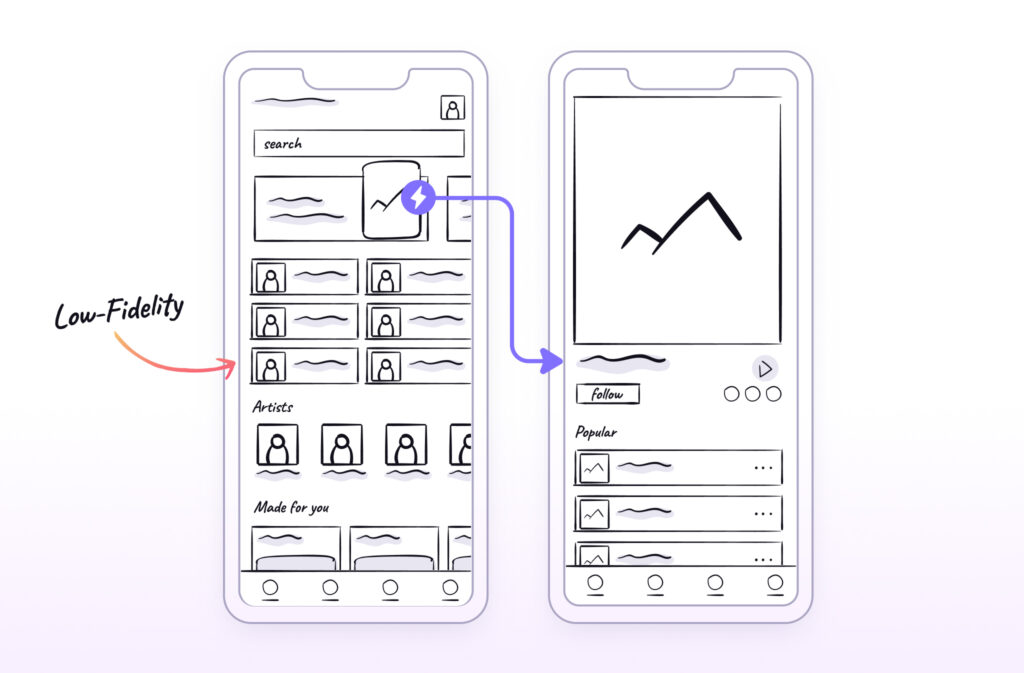
Figma is another essential tool for this process. By using its prototyping features, you can create clickable flows that simulate a new feature's impact. When testing these prototypes, track specific metrics like the time taken to complete a task or the number of errors a user encounters.
If the prototype fails to improve these metrics compared to the current manual process, you have successfully validated that your proposed solution is not the right path. This "failure" is a win, as it saves weeks of development time and prevents the deployment of features that do not move the needle for your business.
Risks of relying solely on power users
Product managers often fall into the echo chamber of interviewing only their most engaged users. While power users provide excellent feedback on advanced workflows and feature requests, they are inherently biased toward the status quo. They have already overcome the initial friction that prevents new users from finding value, meaning they are the least qualified to identify the usability hurdles causing your churn.
Relying exclusively on this segment leads to a product roadmap optimized for a minority, while the broader market remains underserved or confused. For those building from the ground up, understanding the dorm room SaaS journey can help you avoid these early-stage pitfalls.
Identifying churned users and non-adopters
To build effective continuous discovery habits for SaaS product managers, you must actively recruit participants from outside your core user base. These segments hold the most critical insights regarding your product's value proposition and friction points. Use the following strategies to reach them:
- Automated churn surveys: Trigger an email or in-app survey the moment a user cancels their subscription. Ask one specific, open-ended question: "What is the one thing you were unable to accomplish with our product?" Follow up with a Calendly link to book a 15-minute exit interview.
- Monitor "inactive" cohorts: Use tools like Mixpanel or Amplitude to identify users who signed up but never completed the core activation event. Reach out via LinkedIn or personalized email, offering a small incentive—such as a gift card or extended trial—in exchange for a 20-minute feedback session.
- Leverage customer support tickets: Filter support logs for keywords like "confused," "how do I," or "not what I expected." These users are essentially non-adopters struggling with specific features. They provide immediate, high-fidelity data on where your onboarding or UI design fails.
When you interview these segments, avoid asking what they want you to build. Instead, focus on the "job to be done" they were attempting to solve when they signed up. Ask them to walk you through their current workflow and identify the exact moment they realized the product was not meeting their needs. This shift in focus moves discovery away from feature validation and toward genuine problem exploration, which is the cornerstone of sustainable SaaS growth.
Operationalizing discovery through shared repositories
Discovery efforts fail when insights remain trapped in individual notebooks or siloed Slack threads. To build sustainable continuous discovery habits for SaaS product managers, you must transition from ad-hoc note-taking to a centralized, searchable knowledge base. This shift ensures that every team member—from engineering to marketing—can access the "why" behind product decisions without relying on a single gatekeeper.
Tools for organizing discovery insights
Choosing the right repository depends on your team's workflow and the granularity of data you need to track. Here is how the most common platforms compare for managing discovery research:
- Notion: Best for teams that value flexibility and documentation. Its database features allow you to tag customer interviews by persona, feature request, or sentiment. However, it lacks native transcription and automated sentiment analysis, requiring manual effort to keep data structured.
- Dovetail: Designed specifically for qualitative research. It excels at transcribing audio files and tagging specific video snippets to highlight customer pain points. This is the gold standard if your discovery process relies heavily on long-form user interviews and you need to share "highlight reels" with stakeholders.
- Productboard: Ideal for connecting discovery directly to the product roadmap. It allows you to link specific customer feedback or interview notes to feature ideas. This creates a clear lineage from a user's problem statement to the actual ticket in Jira, making it the most effective tool for justifying SaaS prioritization decisions to leadership.
To operationalize these tools, establish a "discovery hygiene" protocol. Every interview must be summarized within 24 hours, tagged with at least one core customer problem, and linked to an existing product opportunity. By standardizing the format of your insights, you transform raw data into a reusable asset that prevents the team from repeating the same research cycles. This infrastructure is what separates a reactive product team from one that proactively shapes its roadmap based on consistent, evidence-based learning.
Frequently Asked Questions
Frequency requirements for customer interviewing
No. While consistency is key, the frequency should match your product development cycle. For early-stage startups, weekly might be necessary, but for mature SaaS products, high-quality, targeted research sessions every two weeks often yield better insights without overwhelming the team. If you are still defining your process, looking into best product management frameworks for early stage SaaS can provide a solid foundation.
Relationship between continuous discovery and formal market research
Continuous discovery complements rather than replaces formal research. It focuses on tactical product decisions and immediate user pain points, whereas formal market research addresses broader strategic shifts, competitive positioning, and long-term market trends. When you are ready to scale, integrating saas market strategy into your discovery process ensures that your tactical findings align with your broader business goals.

