
.webp)
.png)
Economic valuation of technical proficiency in DevOps roles
The question of does devops require coding and dsa often centers on the hidden costs of hiring. Organizations that prioritize candidates with strong software engineering fundamentals—specifically coding proficiency and data structures and algorithms (DSA) knowledge—typically see a higher initial salary expenditure but lower long-term operational overhead.
Engineers who understand algorithmic complexity can write scripts that scale linearly. This prevents the technical debt that arises when automation tools fail under high-concurrency loads.
Cost-benefit analysis of coding skills in automation
Hiring an engineer who relies exclusively on low-code or GUI-based automation tools often leads to a "vendor lock-in" tax. While these tools reduce the time-to-market for simple CI/CD pipelines, they frequently lack the flexibility required for complex, custom infrastructure needs.
When an edge case occurs—such as a race condition in a container orchestration layer or a memory leak in a microservice—the low-code practitioner is often forced to wait for vendor support or manually patch the system, leading to expensive downtime.
Conversely, an engineer with a background in DSA and software development can build bespoke automation solutions using Python, Go, or Bash. The return on investment (ROI) here is measured in reduced mean time to recovery (MTTR).

For instance, an engineer who understands how to optimize a search algorithm can significantly reduce the time a log-aggregation tool takes to query terabytes of data. This proficiency transforms the role from a simple maintenance function into a performance-engineering asset.
While the recruitment cost for such talent is higher, the ability to write efficient, modular code minimizes the need for expensive third-party plugins and reduces the overall cloud compute bill by optimizing the underlying infrastructure logic.
Operational efficiency gains from does devops require coding and dsa
Integrating software engineering rigor into DevOps workflows directly impacts infrastructure stability and operational overhead. When DevOps engineers possess coding proficiency, they move beyond manual configuration management toward Infrastructure as Code (IaC).
This shift allows teams to treat environment provisioning with the same version control, testing, and deployment discipline as application development. Organizations that mandate these skills see a reduction in configuration drift, as automated scripts replace error-prone manual console changes.
Impact of DSA on system architecture scalability
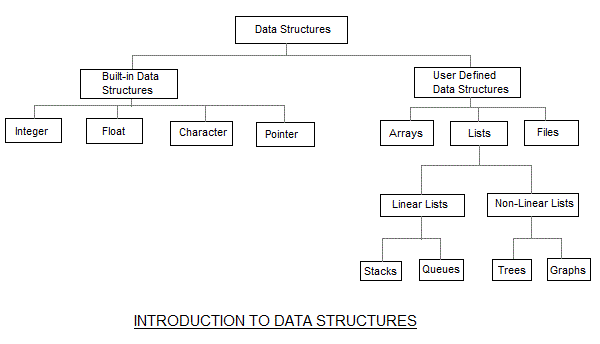
Understanding data structures and algorithms (DSA) prevents expensive performance bottlenecks in cloud environments. A DevOps engineer who understands the time complexity of a search algorithm or the memory footprint of a specific data structure can make informed decisions when configuring distributed systems.
For instance, selecting the wrong database indexing strategy or failing to account for O(n) complexity in a log-processing script can lead to exponential latency increases as traffic scales.
Consider a scenario where a team implements a custom monitoring tool to aggregate metrics from thousands of microservices. Without knowledge of efficient data structures like hash maps or heaps, the tool might rely on nested loops to process incoming data.
This oversight results in CPU spikes and memory exhaustion during peak traffic, forcing the company to over-provision cloud resources to compensate for inefficient code. By applying DSA principles, engineers write scripts that handle high throughput with minimal resource consumption, directly lowering monthly cloud expenditure.
Furthermore, proficiency in these areas enables better collaboration with site reliability engineering (SRE) teams. When DevOps engineers understand how data is structured within an application, they can optimize caching layers and load balancer configurations more effectively.
This technical depth reduces the mean time to recovery (MTTR) during outages, as engineers can quickly diagnose whether a system failure stems from an infrastructure misconfiguration or an inefficient algorithmic process within the application stack.
Framework for calculating ROI on engineering hiring standards
Establishing a rigorous hiring standard for DevOps roles creates a direct financial impact on the bottom line. When organizations mandate high proficiency in coding and Data Structures and Algorithms (DSA), they often experience longer time-to-hire metrics, which increases the opportunity cost of unfilled positions.
Conversely, lowering these bars may lead to faster onboarding but results in higher long-term technical debt and increased operational overhead as teams struggle to automate complex infrastructure.
Quantifying the cost of hiring versus training
To determine if a candidate needs deep DSA knowledge, compare the cost of a premium salary for a "full-stack" DevOps engineer against the cost of training an existing sysadmin. A senior DevOps engineer with strong algorithmic skills often commands a 20-30% salary premium over traditional operations staff.
If your infrastructure relies on high-frequency trading platforms or massive-scale distributed systems, this investment is justified by the reduction in system latency and downtime.
For most mid-market companies, the ROI calculation follows this pattern:
- Recruitment Cost: High-bar technical interviews require senior engineering time, often costing $2,000–$5,000 per candidate in billable hours lost.
- Time-to-Productivity: A candidate who lacks coding fundamentals will require an average of 3–6 months of mentorship, effectively doubling their initial salary cost during the ramp-up period.
- Operational Efficiency: Engineers who understand DSA can write efficient scripts that reduce cloud compute costs by 15-20% through better resource management.
When evaluating does devops require coding and DSA, consider the specific technical debt your team faces. If your primary bottleneck is manual server configuration, prioritize automation scripting skills over complex algorithmic knowledge.
If your bottleneck is scaling microservices under heavy load, the ability to analyze time complexity and memory management becomes a tangible asset that prevents costly cloud over-provisioning.
Ultimately, the financial trade-off is between the immediate expense of a specialized hire and the hidden, compounding costs of inefficient automation. Organizations that map their specific infrastructure challenges to these hiring standards avoid over-paying for skills that do not directly contribute to their operational velocity.
Risk mitigation through technical competency
Hiring for DevOps roles without verifying coding and data structures and algorithms (DSA) proficiency often leads to significant operational debt. When engineers lack the ability to read or modify the automation scripts they manage, they become dependent on external developers to fix production bottlenecks.
This creates a dangerous feedback loop where infrastructure issues remain unresolved during critical outages because the can devops engineer be replaced by ai question often overlooks the human element of debugging.
Technical competency acts as a primary risk mitigation strategy for several reasons:
- Root Cause Analysis: Engineers who understand algorithmic complexity can identify why a specific service is consuming excessive CPU or memory. Without this knowledge, teams often resort to "blind scaling," which increases cloud costs without addressing the inefficient code causing the spike.
- Tooling Customization: Most mature DevOps environments require custom glue code to integrate disparate APIs. If a hire cannot write clean, maintainable Python or Go, the organization is forced to rely on brittle, off-the-shelf plugins that lack flexibility.
- Security Auditing: Understanding how data structures are implemented allows DevOps engineers to spot potential vulnerabilities, such as buffer overflows or inefficient regex patterns that could lead to ReDoS (Regular Expression Denial of Service) attacks.
Organizations that explicitly ask does devops require coding and dsa during the interview process tend to build more resilient systems. By testing for basic DSA concepts—such as understanding Big O notation for time and space complexity—hiring managers ensure that candidates can predict how their infrastructure configurations will behave under heavy load.
A candidate who understands that a nested loop in a configuration management script will cause exponential latency growth is far more valuable than one who only knows how to execute existing commands.
Relying on candidates who lack these fundamentals forces the company to invest heavily in remedial training. This creates a hidden economic impact: the cost of a "senior" DevOps hire who cannot code is often double the salary, as it includes the lost productivity of the senior software engineers who must constantly mentor them or perform their technical tasks.
Establishing a baseline for coding and DSA proficiency ensures that the infrastructure team functions as a force multiplier for the development organization rather than a bottleneck.
Strategic resource allocation for DevOps infrastructure
Optimizing your engineering budget requires a clear understanding of whether your DevOps team needs deep software engineering expertise or operational proficiency. When evaluating if does devops require coding and dsa, consider that hiring a candidate with strong algorithmic skills often commands a 20-30% salary premium.
If your infrastructure is primarily managed through managed services like AWS Fargate or Google Cloud Run, the need for complex data structure knowledge diminishes significantly.
Balancing technical depth with operational velocity
Focus your hiring budget on the specific architectural needs of your stack. If your team manages a high-traffic microservices environment, you need engineers who understand how to optimize memory allocation and latency—tasks that directly benefit from a background in data structures and algorithms (DSA).
Conversely, for teams relying on Infrastructure as Code (IaC) tools like Terraform or Pulumi, coding proficiency in Python or Go is non-negotiable, but deep DSA knowledge is rarely exercised in daily configuration management.
- Infrastructure-heavy roles: Prioritize candidates with mastery in shell scripting, YAML/JSON configuration, and cloud provider APIs.
- Platform engineering roles: Seek engineers who can build custom internal tools, where DSA proficiency is essential for writing performant, scalable code.
- Site Reliability Engineering (SRE): Focus on system design and distributed systems knowledge rather than competitive programming-style algorithms.
By mapping your hiring requirements to these specific domains, you avoid overpaying for specialized skills that do not contribute to your deployment frequency or system uptime.
A common mistake is requiring a generic "software engineering" interview for DevOps roles. Instead, replace standard DSA whiteboarding with practical assessments involving container orchestration, CI/CD pipeline debugging, or cloud cost optimization exercises. For those looking to automate these workflows, exploring the best AI agents for coding and development can provide significant leverage.
This alignment ensures that your human capital investment directly correlates with improved system reliability and faster time-to-market.
Frequently Asked Questions
Role-specific necessity of coding and DSA proficiency
No. While coding is essential for infrastructure-as-code and automation, deep knowledge of Data Structures and Algorithms (DSA) is rarely required for standard DevOps tasks. Requiring these skills for purely operational roles often leads to higher salary demands and longer time-to-hire metrics.
Measurement methods for ROI on technical hiring requirements
Measure ROI by comparing the 'time-to-productivity' against the 'cost-per-hire.' If a role focuses on platform engineering, high coding proficiency is a high-ROI asset. If the role focuses on maintenance and CI/CD pipeline management, prioritizing scripting and cloud-native tool expertise yields better financial efficiency.

