
.webp)
.png)
Quantifying the true cost of autonomous agent deployment
Understanding why what are AI agents explained and their risks is essential for organizations, as the financial impact often extends far beyond the immediate cost of AI agents and wasted API tokens. When an agent hallucinates a transaction or enters an infinite loop of API calls, the resulting technical debt and remediation labor often exceed the original development budget by 30% to 50%.
Organizations frequently underestimate the cost of human-in-the-loop oversight required to mitigate these failures. This turns what was intended to be an automated process into a high-touch manual operation.
Hidden operational overhead beyond API calls
Many teams calculate their AI budget based solely on token consumption, ignoring the significant infrastructure required to maintain stability. Managing latency is a primary driver of hidden costs; when an agent takes too long to respond, downstream systems often time out, triggering redundant retry logic that doubles or triples the billed usage. This creates a feedback loop where the agent consumes more resources to resolve errors it created in the first place.
AI agent frameworks for error handling represent another massive, often overlooked, financial burden. Building robust guardrails—such as semantic validation layers, circuit breakers, and automated rollback mechanisms—requires specialized engineering time. For instance, if an agent is tasked with updating a CRM, you must implement a secondary verification layer to prevent data corruption.
The maintenance of these data pipelines is not a one-time setup cost; it is a recurring expense that scales with the complexity of the agent's decision-making process. When these systems fail, the cost of data reconciliation—manually auditing logs to identify where the agent deviated from business logic—can reach thousands of dollars per incident in engineering hours alone.
Finally, consider the cost of observability. To prevent catastrophic failure, you must deploy monitoring tools like LangSmith or Arize AI to track trace-level performance. These tools carry their own subscription fees and require dedicated staff to configure alerts and analyze drift. Without this investment, the risk of silent failures—where the agent continues to operate but produces inaccurate output—remains high, potentially leading to long-term financial damage that is difficult to quantify until an audit occurs.
Economic drivers of why AI agents fail and their risks
Financial losses stemming from autonomous systems often trace back to a misalignment between agent training data and real-time market volatility. When an AI agent operates outside its intended parameters, the resulting economic damage manifests as direct capital loss, regulatory fines, and the hidden operational burden of manual oversight.

Organizations frequently underestimate the 'shadow cost' of maintaining these systems. This cost grows exponentially when agents require constant human supervision to prevent catastrophic errors.
Calculating the cost of corrective human intervention
The true cost of an AI agent is not merely its API usage or compute consumption; it is the total labor cost required to audit its outputs. When an agent deviates from AI agents for business logic, senior analysts must pivot from value-added tasks to 'firefighting'—manually overriding trades, correcting CRM entries, or patching hallucinated data.
To quantify this, calculate the Intervention Ratio: (Total hours spent on manual overrides) / (Total hours of agent uptime) multiplied by the hourly rate of the human supervisor. If this ratio exceeds 15%, the agent is economically net-negative. Beyond salary costs, consider the opportunity cost of these experts being diverted from strategic initiatives to perform rote verification of automated outputs.
Risk exposure from non-deterministic output
Non-deterministic behavior—where the same input yields different outputs at different times—creates significant liability risks in high-stakes environments. Unlike traditional software that follows rigid if-then logic, agents comprehensive autonomous can produce unpredictable results that violate compliance protocols or contractual obligations.
The financial impact of these errors includes legal defense costs, customer churn, and potential regulatory sanctions for failing to maintain 'human-in-the-loop' oversight. Reputational damage is harder to quantify but often results in a measurable decline in customer lifetime value (CLV) following a public-facing service failure. Firms must treat these risks as a form of operational insurance, setting aside capital reserves specifically to cover the potential fallout of automated decision-making errors that bypass standard quality assurance checks.
Framework for measuring agentic ROI
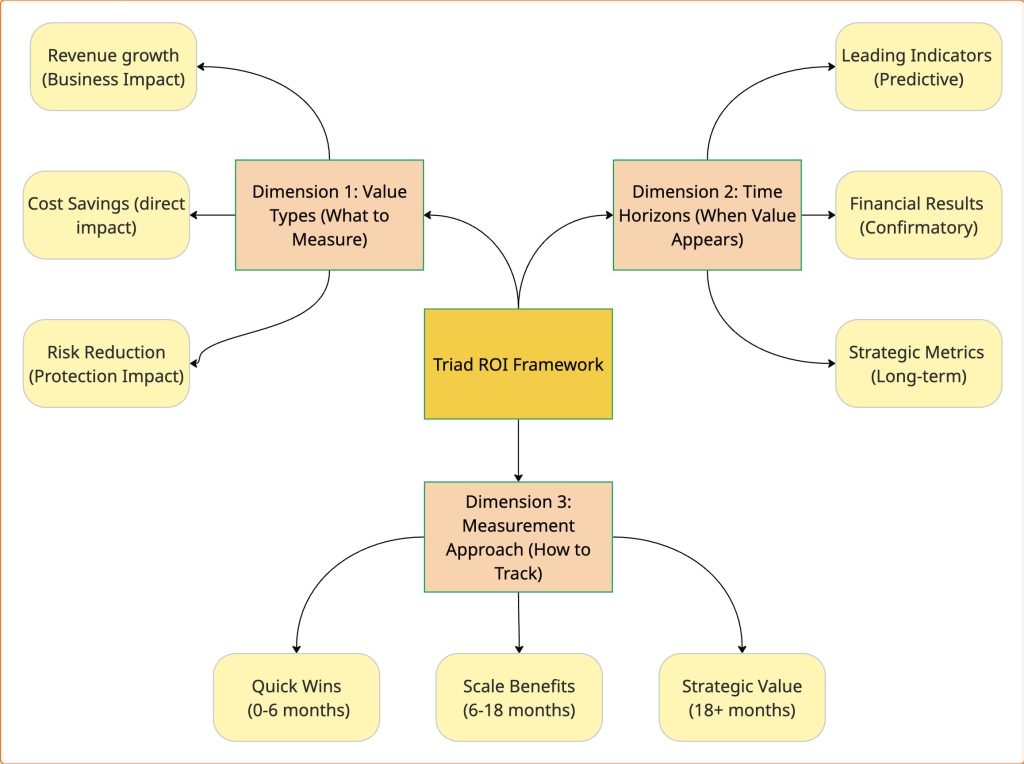
Calculating the return on investment for autonomous systems requires shifting focus from infrastructure costs to operational output. Organizations often miscalculate value by tracking only API token consumption or server uptime, which are vanity metrics that fail to capture the financial impact of agent performance. A robust framework must isolate the cost per successful task completion versus the cost of human intervention required to correct agent errors.
Defining success metrics for autonomous workflows
To accurately assess performance, teams should prioritize outcome-based KPIs that mirror human personal productivity metrics. Moving beyond token usage involves tracking three core indicators:
- Task Completion Rate (TCR): The percentage of workflows an agent finishes without triggering a human-in-the-loop exception. A low TCR indicates that the agent lacks the necessary context or tool-use capabilities to handle edge cases.
- Cycle Time Reduction: The delta between the initiation of an automated process and its final verification. If an agent completes a task faster than a human but requires three rounds of manual review, the net cycle time is often higher due to context-switching costs.
- Error Remediation Cost: The total financial loss associated with agent hallucinations or logic failures. This includes the salary cost of staff members tasked with auditing logs and the potential revenue loss from incorrect customer-facing outputs.
When evaluating why how to create an AI agent step-by-step, companies must account for the hidden expense of 'silent failures.' These occur when an agent completes a task incorrectly but logs it as a success, leading to downstream data corruption.
By implementing a cost-per-outcome model, businesses can determine whether an agent is actually reducing operational overhead or simply shifting the burden of work to senior engineers who must debug complex, non-deterministic workflows. Successful deployment depends on setting a clear threshold for acceptable error rates; if the cost of human oversight exceeds the savings generated by the agent, the system is effectively a net-negative asset regardless of its technical sophistication.
Mitigating financial volatility in agent scaling
Unchecked AI agent autonomy often leads to runaway compute costs and unpredictable API consumption. When agents operate in loops without human oversight, a minor logic error can trigger thousands of redundant calls to expensive LLM endpoints like GPT-4o or Claude 3.5 Sonnet. Organizations must shift from reactive monitoring to proactive financial governance to prevent these automated systems from draining operational budgets.

Implementation of circuit breakers for cost control
Programmatic circuit breakers act as a final safety layer between your agentic workflows and your cloud billing dashboard. By wrapping your agent's execution logic in a middleware layer, you can enforce hard limits on token usage per request or per session.
For instance, using a Python-based guardrail, you can monitor the usage_metadata returned by an API provider. If the cumulative token count for a single task exceeds a pre-defined threshold—such as 50,000 tokens—the circuit breaker raises an exception, immediately killing the process and preventing further expenditure.
Beyond simple token caps, implement temporal circuit breakers that track the frequency of agent calls. If an agent attempts to initiate more than ten external API requests within a sixty-second window, the system should automatically trigger a 'cooldown' state. This prevents infinite recursion loops, which are a primary reason why marketing agents transforming the landscape often fail and their risks manifest as massive, unexpected cloud invoices.
Integrating these checks directly into your orchestration framework, such as LangGraph or CrewAI, ensures that cost management is baked into the agent's architecture rather than treated as an afterthought. Finally, establish a tiered alert system tied to your financial operations (FinOps) stack. Use tools like Datadog or custom Prometheus exporters to track cost-per-task metrics in real-time.
When spending hits 70% of the daily budget, the system should trigger an automated notification to the engineering lead. This visibility allows teams to distinguish between productive agent activity and 'zombie' processes that are consuming resources without delivering business value. By treating agent compute as a finite, budget-constrained resource, firms can scale their automation efforts without exposing the balance sheet to uncontrolled volatility.
Frequently Asked Questions
Methodology for calculating the ROI of an AI agent deployment
Calculate ROI by subtracting the total cost of ownership—including development, API token consumption, and human-in-the-loop oversight—from the operational savings or revenue generated by the agent's tasks.
Primary financial risks associated with AI agent failure
The primary financial risk is 'runaway cost,' where an agent enters an infinite loop of API calls or makes erroneous transactions that incur significant cloud infrastructure fees and potential liability costs.

